


30 December 2025
As 2025 draws to a close, we turn our attention across the UK’s nations to reflect on the moments that mattered most. From pivotal challenges to landmark breakthroughs, we explore the stories that shaped optometry over the past year.
OT spoke with the AOP’s Dr Peter Hampson, Optometry Scotland’s Eilidh Thomson, and Optometry Wales’ Owain Mealing to unpack the defining developments in their nations – and to hear their single wish for the profession as it looks ahead to 2026.
OT asked… What was the most important development or breakthrough for optometry in your nation in 2025?
Eilidh Thomson, chair of Optometry Scotland: “For me, is it was the introduction of the General Ophthalmic Services Specialist Supplementary Service for complex anterior eye conditions, enabling optometrists to manage more complex cases safely within the community.
“Introduced during 2025 and moving towards full implementation in January 2026, the service has strengthened community optometry’s clinical role and improved access to timely, NHS-funded care closer to home. It demonstrates how appropriately commissioned community services can reduce avoidable hospital referrals and support NHS sustainability.”
Dr Peter Hampson, clinical and policy director at the AOP: “The 10- Year Health Plan signalled a major step forward in how the Government proposes to tackle some of the most significant and long-standing challenges within the NHS.
Important for the sector was the recognition of optometry in the Gloucestershire example, demonstrating how teams across primary and secondary care can work together to lead the way in digital integration and co-design to improve outcomes, efficiency, and patient experience.
“A central reform in this policy is the move away from National Service Frameworks towards Modern Service Frameworks. The commitment to a digitally accessible health service, including shared patient records, demonstrated the recognition that silos of information must be broken down.
“Together these reforms provide a unique opportunity to make community-led care a reality for patients. But to succeed, primary care, including optometry, must be embedded from the outset as a strategic partner in service design, not treated as an afterthought.”

Important for the sector was the recognition of optometry in the Gloucestershire example, demonstrating how teams across primary and secondary care can work together to lead the way in digital integration and co-design to improve outcomes, efficiency, and patient experience
Owain Mealing, chair of Optometry Wales: “The most important development for optometry in Wales in 2025 was the continued embedding and recognition of the reformed NHS Wales optometry contract under Wales General Ophthalmic Services (WGOS), which firmly positioned community optometry as a core part of primary care. All practices (including domiciliary) provide NHS funded urgent eye care as a core service, which ensures that patients can access urgent eye care local to home in a timely manner.
“June 2025 saw the extension of the certify vision impairment service in Wales and, in a first across the UK, Wales will allow optometrists to officially certify vision impairment for all types of eye conditions. This major change is expected to improve support for people with sight loss and reduce the pressure on busy hospital eye departments.
“Throughout 2025, WGOS-accredited optometrists and dispensing opticians increasingly delivered enhanced clinical services that would previously have sat in secondary care, demonstrating both the clinical capability and value of the profession. We were delighted to witness the high uptake of (opt-in) services by practices including medical retina, glaucoma, independent prescribing and low vision services, which has revolutionised how eye care is delivered in Wales and supported with ophthalmology waiting lists. This not only improved patient access closer to home, but also reinforced Wales’s position as a UK leader in enabling practitioners to work at the top of their licence.
“The recent procurement of a national electronic referral system has been warmly welcomed by the profession to further support digital integration of eye care services in Wales, which will roll out in early 2026.”

The price of sight
OT explores new economic analysis that reinforces the value optometrists offer – and provides a vision of expanded professional roles
OT asked… What was the biggest challenge in your nation in 2025 and how was it overcome?
Owain Mealing, chair of Optometry Wales: “The biggest challenge in 2025 was ensuring sustainability of services against rising financial pressures felt across the UK.
This was addressed through constructive engagement between Optometry Wales, the Welsh Government and NHS Wales, ensuring that funding discussions, service development and workforce planning remained aligned. The profession’s willingness to demonstrate outcomes and collaborate across primary and secondary care was critical in overcoming these challenges.”

Eilidh Thomson, chair of Optometry Scotland: “The continued financial and workforce pressures on community optometry, particularly for practices in rural communities and for those delivering enhanced services, have been a challenge. We are undertaking workforce research with sector partners to better understand these pressures. We aim to produce an evidence-based report in the first half of 2026 which will guide our advocacy for the sector in continued engagement with Scottish Government colleagues. Remaining as a collective voice across independent and multiple practices was critical in navigating this work.”
OT asked… What achievement in another nation were you most interested in this year?
Eilidh Thomson, chair of Optometry Scotland: “I’ve followed with interest the continued development and embedding of the Welsh low vision service within community optometry. Wales has demonstrated how a nationally commissioned, community-based low vision model can improve access, consistency and patient experience when properly supported. This provides valuable learning for Scotland as planning progresses to support the future rollout of a sustainable national low vision service.”
Owain Mealing, chair of Optometry Wales: “We were particularly interested in developments in other UK nations exploring expanded clinical pathways for optometrists, especially around closer integration with general practice and ophthalmology services.
“These initiatives reinforce a shared direction of travel across the UK and provide valuable learning opportunities. Wales has often led in this space, and it is encouraging to see other nations building on similar principles of community-based, clinically led eye care.
OT asked… What is your one wish for optometry in your nation in 2026?
Owain Mealing, chair of Optometry Wales: “Our one wish for 2026 is continued stability and confidence in the Welsh optometry model, allowing the profession to focus on delivering high-quality patient care without uncertainty. With sustained investment, workforce support and collaborative leadership, optometry in Wales can continue to grow as an essential pillar of primary care benefiting patients, practitioners and the wider NHS alike.”
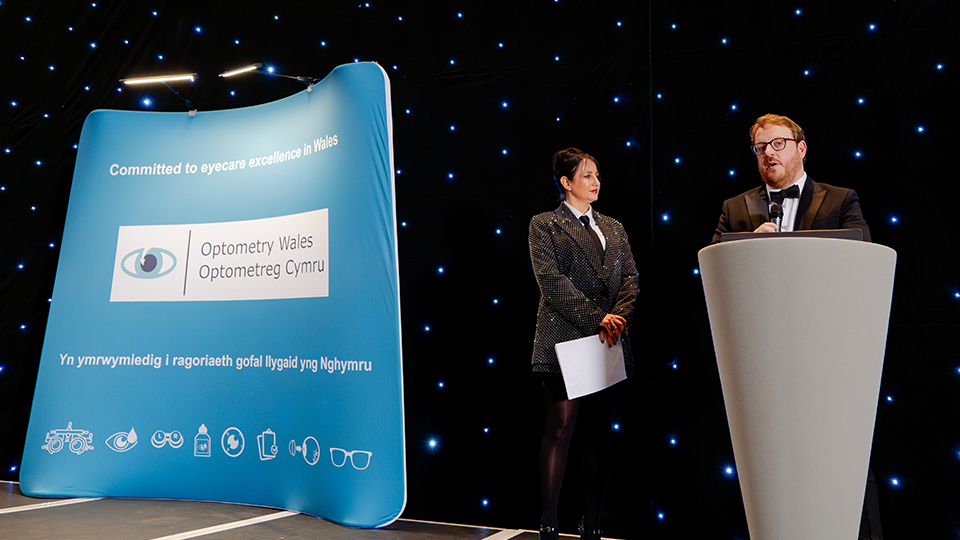
With sustained investment, workforce support and collaborative leadership, optometry in Wales can continue to grow as an essential pillar of primary care benefiting patients, practitioners and the wider NHS alike
Dr Peter Hampson, clinical and policy director at the AOP: “It was disappointing to see the NHS England Medium Term Planning Framework land with an overly narrow definition for primary care, with the term ‘primary care’ slipping back to meaning GPs. While our GP colleagues are naturally central to the NHS, they are only one important pillar within an ecosystem that also includes optometry, pharmacy, and dentistry. The hope is that in 2026 we begin to see long-term certainty, more inclusive planning, and better investment in primary care as a whole – only by taking these steps can there be real transformation of NHS services.
“Optometry, despite consistently delivering high-quality, accessible eye care, remains under-funded, overlooked and unevenly commissioned, creating postcode lotteries for patients. Our wish is that optometry is fully embedded in NHS planning, enabling universal access to enhanced community eye care. This would improve outcomes, reduce inequalities, free up millions of GP and hospital appointments, and deliver on the Government’s ambition to bring care closer to home for all.”


Comments (0)
You must be logged in to join the discussion. Log in