


05 June 2026
If a patient walks into an optometry practice in Wales, during their eye examination they will be asked if they smoke and if they know what their diabetes risk is. Those under the age of 16 will be asked about how much time they spend outdoors.
These questions, introduced as part of sweeping changes to the Welsh contract in October 2023, see optometrists play an important role in not only supporting the eye health of their patients – but identifying and managing broader health risks.
“Alongside routine eye care, optometry teams are increasingly helping to identify wider health risks, from smoking and diabetes to broader lifestyle and wellbeing concerns, marking a significant move towards prevention-focused care within primary care services,” Health Education and Improvement Wales (HEIW) prevention lead for optometry, Cerys Parker-Williams, told OT.
All patient-facing staff in Welsh optometry practices – including receptionists, optical assistants, dispensing opticians, contact lens opticians and optometrists – undergo training in Making Every Contact Count (MECC) Level 1.
Developed by Public Health Wales and hosted on HEIW’s Y Ty Dysgu platform, the training equips practice teams with the skills and confidence to engage patients in supportive conversations around health and wellbeing.
MECC is a national initiative that harnesses the millions of interactions people have every day across a broad range of organisations to support individuals in making positive changes to their physical and mental health and wellbeing.
“Whilst optometrists may initiate conversations during examinations, wider practice staff can also use interactions throughout the patient journey to reinforce health messages, identify potential concerns and direct patients towards appropriate support services,” Parker-Williams explained.
She added that these conversations can create opportunities for more holistic discussions around lifestyle, wellbeing and prevention – sometimes enabling patients to access support they may otherwise never have engaged with.
Smoking cessation referrals
118
referrals to Help Me Quit by optometrists in Aneurin Bevan University Health Board in 2024
120
referrals to Help Me Quit by optometrists in Aneurin Bevan University Health Board in 2025
47 referrals
to Help Me Quit by optometrists in Aneurin Bevan University Health Board
For example, a patient in Caerphilly who discloses feelings of anxiety or social isolation may be directed towards a local nature wellbeing initiative, while a smoker expressing a desire to quit may be referred to Help Me Quit Wales for smoking cessation support.
“It can be surprising what comes up in conversations,” Parker-Williams said.
“It’s about being compassionate and not just seeing the person who walks through the door as a pair of eyes,” she said.
Parker-Williams, who continues to work two days a week as an optometrist alongside her HEIW role, highlighted that early identification and appropriate signposting can help to reduce long-term health complications.
“There are significant opportunities for optometry to play a greater role in preventative healthcare in Wales, largely due to the accessibility of optometry services and the regular contact optometrists have with patients across all age groups, usually when they are otherwise well,” she said.
Asked how patients respond to having broader conversations about health in an optometry practice, Parker-Williams shared that conversations about smoking and diabetes risk can be directly related back to ocular health.
“I do recognise that there are other lifestyle behaviours that are more difficult to broach, but I see it as more of an opportunistic conversation,” she said.
“If the patient opens up, then you can go from there,” Parker-Williams reflected.
While there are time constraints within clinical appointments, Parker-Williams noted that the broader practice team can also play a role in preventative healthcare.
“One key challenge is time and capacity within busy community practices,” she said.
“Optometry appointments are often focused on clinical eye care – incorporating meaningful prevention and health behaviour change conversations can be difficult without appropriate time, support, and workflow adjustments,” Parker-Williams highlighted.
However, she emphasised that a whole-practice approach can help to distribute this responsibility more effectively across the practice team.
“Support staff provide valuable potential in relieving optometrists of some of this responsibility,” she said.
Alongside the online learning module that is provided to all patient-facing staff for MECC Level 1, Parker-Williams highlighted that a MECC Level 2 programme is now available as face-to-face training in some health boards, providing more advanced training in behaviour change conversations and patient engagement.
“An E-learning module is also available to support wider access,” she said.
A report from the Cwm Taf Morgannwg University Health Board Public Health Team found that practices completing MECC Level 2 face-to-face training showed increased referral rates into Help Me Quit, the NHS national smoking cessation service.
Optometry practices can be a more relaxed environment for some patients – they may be happier having more meaningful extended conversations
Smoking cessation
Optometrist and regional optical committee chair, Nkosi Yearwood, told OT that he is beginning to see patients in practice for their two-year recall following an initial smoking cessation conversation in 2023 and 2024.
“We’re getting to the point now where we are asking patients about smoking for the second time. I had one person who came in and proudly told me they had stopped smoking,” he said.
“That was a lovely conversation to have – because of that interaction from a source they weren’t necessarily expecting they’ve improved their health and improved their lifestyle,” Yearwood highlighted.
Reflecting on how he navigates general health conversations, Yearwood emphasised that an open, non-judgemental approach is key.
“I'm not going to sit there and interrogate someone until they accept that they need to stop smoking,” he said.
“Smoking is often linked to stress, and it may be a necessary evil for them at the time. You have the conversation and you plant the seed for next time,” Yearwood shared.
I had one person who came in and proudly told me they had stopped smoking
He observed that many patients are becoming accustomed to receiving general health questions from more than one source.
“So long as the practitioner seems confident, most patients seem happy to chat,” Yearwood said.
“If people look a little bit unsure, then you can always bring the conversation back to how it relates to eye health. There is that safety net for practitioners,” he said.
Asking children about outdoor time can provide an opportunity to talk with patients and their families about myopia, Yearwood shared.
“It’s good for kids to play outdoors from a general health point of view, but from an optometric perspective, we are also trying to mitigate the risk of myopia,” he said.
Yearwood had been qualified as an optometrist for one year when the optometry contract reforms were introduced in October 2023.
“I had a rough idea of how everything worked and then it all changed very quickly. In a way being newly-qualified was an advantage because I didn’t have that previous way of working cemented into muscle memory,” he said.
Yearwood told OT that prior to the reforms he had felt disheartened at the disconnect between what he had learned at university and what he was able to do in practice.
“You’re taught all the things that optometrists can do, and then you go into the real world, and it’s so varied depending on the commissioning,” Yearwood reflected.
A collaborative project to prevent falls
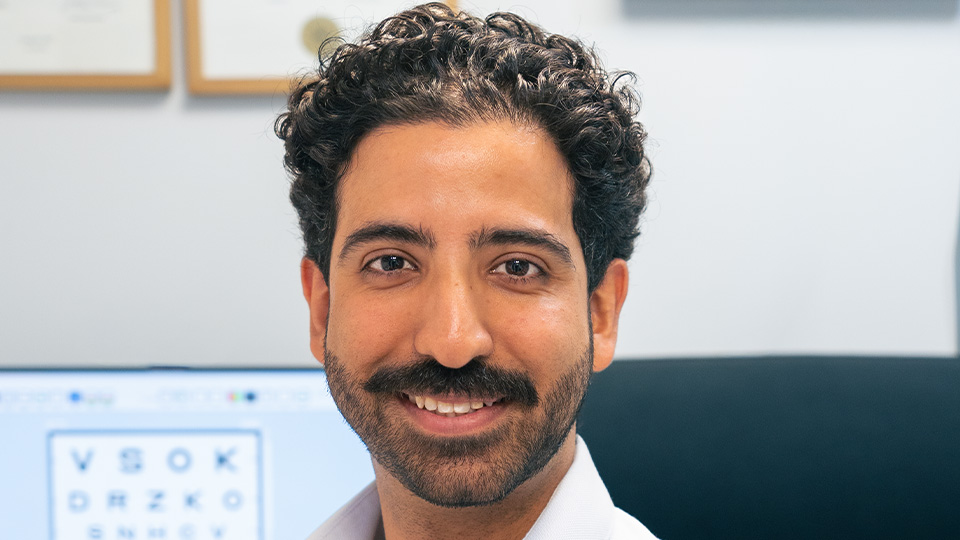
North Monmouthshire collaborative lead and optometrist, Adib Missaghi, qualified as an optometrist from Cardiff University after relocating from Iran, where many of his family members continue to work within optics.
Missaghi shared that even though he is relatively early in his career, there has been a large amount of change within optometry in Wales in a short space of time.
“When I first started, we had to refer patients into hospital even though we had the training to manage them,” he said.
“You felt a little bit powerless because the hospital was struggling,” Missaghi shared.
Following the introduction of the 2023 contract, Missaghi shared that more than half of his daily workload at Monnow Eyecare is an extended clinical service.
As a collaborative lead, Missaghi is working alongside the falls and frailty team within North Monmouthshire to maximise the role that optometrists can play in reducing the risk of harm from falls.
He shared that many staff within the service were unaware of the funded eye care services that were available.
“They have this basic way of checking eyes with household items, but they had no idea of what the results mean,” he said.
Missaghi shared that there are plans raise awareness of the funded eye care services that are available, as well as source vision screening equipment that the frailty team can then be trained to use.
“It motivates me that we are helping people and also making the profession better,” he said.
“Also, as someone who is an immigrant, this country has given me so much. This is a way that I can give back,” he said.
Missaghi shared that the example of his colleagues, Professor Barbara Ryan and Helen Tilley, has served as an inspiration to him.
“That generation brought us all that we have. They were fearless and now I am learning to be fearless too,” he said.
Care close to home
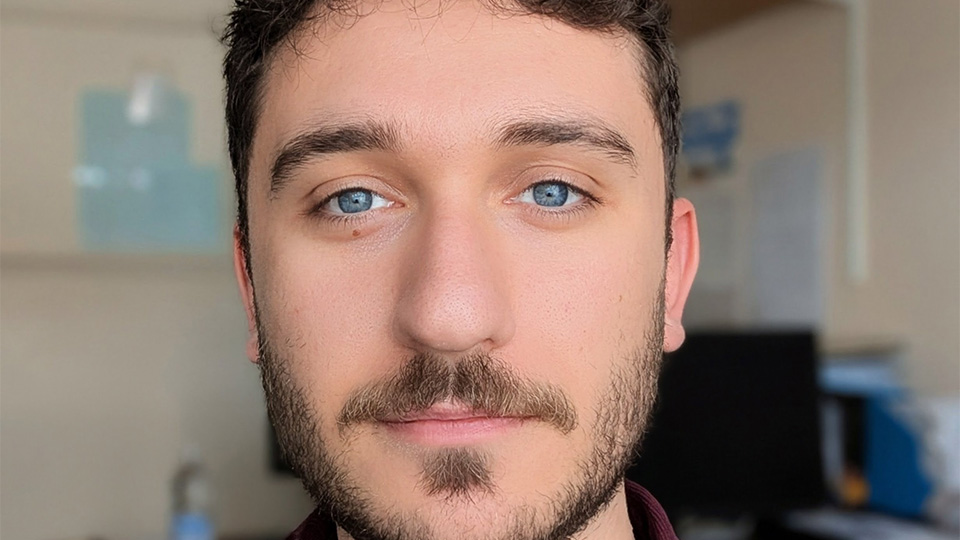
Aneurin Bevan Health Board Caerphilly service improvement manager, Neirin Rees, told OT that optometry has a key role to play in early diagnosis and referrals to preventative services.
“I think optometrists are in a great position to support with this – they will be seeing people who may have not seen their GP in years,” he said.
“Optometry practices can also be a more relaxed environment for some patients – they may be happier having more meaningful extended conversations about their health in this setting,” Rees observed.
Within Rees’ role he supports optometry collaborative leads – including Missaghi – to form connections within the wider care network.
Meetings with collaborative leads will often be used to improve awareness of the local services that are available for optometrists to signpost to.
“We want to help optometrists see beyond the four walls of their testing rooms and have a good understanding of what local services are available to their patients, and to also have the confidence to refer into these services,” he said.
He told OT that care closer to home is one of the key principles that the primary care division is working towards.
“From the patient’s perspective delivering care closer to home means the care they need is more accessible and convenient for them and is seen to be less stressful than visits to a hospital site,” he said.
“For us in the health board it means less reliance on hospitals freeing up capacity further down in the system,” Rees shared.
Rees has personally experienced the benefits of receiving care close to home after he had a floater assessed by Optimise Opticians in Risca.
“They were very professional, knowledgeable and well equipped, which is always reassuring,” he said.
Although he could not drive following the appointment because his pupils had been dilated, it was only a 10-minute walk back to his home.
He also valued being able to receive a same-day appointment.
“It is a bit disconcerting to have something wrong with your vision because you do wonder if it is something serious. They ruled out a retinal detachment and confirmed it was just a floater. To have that reassurance on the same day was amazing,” Rees said.
He added that the experience enhanced his appreciation of the importance of delivering care close to home.
“You can appreciate that it is a good idea on paper, but when you actually experience it yourself, it motivates you to drive this forward for other patients,” he said.


Comments (0)
You must be logged in to join the discussion. Log in