


27 June 2026
The dry eye conversation might come from a new patient desperate for relief and eager to discuss treatment options, or it might begin in those small, passing conversations at the front desk about irritating ever-watering eyes.
Each member of the practice team can play a crucial role in spotting and supporting the needs of dry eye patients.
OT asked two practices to unpack the dry eye conversations that happen with their teams, what training looks like, and top tips for tailoring the message to different patients.
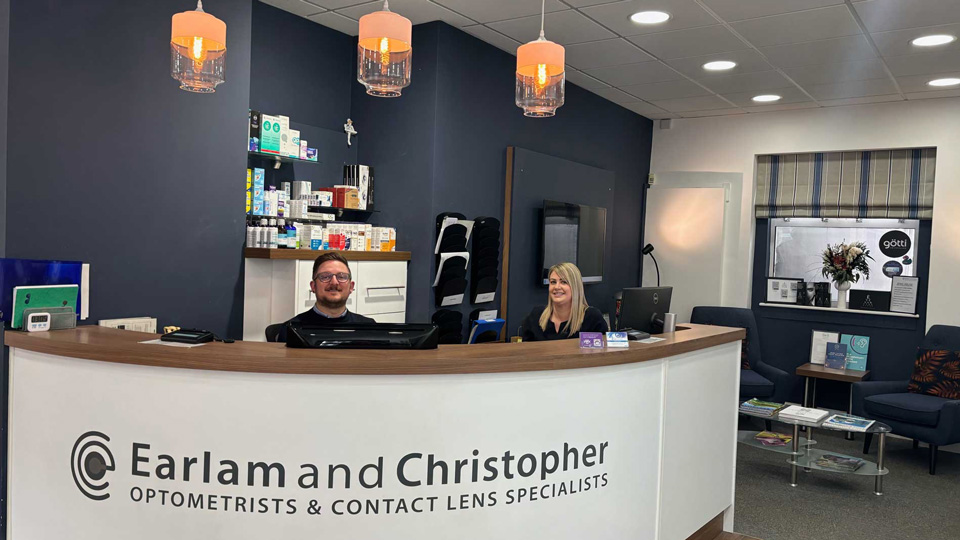
Sarah Farrant, optometrist, practice owner at Earlam and Christopher, and expert in therapeutics and dry eye management, highlights the kinds of comments the team often hear from patients and creating a culture of confidence.
Becci Zawadzki, independent prescribing optometrist and partner at Norville Opticians, a Hakim Group independent practice, discusses the role of team huddles in training, recognising patients who are struggling, and the importance of small check-ins.
What role can different members of the practice team play in supporting dry eye awareness? What does that look like in your practice?
Sarah Farrant (SF): At Earlam and Christopher, dry eye awareness is very much a whole-practice responsibility. I think one of the biggest missed opportunities in practice is assuming that dry eye conversations only happen in the consulting room. In reality, patients often mention symptoms casually at reception, during pre-screening, while choosing spectacles, when ordering contact lenses, or when collecting and buying products.
Our reception and front-of-house team are often the first to hear comments such as ‘my eyes are tired,’ ‘they water all the time,’ ‘I can’t wear my lenses as long,’ ‘My vision goes blurry on the computer,’ or ‘I just feel gritty by the end of the day.’ They are trained to recognise that these comments may be signs of ocular surface disease rather than simply something to dismiss as tiredness or age. Their role is not to diagnose, but to signpost appropriately and let patients know that dry eye is something we take seriously, and that there is a specialist clinic for this and effective treatments.
Our clinical support team help by gathering information, completing questionnaires, performing imaging and objective tests where appropriate, and making the patient journey feel structured rather than ad hoc. Many dry eye patients have already tried multiple over-the-counter drops and feel they have ‘failed treatment.’ Showing them that we are looking at tear film stability, lid health, meibomian gland function and lifestyle factors help them understand that dry eye is not one single problem.
Our dispensing team see the link between ocular comfort, visual performance and lifestyle every day. They can reinforce messages about screen use, lens comfort, blinking, environmental triggers, contact lens replacement schedules, make-up removal, lid hygiene and the importance of follow-up care.
In our practice, we try to create a culture where every team member feels confident saying: ‘That could be dry eye related – we have a dedicated clinic and there are things we can do to help.’ That simple sentence can be hugely powerful.
I think one of the biggest missed opportunities in practice is assuming that dry eye conversations only happen in the consulting room
Becci Zawadzki (BZ): All our team members are trained in dry eye treatment advice, being able to autonomously give patients suitable help when needed, but also aware of when there are any red flags to escalate.
From reception to the dispensing team, to optometrists, we’re all clued-up on the products we stock, why they’re being recommended and how they should be used. This enables the patient journey to be fluid without interruption.
The receptionists are greeting the patients as they come in, doing the over the counter till transactions for an extra set of drops or a new eye bag. They are the ones who are chatting to the patient and checking in with them. If the patient comes in for an adjustment, to collect their new glasses, or looking for a second pair, then it will be the dispensing team who have that point of contact with the patient.
That is why we encourage all of our team to be able to feel comfortable and confident to be able to talk about the different drops and the roles of dry eye treatments. We need to encourage patients to understand that dry eye drops are not the treatment for dry eye – it is an eye bag, cleaning the eyelids, and things like that.
Sometimes as an optometrist, we will explain everything, and the patient will still come out and say: ‘I’ll just buy the drops.’ That’s when the front of house team need to feel confident in saying: ‘This is why the optometrist has recommended this, because it’s treating the dry eye.’
All our team members are trained in dry eye treatment advice, being able to autonomously give patients suitable help when needed, but also aware of when there are any red flags to escalate
How are new products and treatments introduced to the whole team?
SF: For us, bringing the team along with regular team meeting and training sessions often starts with explaining the ‘why’ before the ‘what.’ If we introduce a new product, device or service we do not want the team to feel they are simply being asked to sell something new. They need to understand the clinical problem it addresses, the type of patient it may help, where it fits into our pathway, and what we can and cannot claim.
Dry eye patients are often complex. Some have evaporative dry eye, some aqueous deficiency, some inflammatory disease, some contact lens discomfort, some skin or lid-related disease, and many have several contributing factors. So, when we introduce something new, we frame it within that bigger clinical picture.
Practically, this means we use team training sessions, short internal guides, shared language, and patient journey mapping. We talk through common patient questions and the whole team needs to feel comfortable answering in a consistent, balanced way.
We also try to let the team see the technology and the patient experience for themselves. If staff understand what a treatment feels like, what the appointment involves, what the patient sees on the screen, and what follow-up looks like, they are much better able to talk about it naturally.
I also think it is important to create space for the team to challenge and ask questions and to not be afraid to admit when they are not sure. If the team have doubts, patients will sense that. Education should not just be a one-off product briefing; it should be an ongoing process where we review outcomes, discuss patient feedback, and refine how we communicate the service.
Education should not just be a one-off product briefing; it should be an ongoing process where we review outcomes, discuss patient feedback, and refine how we communicate the service
BZ: We have a weekly huddle, which is a time for us to have a coffee and chat through updates. We’ll often chat about dry eye, whether it’s going through a new product we’re stocking or a reminder of a treatment we offer.
I recently presented a dry eye refresh in our weekly huddle just going back to the basics as we have had a couple of new members of the team, but it’s good to refresh that training anyway. I went through what the tear film is, the layers, and the different classes of dry eye, then why we recommend treatments.
Clinical staff often attend CPD days focusing on dry eye – we're all keen on helping out dry eye patients and so need to keep up with the latest developments.
Sometimes we’ll close the practice for an extended huddle if we have something new to bring across. Quite often we’ll get the training teams from the companies we buy our products from to come in and explain the new products, going through the nitty gritty so the practice team really understand the benefits.
One of the main points of our training is to cover the ingredients and what the benefits are. We provide enough detail to have a reasoning behind every benefit to the patient, so everybody in the practice is fully informed about what we’re recommending. It means that when a patient wants to know why a certain drop has been recommended over another, everyone is comfortable saying: ‘There’s this ingredient that does this, and the benefit of it is this, and it does this for the tear film.’
Being part of Hakim Group, we have access to the HG Academy which has training for all levels of staff, which we all enjoy and engage with. A new learning management system has been introduced recently and one of the first new modules they’ve brought in is dry eye.
We attended the Hakim Group Dry Eye Immersion Day which had two tracks: a clinical track which myself and another optometrist were doing, and a business track which our dry eye champion, Kerry, attended.
We provide enough detail to have a reasoning behind every benefit to the patient, so everybody in the practice is fully informed about what we’re recommending
How can the whole practice team help to aid and reinforce the messages around dry eye?
SF: The most important message the team can reinforce is that dry eye management is a process, not a one-off event. Many patients arrive expecting a quick drop recommendation, but modern dry eye care is often about understanding triggers, identifying the subtype, improving the tear film environment and supporting the ocular surface over time.
The team can help by repeating simple, consistent messages at different points. For example: ‘Use the treatment regularly, not just when your eyes feel bad.’ ‘Come back if symptoms change.’ ‘Watery eyes can still be dry eyes.’ ‘Contact lens discomfort is not something you simply have to put up with.’ ‘Screen-related symptoms are common, but there are practical ways to manage them.’
Reception staff can reinforce follow-up appointments. Dispensing staff can discuss visual comfort and occupational needs. Contact lens support staff can identify early signs of dropout risk. Clinical assistants can explain why images or tear film measurements matter. Everyone can help normalise the idea that dry eye is common, treatable and worth addressing early.
At Earlam and Christopher, we also try to avoid making patients feel blamed. Lifestyle factors matter, but the language has to be supportive. Rather than saying, ‘You are on screens too much,’ we might say, ‘Your work pattern is putting extra demand on your tear film, so let’s build a plan that fits your day.’
That kind of reinforcement outside the testing room is crucial. Patients often remember the repeated, simple explanations more than the detailed clinical discussion.
BZ: Dry eye is such an ongoing chronic problem for so many of our patients. We all know how debilitating it can be, so having a dedicated dry eye clinic which all our staff feel confident discussing with patients, is vital.The most important message the team can reinforce is that dry eye management is a process, not a one-off event
It is important that we can detect when a patient is struggling. Quite often you can pick it up by their cues, whether their body language or the words they’re using. Dry eye is on a massive scale – it can be from just irritating every now and then, to the very other end.
We had a patient in the last year who was new to our practice and was at her wit’s end. She was visibly upset when she came in. She had tried all sorts of at-home techniques, so we suggested an in-practice treatment. By the end of it, she was smiling. That said it all really. Everybody could see the difference in this patient’s behaviour, mannerisms, and just how much happier they were becoming, because their dry eye was more under control. It is a great example of how significant our job is.
What we try and do in practice is enable patients to be in control of their dry eye, because their dry eye should not rule their life. We do the best we can to get them into that position where they can manage it themselves, with a bit of extra help from us.What we try and do in practice is enable patients to be in control of their dry eye, because their dry eye should not rule their life
We’ve curated our over-the-counter dry eye treatment selection to ensure the staff can feel confident when recommending products. Whenever patients pop in to purchase more dry eye products, we check in with them, see how they’re doing and check they are being as compliant as the optometrist would like.
On the patient’s homepage on our practice management system there is a space where we can list the recommendations [made by the optometrist], so it is available to all members of staff at a quick glance. If a patient can’t remember which drops the optometrist advised, the team know.


Comments (1)
You must be logged in to join the discussion. Log in
Anonymous01 July 2026
.
ReportLike0