


Picture an arcade game where for every £1 you put in, £4 would fall into your palm. Or a fruit stall where you could hand over the apple from your bag and receive four in return.
As fanciful as this world of quadruple returns may seem, this is the scale of value that the General Ophthalmic Services (GOS) sight test offers the NHS.
Independent economic modelling commissioned by the AOP, Fight for Sight, Primary Eyecare and Roche Products Ltd determined that for every £1 invested in GOS, the NHS receives £3.98 value in return.
This windfall takes a variety of forms – from the lifelong benefits that result from correcting refractive error in children and young people, to the pressure that is relieved from the NHS through the early detection of glaucoma and age-related macular degeneration.
Using the NHS Disability-Adjusted Life Years model, which is a measure of how many years of healthy life have been lost to disability, the analysis estimates that optometrists deliver £1.63 billion of economic and social benefits each year by providing GOS. The cost of offering GOS in England in 2022–2023 was £525 million.
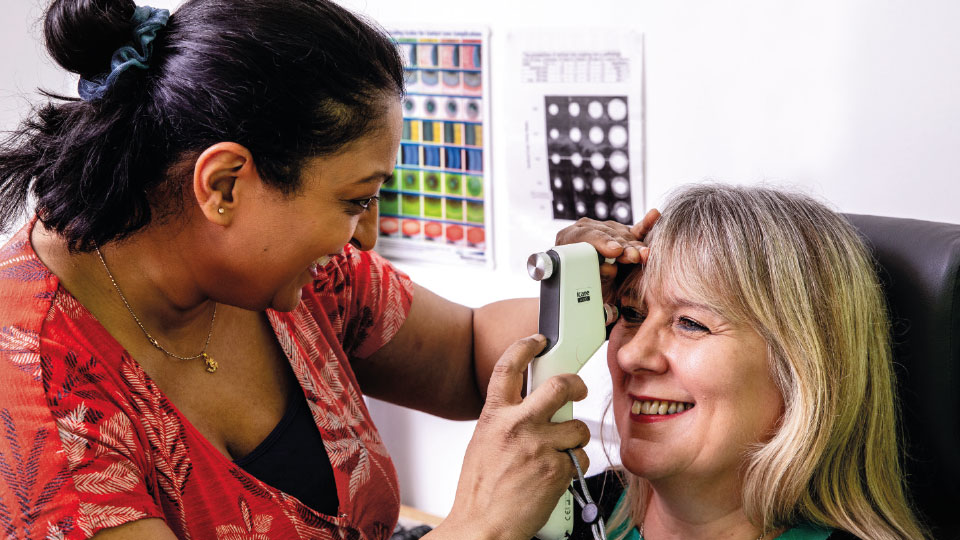
As well as outlining the value currently offered by GOS, the economic analysis puts forward a case for how further savings could be made utilising the optometry workforce.
The report estimates that a national roll out of Community Urgent Eyecare Services (CUES) could free up around 200,000 hospital eye service appointments each year, save around 240,000 accident and emergency appointments and reduce appointments in GP surgeries by 425,000 each year.
Implementing a national integrated glaucoma pathway, including referral refinement, enhanced referrals and monitoring, could save around 300,000 hospital eye service appointments each year.
A national integrated cataract pathway, incorporating both pre-operative and post-operative assessments, has the potential to release around 480,000 hospital eye service appointments annually.
Lastly, enhancing the use of optical coherence tomography in community settings – and providing appropriate funding – is estimated in the report to offer £20.8 million in net benefits to the NHS.
Trailblazing optometry services in South East London
IP optometrist, Bhavina Patel, is South East London joint clinical lead for Primary Ophthalmic Solutions.
The company provides a range of extended clinical services through a single point of access on behalf of two local optical committees (LOC) – Bromley, Bexley, Greenwich LOC and Lambeth, Southwark, Lewisham LOC.
Around 40,000 patients are processed through the single point of access service each year. Following triage, patients can go on to receive care at one of the 80 optometry practices within South East London that are signed up to provide Minor Eye Conditions Services (MECS).
As a profession, we are a group of people who want to do the best for our patients. We tend to go above and beyond
Patel explained that the MECS contract was established in South East London 15 years ago. As well as acute eye care, glaucoma repeat measures and referral refinement, and pre-operative cataract assessments were included within the original MECS contract.
Practices that sign up to MECS in South East London will offer these three services as standard. They may also opt into a range of additional services that have been implemented over time – including post-operative cataract assessments, a paediatric module, a hydroxychloroquine screening programme and a learning disabilities module.
“I think it would be amazing to have a national model for optometry that provides for a greater scope of practice. We want to grow as a profession and we absolutely have the skills to do so,” she said.
Alongside her role for Primary Ophthalmic Solutions, Patel lectures at City St George’s University and works in the glaucoma clinic at St Thomas’ Hospital. She also practises in the community with a small group of South East London practices.
She highlighted that MECS has reduced inappropriate demand on secondary care, while also ensuring the referrals made are directed to the correct sub-specialty with the appropriate level of urgency.
Patel highlighted that offering extended clinical services within optometry practices has made eye care more accessible to patients.
“Particularly after the pandemic, a lot of the trusts have become restricted in terms of how you can access ophthalmology,” she said.
“It can be difficult to get a GP appointment and quite often there is a sense of frustration. Most of the patients we deal with are very grateful that they can be seen,” Patel shared.
After all these years, I still enjoy working as an optometrist. I am passionate about my profession and proud to offer a community service
Patel observed that as well as freeing up appointment slots in the hospital eye service, there are benefits for the optometrists who offer MECS.
“I think that it adds a sense of diversity to our workload that you can’t put a price on,” she shared with OT.
“I like the fact that you never quite know what you’re going to get with MECS,” Patel added.
While Patel welcomes a national model for extended services, she highlighted the need to carefully consider the level of reimbursement.
“There is a sense of satisfaction for the practitioner that comes with offering these services. The difficulty for practice owners – whether they are multiple or independent practices – is balancing out the financial viability,” she emphasised.
“I would be very nervous if there was a national model where the fee structure was set with GOS as a benchmark. We make a loss on GOS as a practice,” she highlighted.
Underfunding of GOS forms a backdrop to the prevailing business model within optometry where spectacle sales subsidise the provision of clinical services.
“As a profession, we are a group of people who want to do the best for our patients. We tend to go above and beyond,” Patel emphasised.
“Most practices and most practitioners have simply swallowed the cost of providing these services,” she added.
However, Patel shared that this approach has led to a misunderstanding among members of the public and healthcare colleagues about what is funded through GOS.
“We’ve set a precedent. There is an expectation that this service is free, but it’s not free. Practitioners are paying for it out of their own pocket,” she said.
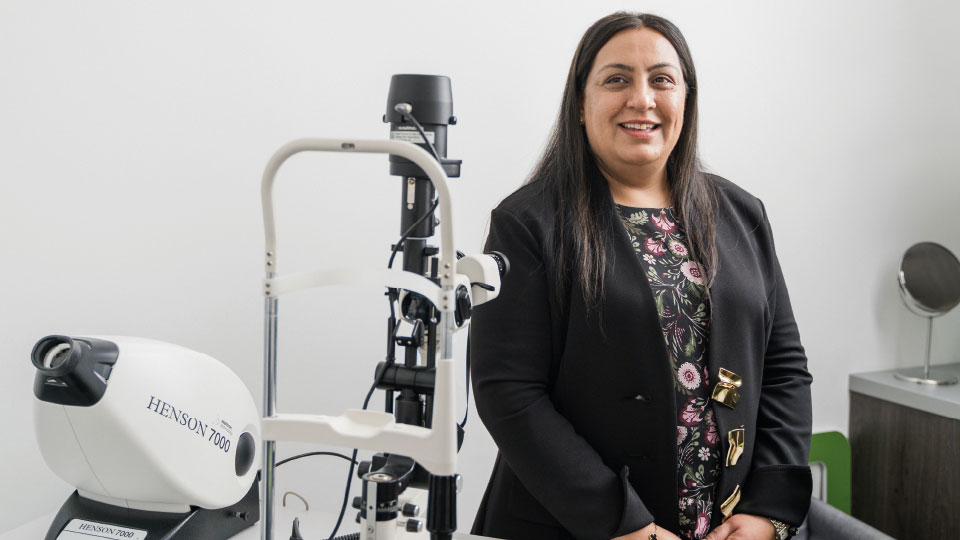
Optometrist Rashida Shaikh at EyePad Opticians in Old Trafford, Manchester
A healthcare hub in Manchester
EyePad Opticians in Old Trafford, Manchester, is an optometry practice with a difference.
Rather than being located on a High Street or within a shopping mall, optometrist Rashida Shaikh has established her practice within a purpose-built health and wellbeing hub.
The Limelight centre incorporates a GP practice, pharmacist, podiatry clinic, orthoptist clinic, blood testing service and assisted living complex, as well as a café, library, hairdressers and nursery. Shaikh highlighted the benefits of being located in a healthcare hub, rather than a predominantly retail environment;
“I think people do find it more convenient. My team and I have a good relationship with the pharmacist and GP practice,” she said.
“While we are different organisations, we frequently work together to provide a one-stop-shop for health services,” Shaikh shared.
Shaikh aims to provide a relaxed environment for her patients where they can take their time during the appointment.
She speaks Gujarati and Urdu and “can just about get by” in Punjabi. “For some of the older patients if you can speak their language it can help to make them feel more comfortable,” she said.
Many patients followed her from her original practice location on Seymour Grove in Old Trafford when she moved to the Limelight centre in 2018.
“We have a very loyal patient base. I have lived here most of my life so friends and family will recommend the practice. Word of mouth has been our biggest advertising,” she said.
Shaikh was initially attracted to practice ownership because of the flexibility it offered around her family responsibilities.
She had also observed a lack of optometry practices in her local area.
“I have grown up in Old Trafford, and I noticed as my parents were getting older that there was nothing in the area,” she said.
“It’s OK if you have a car or you have someone to take you, but that may not be the case for everyone. It was unfair that there was nothing local that you could just pop into,” Shaikh told OT.
With the help of her husband, whose background is in supply chains, Shaikh began the work of setting up her optometry practice from scratch in 2013. Although she had friends who had purchased pre-existing practices, she did not know anyone who had established a practice from the ground up.
“It was very daunting. There were lots of times when we thought, ‘Are we doing the right thing or not?’,” she said.
More than a decade later, Shaikh has no regrets about taking the step into practice ownership.
“After all these years, I still enjoy working as an optometrist. I am passionate about my profession and proud to offer a community service.”
Offering convenient care in Hampshire
The effect of extended services can be seen in sharp relief when considering the choices available to a patient on the Isle of Wight who experiences an eye problem on the weekend.
Before the advent of CUES, in this situation the patient would need to travel by ferry to Portsmouth to receive care – as the only hospital on the island is closed on the weekend.
Now patients with urgent eye care problems can book into a practice on the island instead.
“There are quite significant implications, time and money wise, for the patient,” optometrist and Hampshire LOC chair, Bryony Allen, told OT.
Allen highlighted that across the county, the majority of areas have cataract, glaucoma and CUES services commissioned.
We know that there are some areas of economic deprivation that aren’t receiving the same level of basic service
Where CUES is commissioned, there is a telephone line that patients can contact in the first instance.
“If the issue can be resolved with a phone call or through sending a photograph, then they don’t even have to leave their home,” she said.
“If they need to be seen face-to-face, they are booked into a practice following the triage and pre-assessment. They can be seen quickly and efficiently,” Allen highlighted.
She shared that patients within the glaucoma monitoring service are happy not to have to travel to the hospital to have tests carried out.
“They can go to the High Street. They might feel like they have a bit more time to ask questions with an optometrist who they already have a relationship with,” Allen observed.
She highlighted that offering cataract services within optometry practices on the Isle of Wight has brought down waiting times for treatment.
Allen supports the concept of national contracts for extended clinical services offered within optometry practices.
“Having a national contract for services like urgent care would provide reassurance that wherever you are in England, you can get the care that you need without having to jump through hoops,” she emphasised.
She shared that variation in the provision of services can exacerbate health inequalities.
“We know that there are some areas of economic deprivation that aren’t receiving the same level of basic service. There are patients who can’t or won’t pay privately and, as a result, their vision and health outcomes may be worse,” she said.
A changing role
Optometrist and senior lecturer at City St George’s, Dr Peter Campbell, told OT that the role of optometrists has changed markedly over the course of his career.
When he started working in the community, optometrists would primarily refer patients to ophthalmologists for the detection and management of glaucoma.
Campbell highlighted that now optometrists with the appropriate level of training are playing an important role in glaucoma care through a range of different schemes.
“Within glaucoma, extended roles for optometrists have been shown to work very reliably,” he highlighted. “Optometrists have worked effectively alongside our other colleagues within multi-disciplinary teams,” he added.
As well as his academic role, Campbell works as an optometrist in practice and within the glaucoma clinic at St Thomas’ Hospital.
He highlighted that involvement in extended services can give optometrists a broader understanding of their patient’s care.
“In the past, when working in a practice, you could become a little isolated from the rest of the eye care pathway,” he said.
“These enhanced schemes, as well as being an interesting part of the job, give you a better sense of our role within the overall eye care pathway,” Campbell highlighted.
He emphasised that optometrists have long-argued for an expansion of their role in managing a number of different eye conditions in order to meet patient demand.
“Patients might not be seen for many months within a hospital setting – thereby delaying any diagnosis and starting any potential treatment which is necessary to reduce their risk of sight loss within their lifetime,” Campbell observed.
Consideration needs to be given to the level of reimbursement if national pathways are rolled out, Campbell shared with OT.
“There has to be an appropriate allocation of funds to enable optometrists to take on these roles,” he said.
“Optometry practices in the community are effectively businesses so there has to be appropriate compensation to justify use of chair time,” Campbell emphasised.
A pioneering community ophthalmology service in Kent
Within the area covered by Kent and Medway integrated care board, optometrists are managing a range of acute and chronic eye conditions through two commissioned services.
The Community Ophthalmology Team, which was established in 2009, sees optometrists diagnose, manage and treat conditions such as glaucoma, ocular hypertension and corneal conditions.
This scheme was followed in 2012 by the Acute Primary Care Ophthalmology Service (APCOS), with optometrists the first port of call for conditions such as red eye, uveitis, corneal ulcers and flashing lights or floaters.
Behind the cover story
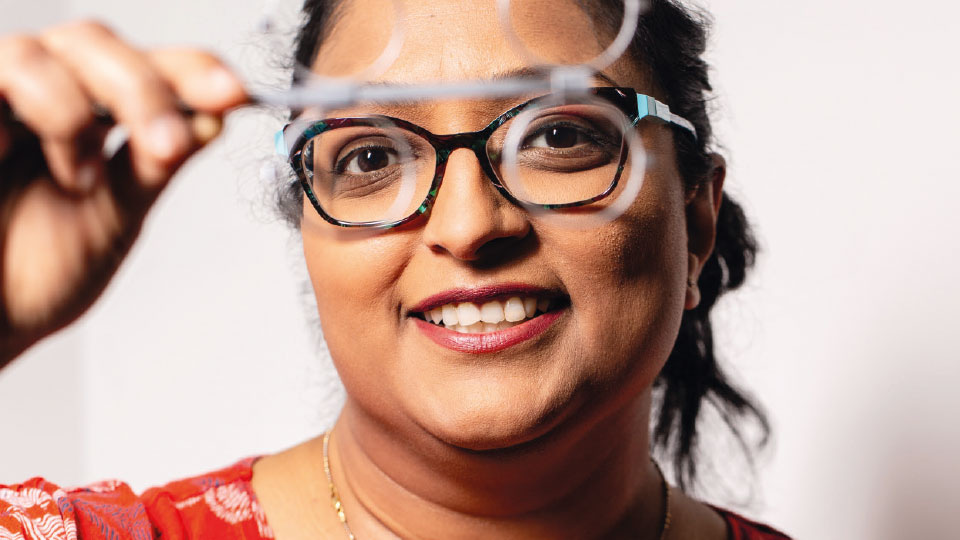
IP optometrist Bhavina Patel pictured at Pursers Opticians – the Purley branch of R Woodfall Opticians
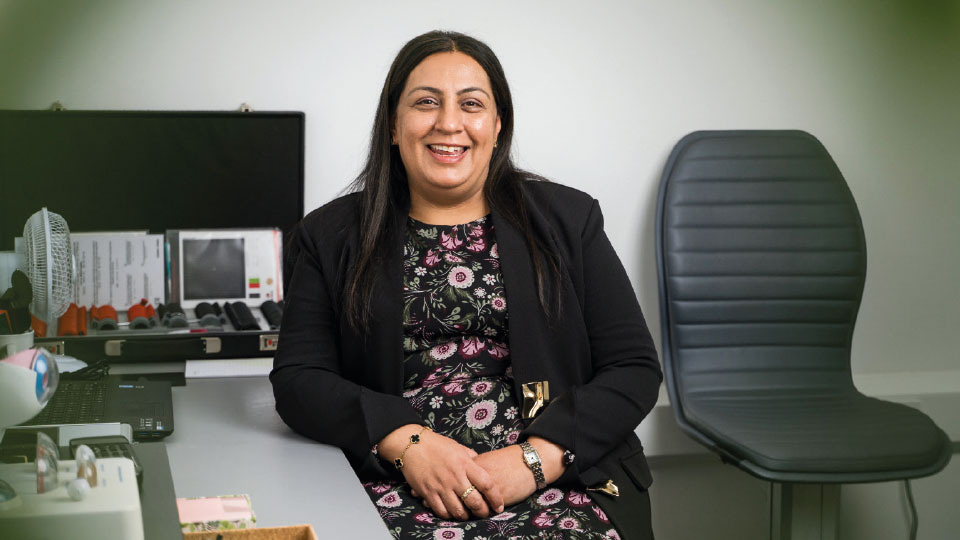
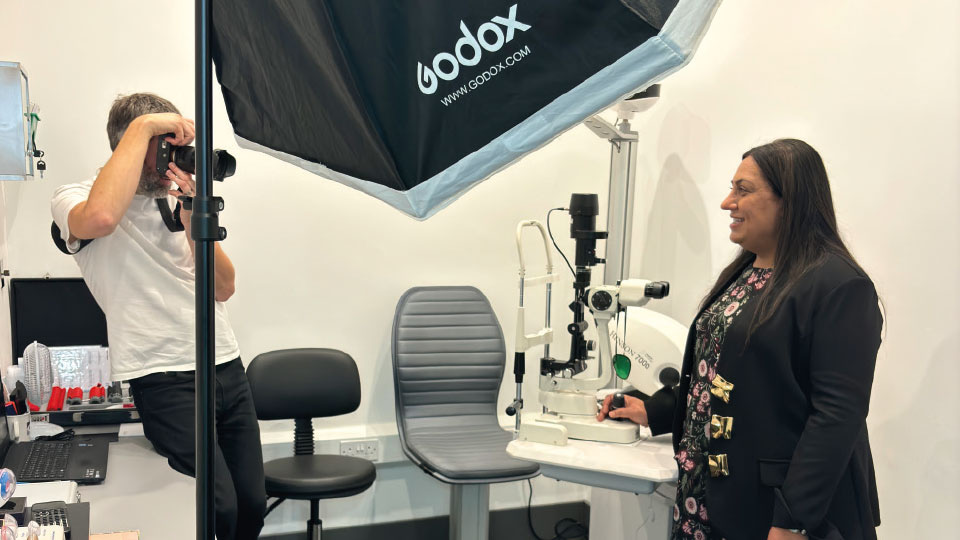
Optometrist Rashida Shaikh was photographed at EyePad Opticians – located within the Limelight centre in Old Trafford, Manchester
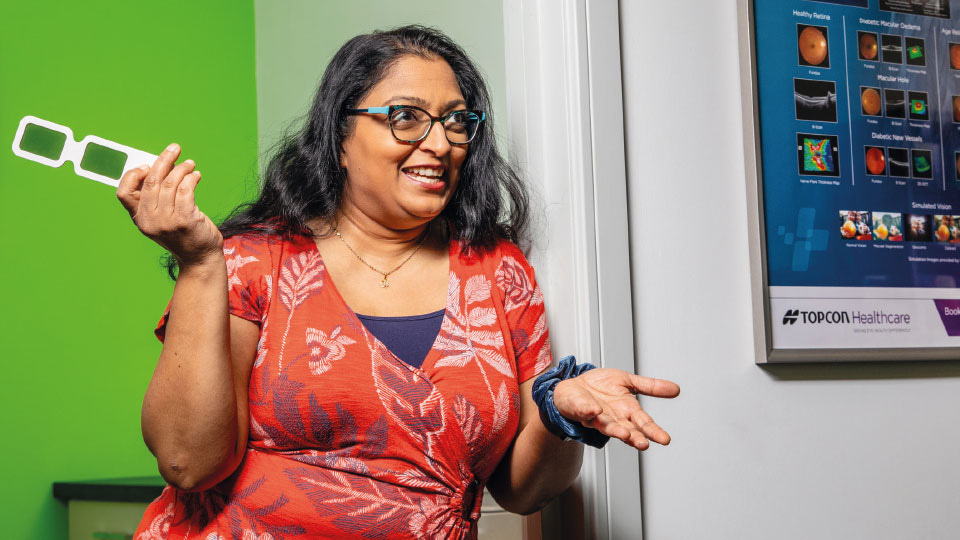
“There was much laughter and banter,” IP optometrist, Bhavina Patel, said of the OT December/January photoshoot
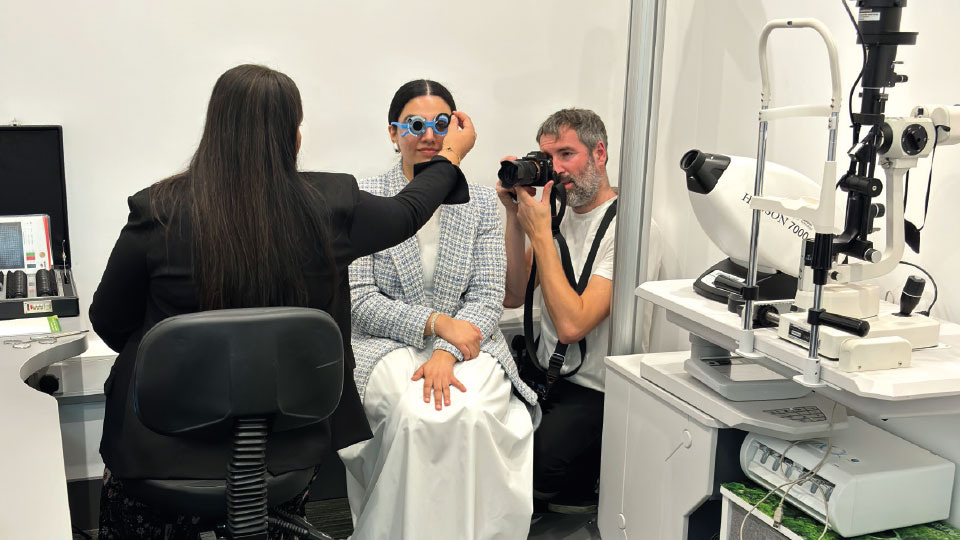
Photographer Mark Newton captures optometrist Rashida Shaikh at work at EyePad Opticians in Manchester
Referrals are made to the service by GPs, optometrists, pharmacists and the hospital eye service, with each referral triaged and then directed to a participating practice.
Advanced clinical practitioner (ophthalmology), Dr John Gurney, told OT that only around 5% of patients seen through APCOS require referral to hospital.
“The rest we deal with in practice. It means that the patients who have sight threatening conditions can be seen much quicker,” he said.
After extended clinical services were commissioned in Kent, Gurney was able to switch the focus of his practice to the provision of community-based ophthalmology services.
By the time he sold Kent Eye Care in 2023, extended services accounted for around 75% of the practice’s workload.
“I’m pleased to say that the new owners have continued to champion ophthalmology services at Kent Eye Care,” he said.
Gurney and other optometrists locally were responsible for negotiating with commissioners to establish extended clinical services in their area./p>
Gurney told OT that they outlined to commissioners the flaws in the current service and how it could be improved by the involvement of optometrists.
“When we did it, we could have failed but we had to take a punt, because it felt like the right thing to do,” he said.
He added that it was important that there were a group of optometrists in the surrounding area who were keen to switch their business model.
“They had the courage to make a change too. At the same time, we all went ‘Let’s give it a go, and see what we can do’,” he said.
Gurney highlighted that both the Community Ophthalmology Team and APCOS are commissioned ophthalmology rather than optometry services.
While Gurney supports the move for more optometrists to take on extended roles, he believes that it is important for optometrists to have the right training and experience before pathways for extended clinical services are rolled out nationally.
“You have to educate before you can legislate. We need to have highly-trained practitioners coming out of university who can do the job,” he emphasised.
The AOP view
AOP clinical and policy director, Dr Peter Hampson, highlighted that the findings from the independent economic modelling report would be used to make the “best possible case” for the expansion of optometrists’ roles.
“Optometry provides an amazing and undervalued service, but it is capable of, and willing to do, so much more,” he emphasised.
He highlighted that standardising pathways where possible has the potential to lead to better health outcomes.
“Patients who need post-operative cataract care, glaucoma follow-up, or who present with a red eye have pretty much the same needs and require the same volume of work,” he shared with OT.
“That doesn’t mean that local variation is always bad – there are some specific population health challenges in parts of the country that need a local approach to solve. However, that should only be done when it adds real value,” Hampson emphasised.
He highlighted that the pathways described in the report incorporate the “existing, under-used optometry skillset.”
Hampson would not envisage that it would be mandatory to take part in national pathways.
However, he hopes that optometrists would be interested in signing up to services.
“Whenever we ask our members what they want to see change, they always talk about taking on a greater range of clinical work. This would seem to directly fulfil that aim,” he shared with OT.
Asked about existing services that are operating at a higher level to any proposed national pathway, Hampson emphasised that he does not want to see established, well-running services discontinued.
“Thankfully there is already quite a lot of standardisation, as many services are based on existing pathways. That hopefully means if changes are made they will be very minor.”


Comments (0)
You must be logged in to join the discussion. Log in