


02 October 2026
When optometrist, Noor Sher, is asked about work-life balance, she reflects on a lesson from the hardest working person she knows – her father.
After emigrating to the UK from Pakistan, the money he earned working in bakeries, supermarkets and as a taxi driver was invested in the upbringing and education of his children. He seldom took a day off or spent money on himself.
Now he is retired, Sher’s father has time to spend on the leisure he neglected in his youth, but his health limits the activities he can enjoy.
In contrast to his own relentless work ethic, he encourages his children to take that holiday, to buy that car.
“He says, ‘If that’s what you want, do it now’,” Sher said.
With her father’s wisdom in the back of her mind, Sher works hard but also sets aside time for her family and for herself.
“While work is important and what I bring to the community through my work is important, it’s not the be-all and end-all,” she emphasised.
“Your family and your wellbeing is much, much more precious,” Sher said.
The optometrist is not alone in choosing a career that fits around her other priorities in life. The 2025 General Optical Council Registrant Workforce and Perceptions Survey found work-life balance is one of the main drivers that influences job satisfaction among optometrists and dispensing opticians.
Among survey respondents who were happy with their job, 57% cited good work-life balance as a reason for their professional satisfaction – ahead of earning a good salary (33%).
Optometrists and dispensing opticians are also increasingly prioritising flexibility within their working life. When asked for their main motivations for joining the profession, 17% of survey respondents mentioned flexible working patterns. This proportion rises to 26% among student optometrists.
A portfolio career
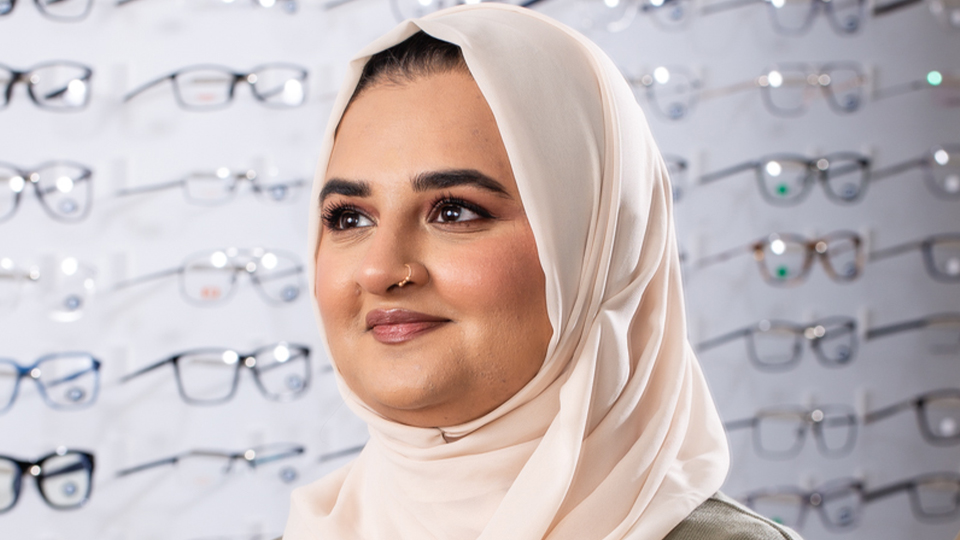
Within her own career, Sher has developed a portfolio of roles. The independent prescribing (IP) optometrist works at Whipps Cross Hospital one day a week in the vitreoretinal and injection clinics.
She also trains and examines ophthalmologists completing their refraction certificate through the Royal College of Ophthalmologists. In April 2025, Sher opened her own optometry practice in Ilford, named Iris Eye Care.
While Sher now has a diverse range of roles, she remembers the repetitiveness of conducting sight tests day-in, day-out early in her career.
“I clearly remember a patient saying, ‘Oh, you look a little bit bored. You should open the door of your room,’” Sher recalled.
Sher added that she does not want to undervalue the importance of refraction within the role of an optometrist.
“It is absolutely the backbone and the foundation that you need in order to progress, but I think it is important to consider building on your strengths and also exploring your weaknesses,” she said.
While work is important and what I bring to the community through my work is important, it’s not the be-all and end-all
For Sher, taking a role within hospital optometry in 2022 was a chance to challenge herself and pick up new skills.
She valued the chance to learn from other professionals in a multidisciplinary team and see how optometry fits within the wider healthcare system.
“Almost every time I’m at the hospital, I come across a case that I’ve not seen before,” she said.
“Having a different challenge every 20 minutes really keeps me on my toes,” she said.
Sher reflected that while it can be easy to feel a sense of imposter syndrome when working in the hospital, everyone has the same goal.
“I’ve come to realise that everyone is in the same boat – we are all being faced with these complex cases. We’re all here to learn. We’re all here to help the patient,” she said.
Starting a practice has also given Sher an opportunity to learn in new ways – building a patient database from scratch, while mastering all the skills that are needed to run a business.
While she acknowledges that the first year of practice ownership has been challenging, she has valued the opportunity to shape the service that is provided.
“The most rewarding thing has been having an idea, then watching it become a reality,” she said.
“I like having the autonomy to make my own decisions and run with them,” Sher said.
She appreciates the flexibility that being a business owner gives her in terms of how she manages her time.
“I make my own rules. I’m able to allocate time to my friends, my children, my husband and my parents as they get older,” Sher said.
Her responsibilities to her family, her practice and her patients have made Sher selective about the commitments she makes.
“I’m firmer and more assertive in saying ‘no.’ Business ownership has given me flexibility, but it has also made me very sure of what I want,” she said.
“I don’t go to bed thinking ‘I wish I’d gone to that event’ because I know I’ve prioritised what is important – both business-wise and personally,” Sher highlighted.
On the road
When domiciliary optometrist and AOP Councillor, Simon Raw, graduated as an optometrist in 1999, the range of available career paths within optometry was limited.
“You went to work for an employer – whether that was an independent, multiple or hospital – and there was an expectation that you would stay with them,” he shared.
Raw’s first role was at Boots in Newcastle where he had completed his pre-registration year. After seven years working in a variety of roles for Boots and a year’s work experience in New Zealand, Raw decided that he needed a change.
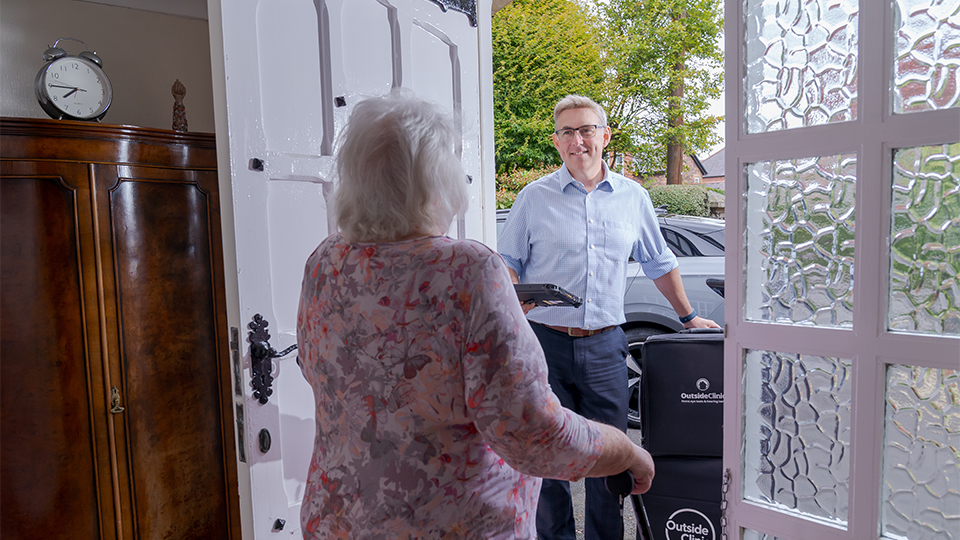
He accepted a role as a domiciliary optometrist for OutsideClinic – a role that he continues to hold 19 years later.
“I loved being out on the road and spending more time with patients,” Raw shared.
The optometrist sees providing eye care in a patient’s own home as a privilege.
“I do my own dispensing and low vision work, so I’m often with a patient for an hour,” he said.
“You get to know your patients better by being in their own house, seeing their family photographs on the wall and hearing their stories,” Raw shared.
Everyday objects can reveal an extraordinary history. Raw recalled finding out that his patient had played rugby for England after asking about a cap that was on display.
On another occasion, Raw asked about a small presentation case with medals.
“I said, ‘Were you in the army?’ And he said, ‘Yes, I was at D-Day’,” Raw shared.
Serving Northumberland and the Scottish borders, Raw’s work has taken him to remote locations.
“I’ve had patients with no electricity who have asked if I would like them to put the generator on,” he said.
Raw shared that there can be misconceptions about the level of service than can be offered through domiciliary care.
“With the right skills, the right training, and the right equipment, you can provide a really good eye test,” he said.
As well as valuing the time he is able to spend with patients, Raw appreciates the work-life balance that domiciliary care offers. His work fits around his family, friends and weekend cricket matches.
“I haven’t worked on Saturday for 19 years,” he shared.
He chose to work a four-day week when his 16-year-old son and 14-year-old daughter were young so he could attend their sports days and performances.
Raw shared that this was in contrast to his own childhood, when his father would go to work early in the morning, come home at 7pm, have some dinner before continuing to work in his study.
Raw has no regrets about adjusting his workload to play a greater role in his children’s lives.
“Getting to see them grow up is quite a privilege,” he said.
Alongside his core domiciliary role, Raw supervises optometrists who are new to domiciliary care and delivers domiciliary-focused continuing professional development courses. He has also provided guest lectures on domiciliary care to university optometry courses.
He is treasurer of the North East Optical Society and represents North East England on the AOP Council. In September, he will take up a clinic supervision and first-year teaching role at Teeside University.
“I’m becoming more of a portfolio optometrist as the years go on. It is completely alien to the job I took when I qualified – which was five days a week for the same company, in the same store, in the same testing room,” Raw observed.
He told OT that working in a variety of roles has provided him with a broader view of optometry.
“At the AOP meetings, I’m hearing all these different perspectives on optometry from people in different roles,” he shared.
“When I applied, I told them, ‘I’m not a policy person. I know the coalface, but I don’t know the politics.’ Over the years, listening to these conversations has made me think about how my role and experiences could shape the future of optometry,” Raw said.
Remote working
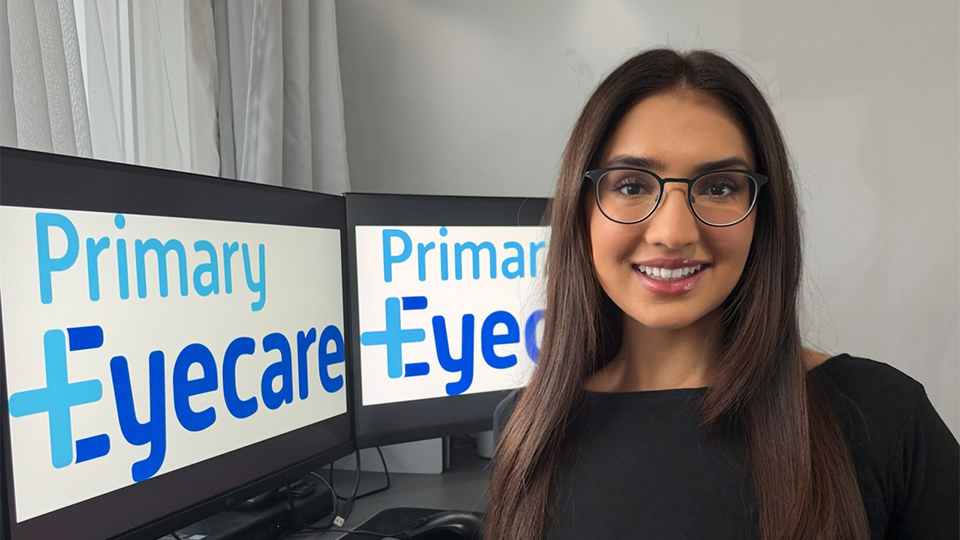
Samiriah Shaikh began working as a telemedicine optometrist for Primary Eyecare Services in April 2024.
“One of the things that I value most about telemedicine optometry services is the flexibility that it offers,” she told OT.
“I think it also provides a sustainable way of balancing career progression with my personal priorities,” Shaikh said.
Patients may self-present with an eye problem or be signposted by a range of healthcare professionals and services, including GPs, pharmacies, and optical practices.
“We also receive referrals directly from NHS 111 and secondary care through our streaming and redirection services, helping to support secondary care and ensure patients access the most appropriate care pathway,” Shaikh explained.
On the basis of the patient’s history and symptoms, Shaikh will decide if the patient needs to be seen in person by an optometrist, referred to hospital or whether they can safely self-manage their condition. She can request images or a video if needed.
The optometrist shared that the role was initially daunting because of the differences between managing a patient in hospital or on the High Street compared to her remote role.
However, she was provided with extensive training through Primary Eyecare Services and guidance from more experienced telemedicine optometrists in cases where she was unsure.
“Like with any role, as you build up that experience and confidence, it becomes second nature to you,” she said.
Shaikh balances her job as a senior telemedicine optometrist alongside a role on the High Street as a senior optometrist at Specsavers. She also works as a locum hospital optometrist.
One of the things that I value most about telemedicine optometry services is the flexibility that it offers
She told OT that her role within telemedicine optometry services has informed her approach to managing patients in person.
“Working within telemedicine optometry services has taught me so much about identifying red flag symptoms quite quickly based solely on the patient history,” she said.
She added that telemedicine optometrists have the same purpose as optometrists examining patients in person.
“At the core, both roles are centred around the same principle: delivering safe, patient-centred care, applying clinical judgment, and ensuring that patients receive the optimum management,” Shaikh highlighted.
Shaikh values the opportunity to provide convenient access to care through her role while also reducing the burden on hospital eye services.
“Sometimes it’s simply about reassuring the patient that if we follow this management plan, their symptoms will self-improve,” she said.
“They don’t have to travel an hour or two hours to the local hospital just to be told the same advice that we give them over the phone,” Shaikh said.
Reflecting on her role as a hospital optometrist, Shaikh told OT that when she is working in the paediatric clinic she can use a more playful manner.
“Honestly, it’s just fun. Sometimes it feels like I’m not at work,” she said.
Shaikh has also expanded her clinical skillset, testing the vision of babies as young as six-days-old.
By seeing children repeatedly, Shaikh learns their favourite colours and what YouTube videos they like to watch.
“You can connect with the patients because you see them more often. You build a good rapport,” she said.

Becoming a founder
For IP optometrist, Mandeep Kaur-Bains, experience working within a paediatric clinic at Whipps Cross Hospital has provided inspiration for her fledgling eyewear brand, Enka Eyewear.
Since taking on the role in October 2018, Kaur-Bains has observed how ill-fitting frames have undermined the meticulous work she performs in clinic to optimise a child’s vision.
“If we give a child with amblyopia a particular lens and they’re wearing a poorly fitting frame which constantly slips down, they will never be looking through the right part of the lens,” Kaur-Bains said.
She has seen the marks of poor dispensing on children’s faces – from contact dermatitis on their cheeks, to marks behind their ears and lines on their nose.
“The vast majority of the frames that are available for children are adult frames, just made smaller – but children’s faces are so different to adult faces. Their frames need to fit their nose bridge, temple and the back of their ear properly,” she said.
While there are frames available that are tailored to the unique proportions of children’s faces, Kaur-Bains noted that some of these brands are at a price point that is beyond the reach of many families.
The origins of Enka Eyewear – which means ‘glasses’ in Punjabi – can be traced back to a conversation between Kaur-Bains and her husband while they were on holiday with their young daughter.
Kaur-Bains was analysing the flaws of her daughter’s sunglasses when her husband suggested that she could have a go at solving the problem herself.
“I said, ‘Alright, I will’,” she said.
I don’t get the Sunday scaries
Since then, Kaur-Bains has picked up a host of skills necessary to design and manage the production of an eyewear brand. She has learned about taxes, VAT, manufacturing processes, cash flow and drawing frames by hand.
Kaur-Bains observed that optometry can be a varied and flexible career if practitioners push themselves outside of their comfort zone.
“If we stay in the same position for too long it can become repetitive. There are so many opportunities for optometrists to have a flexible work schedule now where they can work in different areas of optometry on different days of the week,” she added.

Employer perspectives on flexible working
OT explores how employers are adapting to recognise the range of priorities that optical professionals have within their working and personal lives
The optometrist and founder now has a website and her frames are stocked in 12 optometry practices in London, Essex, Yorkshire and Newcastle.
Whereas last year Kaur-Bains was ordering 100 frames from her manufacturer, she is now ordering 10,000 units.
The optometrist described making her first order of this magnitude as a surreal moment.
“Scaling can be scary. But I just took a breath and thought, ‘This is what happens when you grow’,” she said.
Along the way she has designed and commissioned custom-made sunglasses for her husband to play cricket in – with a wraparound shape, enhanced contrast sensitivity and a snug fit to prevent them from sliding down his face.
Within women’s eyewear, the optometrist aims to provide timeless designs with good quality acetate and lenses at an affordable price point.
Alongside her hospital role and eyewear brand, Kaur-Bains has a remote professional services role for Evolutio Ophthalmology and an in-person role within an Evolutio glaucoma clinic.
The variety within Kaur-Bains’ working week helps her to stay passionate about her profession – from using her further qualifications within the fortnightly glaucoma clinic to the unexpected moments of joy young patients bring to her Mondays.
“I don’t get the Sunday scaries because I work in the paediatric clinic on Monday morning. It’s the day I most look forward to. On Sunday, I’m like, ‘Great, let the work week begin’,” she said.
Rediscovering a passion for the profession
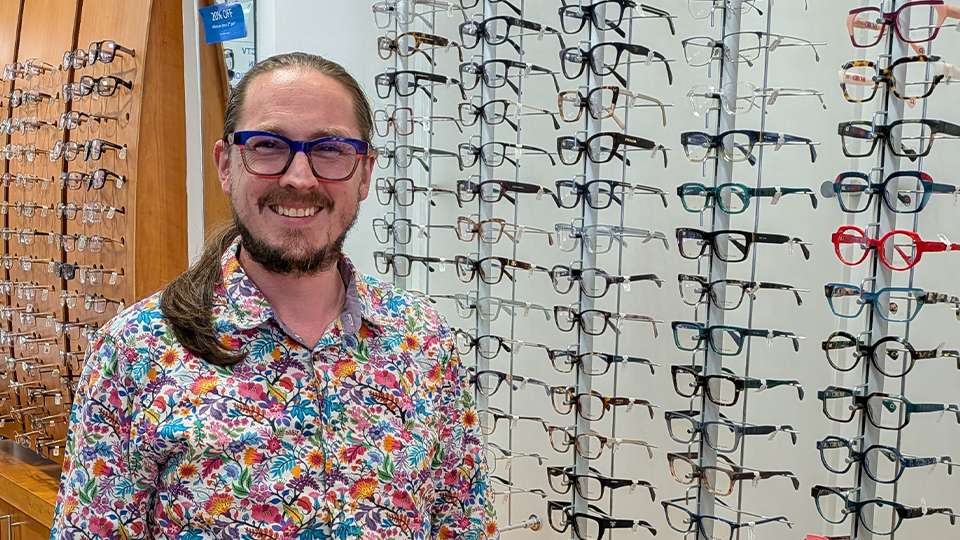
At the end of 2021, dispensing optician, Jamie Wogin, was considering leaving optics.
After a period of intense work managing three practices while other staff were on furlough, patients were flooding back to practices for routine sight tests following the end of social distancing restrictions.
“Every single sight test was a dispense at that time. It was non-stop,” he said.
“I had reached my limit and was considering becoming an estate agent,” Wogin shared.
At the time, Wogin had worked within optics since the age of 15 in a variety of roles for multiples, independents and joint venture partners.
“I had worked in city centres and by the seaside. I had done it all really,” he said.
A chance conversation with a Hakim Group recruitment consultant encouraged Wogin to reconsider his options within the profession.
“He said, ‘Don’t lose those skills. You’ve been doing this for 20 years. It would be a real shame to lose all that experience’,” Wogin recalled.
After a period of locum work, Wogin joined Sheffield practice Bird Opticians on a part-time basis and worked alongside an optometrist as a dispensing optician within the Special Schools Eye Care Service.
He also took on a role as a paediatric and special needs dispensing optician within the South Yorkshire Community Optometry Forum and became a member of the Rotherham and Barnsley Local Optical Committee.
Wogin shared that while he became a portfolio dispensing optician by chance, this way of approaching work suited him well.
“I found it easier and less stressful to do more hours doing lots of different things rather than ploughing everything into one job role,” he said.
“It really did wonders for my wellbeing,” Wogin added.
He valued the chance to broaden his professional horizons by exploring a variety of roles within optics.
“There is a wider scale to community optometry than just your own practice and your own database of patients,” Wogin highlighted.
Through his special schools role, Wogin was able to see the transformation in the behaviour of children consistently wearing glasses for the first time.
Over time, he built trust with children who had previously refused to leave their classroom for a sight test.
“It was the most rewarding job that I’d ever done,” Wogin said.
Wogin’s bag of sensory toys and “dopamine dressing” shirts helped to put his young patients at ease.
“One of the reasons that the job was full of joy is the nature of children with special needs,” he said.
“Without all the influences that shape our personalities growing up in a mainstream world, they don’t fit into the uniform world that we teach people to conform to,” Wogin reflected.
His experience in special schools inspired Wogin to ensure that Bird Opticians provides an inclusive space to everyone who comes for an eye test.
“Being different is celebrated in our practice, rather than being feared or misunderstood,” he emphasised.

Behind the scenes of our Flexibility matters edition
Optometrists were photographed in Gateshead and London for an edition exploring how optical careers are evolving


Comments (0)
You must be logged in to join the discussion. Log in