


02 October 2026
This year has seen the introduction of new advances and updates in existing myopia management treatment lines.
Hoya has introduced the Miyosmart iQ, building on its defocus incorporated multiple segments (DIMS) technology and introducing a ‘triple enhanced design’ that brings the defocus segments closer to the centre of the lens, with a larger treatment zone and a higher defocus power.
Andy Sanders, professional services director for Hoya Lens UK and Ireland, commented: “In simple terms, the lens has been designed to give a stronger and more consistent myopic defocus signal while retaining a familiar, non-invasive spectacle-based approach.”
Data from a 12-month randomised controlled trial indicated no myopia progression on average in children aged between four and 12, minimal mean axial elongation, and that nine out of 10 children showed no clinically relevant myopia progression.
Sanders explained: “A suitable candidate would be a child with progressive myopia where the practitioner feels early and active intervention is in the child’s best interests.
“The current positioning is particularly relevant for children from four years of age, younger early-onset myopes, and children who continue to progress despite an existing myopia management strategy,” he said.
Suitability should not be reduced to a single age range or prescription, Sanders emphasised, adding that the best candidate is one whose risk profile and clinical picture justify a stronger spectacle-based intervention.
Practices should introduce Miyosmart iQ within a structured myopia management pathway, Sanders said, emphasising the importance of a balanced discussion with parents.
Reflecting on the results of the clinical trial, Sanders told OT that the evidence within the cohort of four to six year olds is particularly interesting as younger children can progress more quickly and are less commonly represented in spectacle lens randomised control trials.
“However, it would be sensible to describe this as clinically important 12-month evidence rather than overstate it as the final word. The full peer-reviewed publication and longer-term follow-up will help practitioners understand how these early outcomes sit within the wider Miyosmart evidence base,” he said.
A balanced discussion should also be had with parents, Sanders said.
He shared: “Some may choose Miyosmart iQ because of its reported efficacy; others may choose original Miyosmart because it has the longer-term evidence base and the child is already stable. Both approaches can be clinically reasonable, provided the discussion is clear, evidence-led, and properly recorded.”
The company has also introduced the Miyosmart iQ TF which features an optimised aspherical back surface design.
Sanders explained that this could be an option where “lens aesthetics, edge thickness and easy wear may help the child accept and wear the spectacles more consistently.”
Centration and frame choice matter, he added, with the geometric centre aligned to the pupil centre in primary gaze, and with a frame that supports the required treatment-zone coverage.

In conversation with Dr Natalia Vlasak about the Miyosmart iQ spectacle lens
Hoya Vision Care’s global head of medical and scientific affairs spoke with OT about the research supporting a pioneering spectacle lens for myopia control
Demonstrating advances
Essilor has introduced the Stellest 2.0 lens powered by Highly Aspherical Lenslet Target (HALT) Max technology, designed with increased lenslet power and asphericity.
In a one-year clinical crossover study, the Essilor Stellest 2.0 lenses demonstrated greater efficacy in slowing myopic eye growth compared to the first-generation lenses.
Charlotte Timbury, director of medical and professional affairs for EssilorLuxottica North Europe, said: “There is an ongoing need for enhanced myopia management solutions, particularly for younger children, fast progressors, and those with higher levels of myopia at onset. In such cases, early and proactive use of the most effective available option is encouraged.”
The lens was evaluated in children aged between six and 10, Timbury noted, highlighting its suitability for early intervention.
She explained: “Based on the prescribing eye care professional’s decision, Essilor Stellest 2.0 lenses may be recommended to a child who presents with initial signs of progressive myopia and up until their myopia stabilises.”
In introducing the lens, she suggested practices can demonstrate that they offer the latest technology for myopic patients.
Along with higher efficacy in myopia management, practitioners will also be able to talk about the features of the lens such as the larger 75mm diameter and additional ring of 169 lenslets.
“Practices can proactively recommend Essilor Stellest 2.0 to slow myopia progression, particularly to higher-risk groups. These groups may include children whose baseline myopia is high, those who are younger, and those whose myopia progresses rapidly,” Timbury said.
Timbury highlighted the need for the practice team to receive dedicated training and support when introducing any new lens.
EssilorLuxottica has a dedicated team of medical science liaisons who specialise in myopia management and are available to support practices in launching the Essilor Stellest 2.0.

Myopia management evolution with Stellest 2.0
Charlotte Timbury told OT about the design of the new lens at 100% Optical
Creating continuity
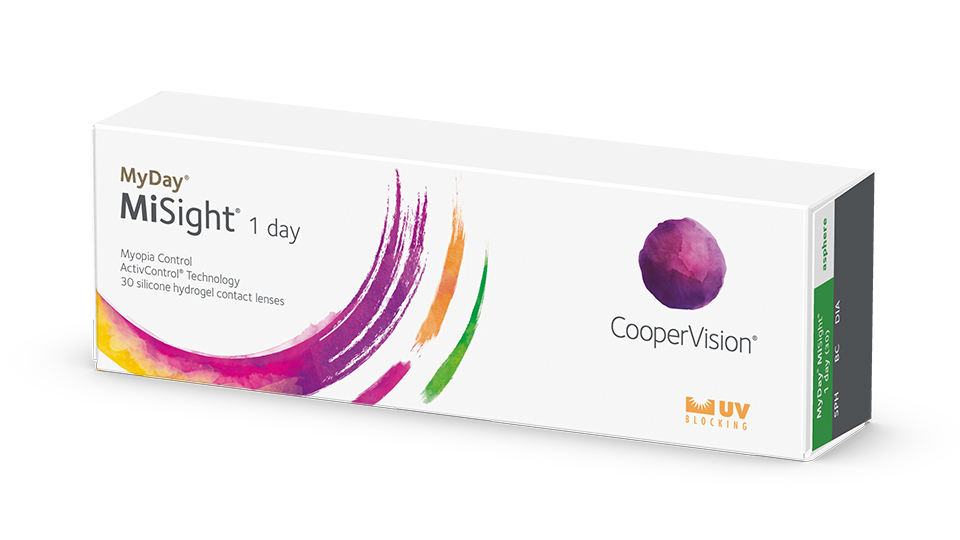
CooperVision has introduced the MyDay MiSight 1 day contact lens, bringing together its myopia management option with its MyDay portfolio of silicone hydrogel lenses.
Clinical evaluations of the MyDay MiSight 1 day featuring ActivControl Technology showed that children achieved excellent visual acuity, better than 6/6 on average, and highly rated their quality of vision, the company said, adding that they were rarely bothered by halos or glare.
In the study, more children rated the MyDay MiSight 1 day contact lens as easier to apply compared to the original MiSight 1 day lens, and more children preferred it for comfort.
Importantly, the lenses produce the same levels of myopic defocus through the pupil, the company highlighted.
Discussing what introducing this lens to practice could mean for professionals, Chithra Dhanabalan, professional affairs manager for CooperVision UK and Ireland, highlighted the long-term patient journey and the potential for continuity.
Dhanabalan said: “As MyDay MiSight 1 day shares the same material and specifications as MyDay sphere, practices may find it easier to transition patients from childhood myopia management into adult contact lens wear.”
“This creates a pathway from myopia management in childhood through to adult vision correction needs, helping practices build long-term patient relationships while maintaining continuity in lens wear,” she added.
Dhanabalan suggested: “Practices should view MyDay MiSight 1 day as an opportunity to put contact lenses at the forefront of their myopia management conversations, while maintaining confidence in clinical outcomes.”
Evidence-based decisions

Alexander Kobrin Optometrists in London has been offering myopia management for more than 15 years and has offered the Essilor Stellest lenses since 2021.
The practice introduced the Essilor Stellest 2.0 following its launch in February.
Paediatric optometrist, Ioannis Tompazos, explained: “We had been informed about the developments in the lens design, including the improvements in asphericity, as well as the encouraging results from the latest study showing even lower axial elongation compared with the original Stellest lens.”
“For us, it felt like a natural evolution of a technology that we were already very confident in, and we were keen to make the latest development available to our patients,” he added.
The availability of peer-reviewed clinical studies plays a significant role in the products the practice introduces, Tompazos shared.
He said: “Personally, I always want to understand how a product works and see strong clinical evidence behind it. Ideally, I want to see peer-reviewed studies with robust methodology and, importantly, results that can be replicated.”
With the Essilor Stellest lenses, he shared: “The combination of understanding the optical mechanism behind the lens and the strength of the peer-reviewed research gave us the confidence to introduce it into our practice.”
Essilor Stellest lenses are not currently FDA approved and are not commercially available for sale in all countries, including the U.S. More information about the lenses can be found on the Stellest 2.0 fact sheet.
More information on the MyDay MiSight 1 day is available on the CooperVision website.


Comments (0)
You must be logged in to join the discussion. Log in