


21 September 2026
Close partnership between charities and practices can help to increase awareness of support available for those living with sight loss, promote community connection, and raise funds for vital services.
OT heard from practices and the charities they have been backing this year to find out more about what this support can look like, the importance of signposting, and the difference it makes for patients and communities.
The role of trust in signposting support
Weygang Opticians, which has four locations in Gloucester, named Insight Gloucestershire as its charity of the year following a “unanimous” vote amongst staff in January.
Victoria Eastwood, practice manager, Weygang Opticians, explained: “Insight Gloucestershire have been fantastic. We’ve referred a few patients through to them who have had sight loss because we know they will give them the support they need or might be able to signpost them elsewhere.”
The connection to organisations like Insight Gloucestershire is important for continuity of care, Eastwood explained.
She said: “Where I have spent time with the Insight team; I know the services they provide and what they can help with. I’ve met them all and spoken to them personally.”
Many of the patients at Weygang Opticians have been attending the practices for many years, Eastwood said: “They know us and trust us. When I say ‘these people will look after you,’ it’s that continuity of care and makes them more keen to go for the support.”
The support system offered by organisations such as Insight Gloucestershire is particularly key for patients, she suggested, acknowledging: “I can sit and talk to someone about sight loss, but I don’t fully understand what they are going through because I haven’t had sight loss myself.”
I can sit and talk to someone about sight loss, but I don’t fully understand what they are going through because I haven’t had sight loss myself
Through hubs provided by Insight Gloucestershire, patients can meet like-minded people, compare experiences, and share ideas.
Eastwood described a story from a placement she had completed at the local low vision clinic, sharing: “There was a lady who said what she struggled the most with was cleaning the house, because she would clean it and her husband would come and clean it again after her. She said that she loves doing the washing because she knows how many clicks the washing machine dial needs.”
“Those are the kind of things that you don’t consider unless you have been through it,” she emphasised.
Supporting a local charity was a key motivation for Eastwood, who explained: “I have been trying to really emphasise that we are community practices, so I am trying to do as much as possible within the local community.”
The Hucclecote practice hosted a community coffee morning earlier this year to increase awareness of Insight Gloucestershire, raising close to £300.
“I spent the whole of the day before at home baking,” Eastwood shared.
A charity coffee morning
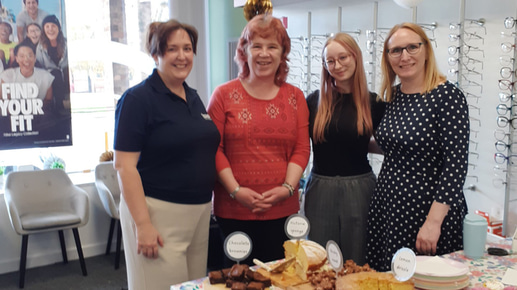
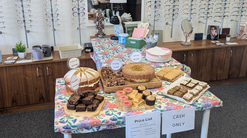

A representative from Insight Gloucestershire joined the coffee morning to speak with visitors about the services available amongst the cups of tea and slices of cake.
The event had a positive community benefit beyond the fundraising opportunity, as Eastwood reflected: “We had so many comments from people saying ‘Oh I wish we did this sort of thing more often. Isn’t it lovely to sit together and have a cup of tea?’”
Weygang Opticians has plans for a quiz night later in the year and for National Eye Health Week, the practice will host a charity raffle.
“Our spectacle and contact lens suppliers have donated so many gifts,” Eastwood said, adding that local businesses have also contributed to the raffle prizes.
Understanding the challenges of living with sight loss
Insight Gloucestershire provides practical advice, emotional support, and digital skills support and training through Community Sight Loss Hubs across Gloucestershire, alongside its resource centres in Stroud and Cheltenham.
The charity noted that this means 90% of people in Gloucestershire live within five miles of its face-to-face support.
Over the last 12 months, the charity delivered 1158 one-to-one sessions while 214 people attended 901 social events.
Currently, 1646 people are registered for Insight Gloucestershire’s services with 177 new registrations during the past year.
Ian Daniels, relationship fundraiser for Insight Gloucestershire, said: “A diagnosis of sight loss can be life-changing and patients may not always know where to turn for support beyond their clinical care.”
One of the most valuable ways practices can work with the charity is to make patients aware of the services, he said, sharing: “Our role complements the work of optical and healthcare professionals.”
“By signposting patients to us, practices can help ensure that people have access to local support from a charity that understands the challenges of living with sight loss,” Daniels said.
Practices can display information leaflets and posters, share the charity details with patients, or invite the team into practice to provide a sight-loss awareness session for staff.
Fundraising for Insight Gloucestershire can make a “significant difference” for the charity, however, these activities can have a much wider impact, Daniels suggested.
He explained: “When a practice chooses to support Insight Gloucestershire, it helps raise awareness of sight loss among staff, patients, and the wider community. It can also help us reach people who may not yet know that support is available to them.”
He added: “We would welcome the opportunity to build relationships with individual practices and explore ways we can work together locally.”
When a practice chooses to support Insight Gloucestershire, it helps raise awareness of sight loss among staff, patients, and the wider community
Building a strong relationship with sight loss services
The teams at Huxter & Davy Opticians set themselves a mammoth charity challenge for 2027 – to run, walk, or cycle 10,000km throughout the year to raise funds for Devon in Sight and iSight Cornwall.
Tom Mannering, dispensing optician and manager of the Kingsbridge practice, told OT: “There are an estimated 10,000 people living with sight loss in just Devon and Cornwall. We decided we wanted to complete a kilometre for every person living with sight loss.”
Explaining why the practice decided to embark on the challenge, Mannering said: “I’ve been working here for a couple of years now and I think we’ve looked after the local community really well. They keep coming back to us and so we thought it was a good idea to give back to the local community.”
Devon in Sight and iSight Cornwall both run low vision services in the respective counties, and the year-long fundraiser has built a stronger connection with these services.
Mannering said: “Previously we didn’t have a strong relationship with the low vision clinics – of course we referred people there, but we wouldn’t know who we were referring to particularly, just the entity. We knew what they did, but maybe not in as much detail as we know now.”
He continued that the stronger ties to the charities has been beneficial to the practice and local community, sharing: “If we need to refer someone, we can say: ‘Oh you’ll see Mandy. She’s really lovely and will look after you really well.’ That’s a nice way of doing things and I think everyone benefits.”
A marathon challenge
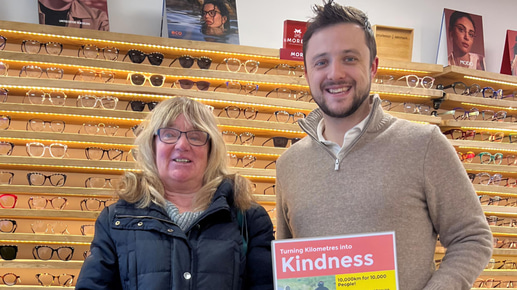
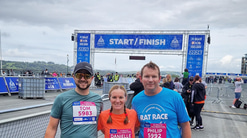
The practice displays posters for the two low vision services and shares information on social media.
At the time of interview in late August, the practice has passed the midway mark of its fundraising challenge, crossing 6000km of movement and raising more than £1300 across the two charities.
This has included fundraising projects, donations from companies, and through taking donations for minor repairs – for which the practice does not normally charge.
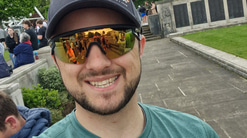
Mannering said: “I’ve been out for long bike rides doing 70 or 80km at a time. The optometrist does loads of running so does 10-20km at a time. So we’re doing big chunks here and there.”
The pair ran the Plymouth Half Marathon in May as part of their fundraising efforts and plan to run the Plymouth Harbour Half in November.
“The others in practice are tracking their dog walks or getting out a bit more than they would do otherwise. It’s nice to know that when we are out and about we are doing it all for a good cause.”
Confidence in making referrals
Part of the Cornish community since 1856, iSight Cornwall supports blind and partially sighted people of all ages across Cornwall and the Isles of Scilly. The charity supported more than 3600 people in the last 12 months, received 2735 referrals and delivered more than 6000 individual service actions.
The charity has a main base in Truro, but with it being a large and rural county, support is provided through outreach sessions, local drop-ins and home visits.
The low vision team offers tailored advice and solutions on everyday tasks, while the organisation also provides low vision assessments, services include welfare and benefits advice, emotional support, and help with employment and Access to Work.
An Eye Care Liaison Officer service is delivered in partnership with the Royal Cornwall Hospital eye clinic.
Carole Theobald, chief executive of iSight Cornwall, said: “During the year, more than 1000 people received low vision support, over 800 were supported through our Eye Care Liaison Officer service, and more than 200 regularly attended our clubs and groups.”
“The important point is that we do not just offer one service. A referral opens the door to a whole range of support, which can be shaped around the individual and can change as their needs change,” Theobald added.
Asked how practices can best engage with the organisation, Theobald said: “The simplest and most valuable thing a practice can do is to make sure its whole team knows about its local sight loss charity and feels confident referring patients to it.”
“In Cornwall, we are fortunate to have excellent relationships with opticians and the Local Optical Committee. iSight Cornwall is embedded within the Cornwall eye care pathways and referrals can be made quickly and easily through our website,” she added.
A referral opens the door to a whole range of support, which can be shaped around the individual and can change as their needs change
Optometrists play a vital role in signposting patients to support, and local charities can work alongside clinical services to provide practical and emotional support.
Theobald said: “We can help people understand what support is available, explore equipment and technology, access welfare advice, remain connected to their community and build confidence in carrying out everyday tasks.”
“The best partnerships are ongoing ones, where the practice and charity know each other and staff understand what happens after they make a referral,” Theobald emphasised.
“Early signposting is particularly important. People do not have to wait until they reach a crisis or until their sight deteriorates further. Connecting someone to support at the right time can help reduce confusion and fear after diagnosis, prevent isolation, improve safety at home, maintain independence and make it easier for the person and their family to adjust,” she added.
Referrals are straightforward but have a significant impact, Theobald emphasised: “It lets the patient know that they have not simply reached the end of a clinical pathway. There is a world of practical help, advice and human connection available to them locally.”
Importantly, practices don’t need to wait until someone is registered as sight impaired to make a referral, Strick said, noting that referrals can be helpful whenever a patient is finding that changes in their vision are affecting daily life.
The best partnerships are ongoing ones, where the practice and charity know each other and staff understand what happens after they make a referral
To support the charity, practices can display information, invite the charity in to speak with the team, join awareness-raising activities, and participate in local fundraising.
Theobald said: “It helps with practices talk about the charity as a normal extension of the support available, rather than as somewhere people go only when all clinical options have been exhausted.”
Support from local practices is significant for charities like iSight Cornwall.
“Some of our NHS services receive NHS funding, but this accounts for only around 20% of our overall costs. For the remainder, we rely on donations and the generosity of our local community,” Theobald explained.
The support can also increase awareness amongst the wider community, she said: “When a trusted local optician supports iSight Cornwall, it introduces the charity to patients and families who may not yet know that help is available. It starts conversations about sight loss, challenges the idea that people simply have to cope alone and reinforces the link between eye care and wider wellbeing.”
Theobald concluded: “Huxter & Davy’s support is a lovely example of a local practice recognising that it can make a difference beyond the consulting room.”
Practices can help ensure patients and their families have the practical and emotional support they need to adapt to life with sight loss
Helping patients adapt to life with sight loss
In Devon, around one in 24 people are living with sight loss that affects their daily lives, explained Mandy Darling, community engagement and fundraising officer for Devon in Sight.
The charity runs a Sight Loss Helpdesk, one-to-one counselling, Home Assistive Technology Service and befriending.
The organisation supports more than 1200 active clients across Devon and holds events across the county tailored to address localised challenges, such as social isolation within rural communities.
Darling said: “Signposting clients to Devon in Sight’s services is the key way practices can engage with us. This includes directly mentioning our services to clients who may benefit from them and keeping information and our In-Vision magazine visible in practice so people know support is available when sight loss comes up.”
Optometrists are vital as the first point of contact for patients receiving a sight loss diagnosis, Darling said, sharing: “By signposting to our services, practices can help ensure patients and their families have the practical and emotional support they need to adapt to life with sight loss, alongside the excellent clinical care you already provide.”
Practices can support the charity directly with a countertop collection pot, offering card payment donations, volunteering time or skills, or naming the Devon in Sight as their charity for the year.
“We’re particularly keen for practices to help promote our new Eyes on the Jackpot lottery as a fun way for clients and colleagues to get involved,” she said.
Devon in Sight receives no Government funding, Darling explained: “With running costs of more than £300,000 a year making fundraising support from local practices essential to keeping our service provision running.”
All money raised adds up, she emphasised and makes a difference in helping local people “live with sight loss with confidence and independence.”


Comments (0)
You must be logged in to join the discussion. Log in