


17 September 2026
More than 120 eye care professionals and researchers gathered in Cardiff this week for presentations on a diverse range of research within optometry, ophthalmology and vision science at the British Congress of Optometry and Vision Science (14–15 September, Cardiff University). Here OT presents a selection of insights from the event.
1 A more accurate way of predicting myopia risk
Optometrist and Cardiff University postgraduate researcher, Hannah Noor, outlined her research exploring how combining information about parental myopia and genetic risk can improve modelling. Noor highlighted that parental myopia is a well-established predictor of myopia risk.
“We know that children with one or two myopic parents are consistently at a greater risk of developing myopia,” she said.
She added that historically parental myopia has been considered a proxy for inherited susceptibility.
“We are now able to measure genetic susceptibility more directly through a polygenic risk score,” Noor said.
Explaining how polygenic risk scores are calculated, Noor shared that genome-wide association studies compare genetic variation across large numbers of individuals to identify which variants are associated with a particular trait. These variants are then weighted before being combined to give a single polygenic risk score.
“Put very simply, it places an individual along a continuum from high to low inherited genetic susceptibility,” Noor said.

Noor observed that because genetic susceptibility can now be measured directly, it raises the question of whether parental myopia status provides any additional information. Noor’s research project, which is funded by the College of Optometrists, addresses this question.
Sharing key takeaways from her research, Noor highlighted that while a polygenic risk score is more comprehensive, parental myopia status can provide useful additional information.
“Combining the two predictors provides the most informative assessment,” she said.
“I think it’s important to emphasise at this stage that the absolute performance of the two predictors still remained modest,” Noor observed.
2 A statistical snapshot of hydroxychloroquine use in Wales
Optometrist and PhD researcher, Turki Almaslokh, presented his research exploring the demographic, socioeconomic and clinical characteristics of hydroxychloroquine users in Wales.
The research analysed two retrospective studies incorporating population-level data, including the Secure Anonymised Information Linkage (SAIL) Databank.
Almaslokh shared that the average age for starting hydroxychloroquine in Wales was 56, with most patients aged between 40 and 70.
The majority of hydroxychloroquine users in Wales were either overweight or obese. More hydroxychloroquine users in Wales are female than male.
Almaslokh shared that most hydroxychloroquine users are located in Cardiff, with hydroxychloroquine use associated with living in areas of higher deprivation.
He added that the main indication for hydroxychloroquine treatment is rheumatoid arthritis, followed by other connective tissue diseases.
“When we look at the clinical background of hydroxychloroquine users in Wales, there is a high burden of systemic comorbidities,” Almaslokh said.

He shared that while the prevalence of hydroxychloroquine retinopathy is less than 1%, around half of hydroxychloroquine users in Wales have an eye condition.
“Although these eye conditions are not caused by hydroxychloroquine, they can be significant in terms of monitoring,” Almaslokh observed.
“For example, cataract can affect the quality of imaging, while pre-existing retinal pathology, such as diabetic retinopathy, has the potential to mimic or mask early changes caused by hydroxychloroquine,” he explained.
He emphasised the need for a multidisciplinary approach to hydroxychloroquine monitoring.
“Our findings support a proportionate, risk-based monitoring pathway in deprived and geographically clustered areas,” Almaslokh said.
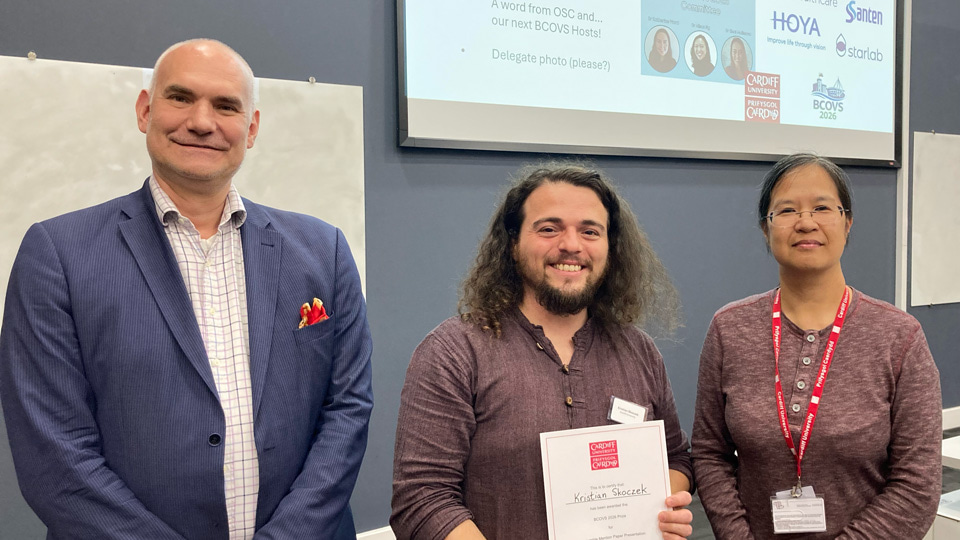
BCOVS 2026 in pictures


3 Could glaucoma be monitored in care homes?
City St George’s University of London vision scientist, Dr Peter Jones, outlined a project exploring the potential for glaucoma monitoring in care homes.
As background, Jones shared that around 250,000 people in the UK live in care homes – with this figure predicted to double by 2050.
“According to prevalence statistics, we can say that around one in 10 of these people will have glaucoma and all of these people will need regular glaucoma monitoring,” he said.
Jones highlighted that a hospital-based monitoring service has challenges for this group of patients.
“It's not good for the residents who often become extremely agitated and upset by it, and can remain so for hours or days afterwards. It's not good for the hospitals because about a quarter of these residents don't turn up, and half of those that do turn up aren't able to comply with all the assessments,” he explained.
Additionally, Jones observed that a hospital-based monitoring service creates an additional administrative burden for care homes, while each appointment costs the NHS around £250.
A research project led by domiciliary and research optometrist, Shreena Patel, is exploring whether it is feasible to provide glaucoma monitoring in a care home setting.

Jones shared that the first phase of the three-year project is investigating how portable diagnostic equipment could be used to conduct glaucoma monitoring.
A group of 60 study participants came to City St George’s University of London to have a series of tests – including fundus imaging, telemetry, visual fields and optical coherence tomography scans – carried out while they were lying in bed.
They then had the same assessments performed in an eye clinic using gold standard equipment.
Jones shared that there was reasonable correlation between data gathered with the two sets of tests, although the images gathered using portable equipment had a lower level of clarity when compared to gold standard imaging equipment.
The vast majority of study participants were able to complete the tests using portable equipment, and it took a similar amount of time to the tests performed in an eye clinic.
He shared with delegates that the next steps for the project is to take the portable equipment into care homes and test it in this environment.
4 The next generation of myopia control spectacle lens
Hoya myopia consultant, Charlotte Bell, outlined the latest research on the Defocus Incorporated Multiple Segments spectacle lens with Triple Enhanced Design (DIMS TED).
Bell shared that within myopia management, even interventions with proven efficacy will have a variable effect between individuals.
“For some children, the current levels of control that we have available to us may not be sufficient, and this really highlights the need for more advanced and higher efficacy solutions to support those patients,” she highlighted.
Bell shared that the DIMS TED lens, which launched in the UK in July, focuses on enhancing myopia control by altering three aspects of the lens design.
The lens features extended treatment coverage and an increased defocus power.
“Finally, we've brought those defocus segments closer into the centre of the lens, in order to consistently stimulate the near peripheral retina,” Bell explained.
An initial study involving 45 children looked at changes in choroidal thickness when wearing the DIMS TED lens.
“Various studies have shown that changes in choroidal thickness may serve as a biomarker that is associated with myopia control,” Bell highlighted.

She added that increases in choroidal thickness wearing the DIMS TED lens in the first two weeks were comparable to increases in choroidal thickness gained in the first three months of wearing the previous generation of lens.
“That gives you an indication of the increased effectiveness of the DIMS TED technology,” Bell shared.
A randomised controlled trial conducted in Hong Kong involved 202 children between the ages of four and 12.
Bell shared that the trial found no myopia progression on average in the first 12 months of wear and minimal axial elongation over the same time period.
“DIMS TED is the first spectacle lens with reported clinical evidence for effective control of myopia progression from the age of four years as a monotherapy for Hoya,” she said.

In conversation with Dr Natalia Vlasak about the Miyosmart iQ spectacle lens
Vlasak spoke with OT about the research supporting a pioneering spectacle lens for myopia control
5 Domiciliary practitioners on the challenges and opportunities in the sector
Optometrist and University of Bradford lecturer, Sophie Coverdale, outlined her research exploring practitioner perspectives on the challenges and opportunities within UK domiciliary eye care.
Coverdale shared with delegates that the number of domiciliary sight tests performed in the UK increased by 58% between 2005 and 2020.
This is a sharper increase than the rise in the total number of General Ophthalmic Services sight tests – which increased by 32% over the same period.
Coverdale shared that the ageing population is contributing to the increase in domiciliary sight tests in the UK.
“There’s an increasing demand for services. My question was, are domiciliary services currently working in the UK?” the optometrist shared.
Coverdale arranged a series of focus group discussions with 29 optometrists and six dispensing opticians with experience providing domiciliary eye care.
One of the themes identified through these discussions centred on systemic barriers in access to eye care.
“This really was about the inequity between access to services for those who can access a fixed practice premises, and those who can’t,” Coverdale highlighted.
She added that regulatory constraints – such as the Pre-Visit Notification (PVN) requirement in England – contribute to these inequalities.
“When you’re providing a domiciliary test in England, you have to give the local NHS area team at least 48 hours’ notice that you’re going to conduct that domiciliary test, which is often very different from a patient walking into a practice and receiving a sight test,” Coverdale said.
The lecturer shared that the PVN requirement creates an administrative burden for practitioners and has the potential to create delays for patients with acute symptoms to be seen in domiciliary settings.
Coverdale highlighted that another key theme that came through in the discussions was a lack of awareness of domiciliary eye care as a service.
“Patients may not be aware of what can be achieved through a domiciliary sight test. They are often quite surprised by how comprehensive the tests are,” she said.
“There was also a lack of awareness about how important eye care is in these populations,” Coverdale added.
Turning to workforce trends, Coverdale shared that there was a perception that university courses are placing less emphasis on direct ophthalmoscopy, which can make it harder for practitioners to adapt to working in a domiciliary environment.
Focus group discussions also highlighted challenges in recruiting domiciliary optometrists with trainee optometrists receiving limited exposure to domiciliary work during their education.
Coverdale also shared that issues of professional recognition were raised during discussions.
“Some practitioners did seem to think that they weren’t valued as other practitioners were. There was a perception that domiciliary was often seen as a less professional test or a less thorough test,” she said.
Another issue identified through discussions was a lack of domiciliary-specific continuing professional development.
Coverdale shared that the focus groups also discussed the personal rewards and challenges of working within the sector.
Challenges that came up through discussions included the physical demands of the job, communication difficulties and the high mileage that is undertaken in the role.
“Some people say they love working alone, but it can also be quite isolating,” Coverdale said.
However, focus group participants also highlighted the rewards of the role.
“Many practitioners were really satisfied in their role. There was that sense of fulfilment that comes with making a tangible difference,” Coverdale highlighted.
“They recalled seeing the absolute relief in a patient’s face when they walked in,” she added.
6 Bridging eye care gaps in West Yorkshire
University of Bradford researcher, Baasimah Batool, outlined her research exploring the views of healthcare professionals and community leaders on how non-clinical settings could be utilised to bridge gaps in eye care provision.
She shared data showing socioeconomic differences between Bradford and York.
“York is a place that’s much more affluent, whereas Bradford – particularly the centre of Bradford – is unfortunately quite deprived,” Batool said.
“In recent years, there has been an increased focus on community engagement as a way to address some of these concerns,” she added.
The optometrist highlighted that community engagement initiatives in Bradford have centred on a range of topics – from mental health and nutrition to menopause.
“None of these projects related to the eyes – which was the inspiration for this research,” she said.
Through her research, Batool aimed to understand perceptions around the perceived value of attending sight tests and also explore attitudes towards providing eye care in non-clinical settings.
Batool carried out interviews with 30 healthcare professionals and 16 community leaders.
“This involved traveling up and down Bradford to different community settings, hospitals, practices, and places of worship,” she said.
From these interviews, Batool highlighted that one of the main barriers to meeting the needs of the local population is difficulties navigating the healthcare system.
“The change to online systems, long wait times, and referral processes was a huge barrier for people trying to access help,” she said.
“Even when people were trying to engage, there was a lot of friction there,” Batool shared.
Batool shared that the interviews outlined how logistical challenges often provided barriers to accessing care.
“People were struggling to come to appointments because they had other responsibilities,” she said.
The interviews revealed that optometry was seen as a lower priority than other public health interventions – such as trying to increase the uptake of cancer screening programmes and encouraging daily health and wellbeing habits.
“The evidence that people are not going for regular sight tests hasn’t reached the decision makers… Eye care is not part of the conversation,” Batool explained.
The researcher noted that the commercialisation of optometry was also seen as limiting the uptake of eye examinations.
“Optometrists were often perceived as focusing too much on sales,” Batool said.
Turning to the potential to offer eye care within non-clinical settings, Batool shared that interviewees believed that non-clinical settings could be used to promote eye health messages – although practical constraints provided a barrier to delivering eye care in these settings.
“The insights from this study are being combined to create an informative resource to address knowledge gaps and to provide people with the information to make informed decisions regarding their healthcare,” she concluded.
7 Reducing myopia progression in adults
Optometrist and postdoctoral researcher at Ulster University, Dr Jane Fulton, outlined research examining the use of myopia control spectacles in adults – known as the Stellest Wear in Adult Progressing Myopes (SWAP) trial.
Fulton noted that eye growth generally stabilises in a patient’s teenage years.
“The problem for some young adults is that this progression doesn’t stop in the late teens as we would expect,” she said.
The researcher added that risk factors for continued progression include parental myopia, higher education and lifestyle factors – such as time on digital devices.
Fulton shared that while there are a range of myopia control interventions available, there is limited evidence on whether these interventions work in adults with progressing myopia.

As part of the SWAP trial, researchers aimed to assess whether the Stellest lens was effective in reducing myopia progression among this cohort.
A group of 42 progressing myopes between the ages of 18 and 40 were recruited for the trial.
The two-year study involved participants wearing a Stellest lens in one eye and a single vision lens in the other eye for the first year, before switching the lenses over in the second year.
“Each eye is exposed to both the Stellest and single vision conditions over the course of the study,” Fulton explained.
The optometrist told delegates that data from the first six months of the trial revealed a small but statistically significant treatment effect from the Stellest lens, with a 0.03mm reduction in axial length progression.
“Although 0.03 over six months seems like a small amount of savings, potentially this could be 0.06 each year, which could add up over a number of years if somebody does continue to progress,” Fulton highlighted.
8 The role of optometrists in Vietnam – a country where the profession is only a decade old
Optometrist and University of Bradford PhD researcher, Hai-Yen Nguyen, delivered a presentation focused on the role of optometrists in delivering paediatric eye care in Vietnam.
Nguyen noted that studies have estimated around 40% of school children in Vietnam have refractive error.
She shared with delegates that Vietnam only began offering optometry training a decade ago.
“Optometry is a very young profession in Vietnam. The first cohort of 15 optometrists graduated in 2018,” she said.
Since 2018, the number of optometrists in Vietnam has grown to around 400.
Nguyen’s research involved interviewing 42 Vietnamese optometrists. Reflecting on themes identified through the research, Nguyen shared that most optometrists highlighted the increasing burden of refractive error within Vietnam.
“They said that for every 10 children who came for an eye exam, nine of them would have a refractive error issue,” she said.
Nguyen shared that practitioners reported a disparity between urban and rural areas when accessing eye care.
“In the urban areas it is easier for patients to access eye care, but in remote areas, especially mountainous areas, it is very difficult. Some patients need to travel up to five hours to get to an optometrist,” she said.

The optometrist added that variable quality in the eye care provided is also seen as an issue within Vietnam.
Nguyen shared that prescriptions provided by practitioners who are not qualified as optometrists have a high error rate.
“If optometry graduates could work in all optical shops, then the rate of incorrect prescriptions would be much lower,” she said.
Study participants reported limitations in their scope of practice with optometrists described as ‘general medical technicians’.
“They are unable to diagnose or treat a patient and should only perform medical technical work. The optometrist can prepare a prescription, but the patient must go to an ophthalmologist to sign the result,” Nguyen said.
Despite these challenges, Nguyen highlighted that optometrists are beginning to develop a professional identity within Vietnam.
“They believe in change and hope for change in the future,” she concluded.


Comments (0)
You must be logged in to join the discussion. Log in