


02 April 2026
The smart eyewear market in the UK is “early and emerging” according to Natasha Cazin, global insights manager for eyewear at Euromonitor International.
Growing visibility of this segment in the market has come from global brand launches and partnerships, Cazin told OT, sharing: “British consumers are interested but they’re still taking their time before fully jumping in.”
Uptake is being driven by growing demand for hands-free artificial intelligence (AI) support, help with everyday tasks, and eyewear that goes beyond vision correction, Cazin said.
She noted that the Euromonitor International Voice of the Consumer Lifestyle 2025 has indicated two-thirds of consumers now want simpler lives.
The analysts have identified an overall openness to wearable devices, from smart phones to smart rings, with Euromonitor International’s Consumer Health & Nutrition Survey 2025 finding three in four consumers track their health with a device or app.
“Brands and retailers are also leaning in, treating smart eyewear as the next big interface in how people interact with tech,” she said.
Brands and retailers are also leaning in, treating smart eyewear as the next big interface in how people interact with tech
Rapid acceleration
One of the major movers in this category has been EssilorLuxottica, with the introduction of Ray-Ban Meta and Oakley Meta.
Giona Riccetti, wearables director, North, at EssilorLuxottica, told OT: “The UK AI eyewear market is entering a rapid acceleration phase, driven primarily by growing consumer adoption of AI-assisted wearables and the momentum behind Ray-Ban Meta and Oakley Meta glasses.”
The category has been shifting from a “niche curiosity to a credible everyday tech accessory,” he said.
Last year saw Oakley Meta launch two new variants which extended the appeal of the eyewear to new consumers, such as performance driven athletes through deeper fitness integrations and a longer battery life.
The growth potential for the market is significant, Riccetti said, sharing: “As consumer awareness grows and practices begin confidently recommending the category, the UK is poised for rapid annual expansion.”
Lifestyle extension
Riccetti shared that, early in the consultation, eye care professionals should explore the patient’s lifestyle to ensure the best fit for AI eyewear, including their daily routine, such as commute, work patterns, and situations where their hands are frequently occupied.
Riccetti suggested practices discuss smart eyewear with patients as an “extension of lifestyle rather than a gadget, with an emphasis on everyday utility such as hands-free photos, messaging, and AI assistance, alongside safety and convenience benefits like navigation and communication without needing to look at a phone.”
Sports habits, in particular, can be an important motivator. For wearers who might be focused on sports and performance, functions such as live metrics, automatic workout capture, and audio coaching, will be particularly important.
Demonstration plays an important role in recommending this type of eyewear, allowing patients to try the fames on and experience the features first-hand. This gives the wearer an idea of how the technology could fit into their routines, Riccetti suggested.
EssilorLuxottica provides onboarding for practices introducing AI eyewear, typically including product functionality and differentiation, live demonstrations and fitting guidance, along with discussion of best practice for lifestyle focused conversations with patients.
In-practice merchandising and digital assets also play a role in supporting the introduction of the frames.
“Consideration should be given to social and creative uses, including photography, sharing moments, and travel,” Riccetti said, adding: “Comfort and usage preferences are key factors, such as battery life versus intended use and whether the patient prefers audio-only features or a combination of camera and AI functions.”
“AI eyewear is most successful when matched to the patient’s real-world needs,” Riccetti said.
AI eyewear is most successful when matched to the patient’s real-world needs
Sound in motion
Eyewear manufacturer, House of Modo, unveiled its new smart eyewear brand, EyeFly, at the 100% Optical and Mido trade shows this year.
Designed to provide “sound in motion,” the frames integrate directional open-ear audio with built-in microphones for hands-free connectivity.
The frame is designed with a modular temple system to allow for the smart audio temples to be swapped out, turning it back into a standard pair of spectacles. The frames are 40g, with no technology in the frame front.
Giovanni Lo Faro, CEO international, house of MODO, told OT: “The smart eyewear market is at a very interesting turning point. It is still young, but the demand for discreet, wearable audio and hands-free connectivity is growing fast. We see smart audio eyewear as the next major evolution of personal audio, and we believe this category is only at the beginning of its growth curve.”
Wearable technology has previously focused on screens and visual interfaces, he said, but is now shifting towards a more seamless way of staying connected. Lo Faro suggested: “Audio-first smart eyewear fits perfectly into this evolution because it integrates technology into an object people already wear every day, without changing their behaviour.”
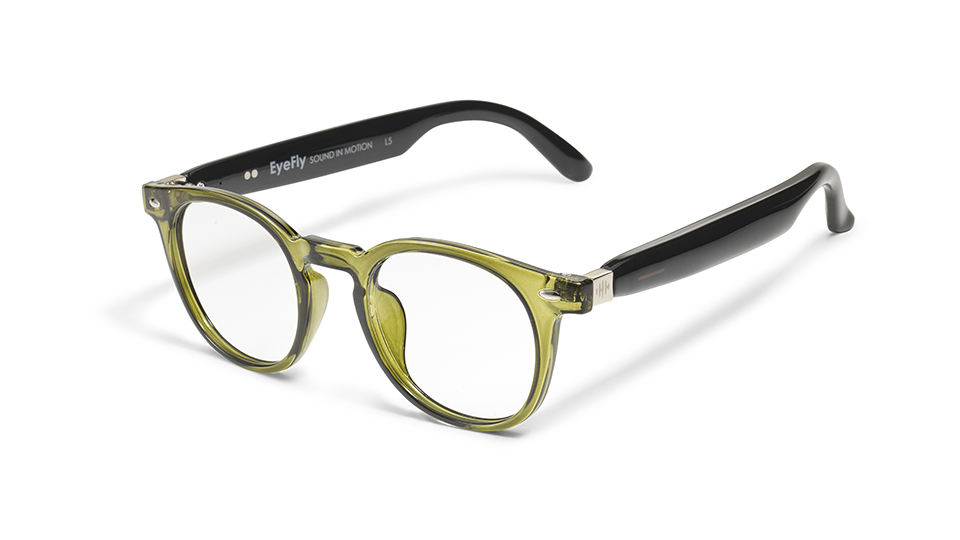
Audio-forward smart eyewear
The company has emphasised that EyeFly is audio-only, with no visual capture or recording capabilities.
Wearers can listen to music, take calls, follow navigation, or interact with artificial intelligence (AI) assistants without earbuds or screens.
Lo Faro explained that the decision to focus only on audio is down to a belief that “sound is the most natural and least intrusive way to integrate technology into everyday eyewear.”
He added that the EyeFly is “tech applied to eyewear, not vice versa.”
“Vision is already doing an important job through the lenses, so instead of adding screens or cameras that compete for attention, we decided to enhance what people can hear while allowing them to stay fully present in the world around them, without compromising social interaction,” he said.
As well as preserving visual clarity and comfort and supporting everyday needs, Lo Faro suggests this approach avoids the privacy and social concerns that have been a conversation around smart eyewear.
Practices should present smart eyewear as a natural evolution of everyday glasses
An evolution based on lifestyle
Practices will need to consider how they position themselves within this market, Lo Faro said, suggesting: “Practices should present smart eyewear as a natural evolution of everyday glasses.”
Recommending that practitioners start by identifying real use cases, he said: “The key is to start from the patient’s lifestyle rather than from the technology itself. The best way to present smart eyewear is as an upgrade to daily glasses: familiar, wearable, and genuinely useful – not futuristic, not complicated, and not intrusive.”
“It’s also important to position smart eyewear alongside premium optical frames, not in a separate “tech corner.” Patients should see it as a frame they would genuinely choose to wear, with the added benefit of audio connectivity,” Lo Faro said. He continued: “Let them try it on, feel the comfort, and experience the sound in a simple demo – one phone call or one song is usually enough to understand the value.”
Lo Faro emphasised the importance of staff training. He noted that teams should be able to explain the benefits in plain language, avoiding technical jargon.
House of Modo offers product training for practices in-person and through digital sessions focusing on explaining and demonstrating the EyeFly, how to position the product and match it with patient lifestyles.
The company also provides point-of-sale materials, demo guidelines, adn digital content, as well as commercial and after-sales support.
“We built EyeFly with interchangeable temples and modular components specifically to make service easier for optical practices,” Lo Faro said, adding that structured support is available for troubleshooting, updates, and replacements, “so practices feel protected and not exposed to tech complexity.”
Inside the practice: Smart eyewear at Eyesite practices
Jim Green, managing director of Eyesite practices, part of Hakim Group, shared how the practice introduced smart eyewear and the response from patients.
Green shared: “This is a brand-new category and it is very interesting because it brings to life everything about eyewear and technology.”
He told OT that the decision to bring smart eyewear into the product offering was driven both by the new category growth and the ability to draw in new patients who might not be the practice’s current core demographic.
In introducing the new category to practice, the team has focused on turning the frames into prescription eyewear.
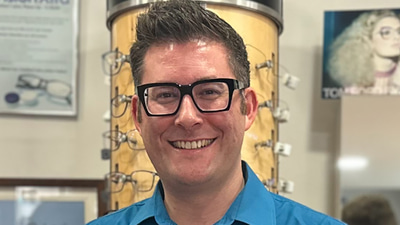
The team has found almost an 80% uptake of the frames with Transitions lenses, and a surprising number of patients purchasing the frames as a second pair.
When people think of smart eyewear, they often see it mostly in relation to its applications for social media. However, Green has found that the hands-free use of artificial intelligence and voice controls can be “life-changing” as a tool for wearers – and is often where the ‘penny drop’ moment comes for patients considering making the purchase.
Sharing an example, he said: “Stuart is one of our Guide Dogs for the Blind representatives. His lovely guide dog will be retiring soon and he has been looking for other ways in which he can live his independent life. We gave him a pair of Ray-Ban Meta to try and he is going to keep them because he loves them so much. Stuart can ask Meta to summarise the items on a menu, for example, or can use it to navigate around a hotel to find his room number.”
The practice also works with elite motorcycle racer, Brad Ray, providing sports eyewear. For Ray, the benefits of the eyewear centre around training and preparation – recording his training and providing live updates on heart rate, for example. While he does not wear these frames for racing, he can walk the track beforehand, share this with his team, and work the information into his preparation.
I think if we’re not evolving and stepping forwards, then we run the risk of being left behind
Patients have also found the eyewear beneficial vocationally. A mechanic specialising in German vehicles can record hands-free and in-real time with the manufacturer to inform diagnostic support.
Green shared: “We’ve seen the rate of change within the mobile phone sector. Only a couple of decades ago we were still on dial-up. Now we have more technology in our phone than we had to send the man to the moon. I think if we’re not evolving and stepping forwards, then we run the risk of being left behind. As a sector, we have to embrace this and the challenges that come with it, in order to stay relevant to our patients and the High Street.”


Comments (0)
You must be logged in to join the discussion. Log in