

18 September 2026
In sixth form, I arranged a medical placement. By that point, I already knew that I wanted to study optometry, however, I deliberately arranged work experience in a GP practice because I wanted to understand the wider systemic aspects of eye health. The GP placement allowed me to review blood results and detailed medical histories to understand how systemic conditions can manifest in the eyes.
One particularly memorable patient had very low ferritin levels. Iron deficiency can sometimes cause an artificially elevated HbA1c result, so the result needed to be interpreted cautiously and reassessed after the iron deficiency had been treated. However, ocular examination with an ophthalmoscope identified retinal changes consistent with diabetic retinopathy. This demonstrated that blood results should not be considered in isolation and showed me how ocular findings can provide important evidence of underlying systemic disease. This pivotal moment proved to me that the eyes are windows to systemic health and inspired me to pursue optometry to diagnose critical conditions like diabetic retinopathy early.
This remains one of my strongest interests at university – systemic disease is my favourite subject alongside optics. In second year I loved the virtual patient scenarios as they mimic real-life consultations. I really love dispensing as it tailors the eye exam findings and what we can do to improve vision. I really look forward to third year and seeing real patients.
Three years post qualification, I want to be a clinically confident optometrist who patients trust.
I want to undertake post-graduate qualifications – whether that is a more advanced degree relating to optometry, another degree in the medical field, or certifications.
I am leaning into delving into more clinical aspects like pathology, research, or legal areas surrounding optometry and the Opticians Act 1989.
If I could, I would keep the Brock String in my personal equipment kit. Having had the opportunity to work as an optical assistant and interact with children, I see that other diplopia tests can make them quite nervous.
If I had the Brock String, we would be able to play with the beads to establish rapport, then I would be able to use it for assessing binocular vision.
I maintain balance by planning on Google Calendar.
I study in focused two-hour blocks using the Flora productivity app to track the time. During my one-hour breaks, I completely disconnect with work or academia and simply relax or enjoy one of my hobbies.
I like to practice kata, a form of mixed martial arts, as well as creating sketches of fashion designs or painting and illustrating – I created an illustration of interference theory.
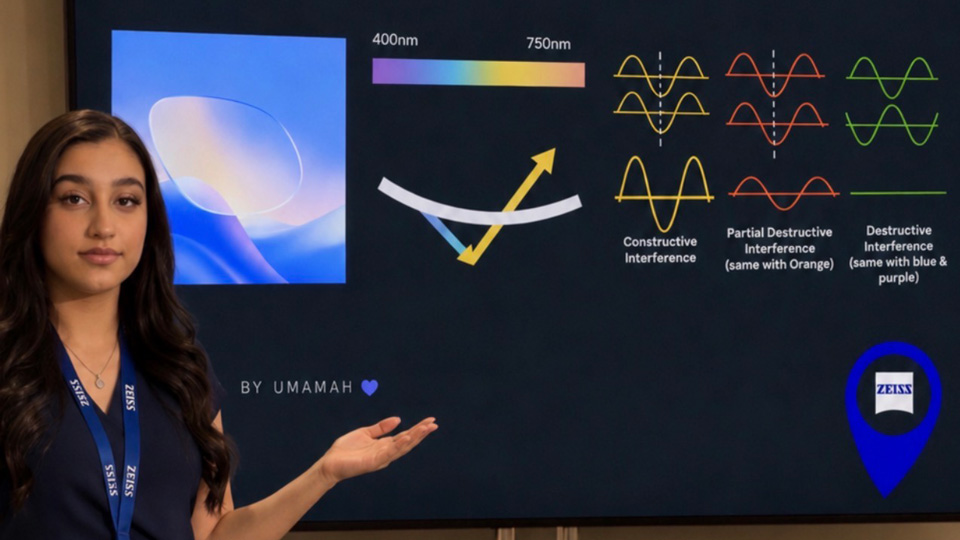
My three must-haves for studying...
- Notability on my iPad. All my notes are on Notability so I can create artificial intelligence-powered quick multiple choice questions for retention and get explanations for complicated terms – it gives me a single workspace without distraction
- Headphones. I prefer to study in silence, but you never know when it may get noisy, so I carry my Beats headphones. I listen to green noise with includes natural sounds like rain tapping against the window, ocean waves or leaves rustling, and which allows me to keep focus
- Coloured ballpoint pens and notebooks. I prefer to answer questions in my designated exam questions notebooks for each subject. I make improvements and correct answers in different colours so I can visualise my strengths, weaknesses and areas for improvement by colour code. I keep my iPad in front of me while I’m answering questions in case I need to refer back to my notes.
About the author

Umamah Shazad 
Optometry student
Umamah Shazad is a third year optometry student at Aston University and is an AOP student representative.


Comments (0)
You must be logged in to join the discussion. Log in