


11 April 2026
I was introduced to optometry at a very young age by my dad, who always took me to eye camps in the rural parts of Kenya, which introduced me to the field.
My love for both biology and physics combined led me to research career paths that would complement my passions, and optometry aligned with them.
My sister has been my biggest inspiration, and I followed her footsteps to become an optometrist. I go to her for all advice. She was thrilled and fully supported my decision and gave me very useful advice based on her personal experience in the field. It was through her shared experiences that I was drawn into the career.
Having a cataract in my eye affected my night driving a lot. Once the optometrist explained that it was congenital, I was calmer and less confused, as I was convinced it was a larger issue. I wanted to be that calming voice for my patients, but looking for a profession that can impact people’s lives was my goal. It is bizarre how such a small organ like the eye can influence your quality of life so much.
I have had placements at ASDA and Specsavers, arranged through university
Not only did I get to see how the two vary in terms of patients, but how the uniformity and standards of testing remain the same. The Specsavers practice had emergency appointments and an independent prescriber, so there was a lot more pathology there. It made me realise that IP would be interesting to do.
I also independently arranged to be an ophthalmic assistant at a well-known eye hospital in Kenya, Dr Agarwals. I secured this placement by emailing a lot of providers – I had a spreadsheet – and was fortunate to hear back from Dr Agarwals. There, I got to observe and help prepare for different surgeries, as well as assist with patient aftercare. Through this role, I realised that there is a hospital side of optometry as well.
Working as an optical assistant has given me insights into different types of patients and ways to deal with them; it is interesting to be on the other side of the testing room. When carrying out pre-testing, I find myself intrigued by the fundus photos, and try carrying out my own differential diagnosis. When looking at visual field tests being done, I find myself trying to find the visual field defects based on the points missed. Because I have worn glasses for almost a decade, I love seeing people put in so much thought into the dispensing side of optometry and pick out glasses. They are a permanent accessory.
My advice for other students would be to apply to as many places as you can.
Don’t lose hope if you don’t hear back from one place, because you are going to hear back from another and it will all work out. Get as much experience as you can through placements because once you qualify it’s hard to get such an opportunity. When you get experience early on, it helps you with basic skills like communication or how you deal with different types of patients.
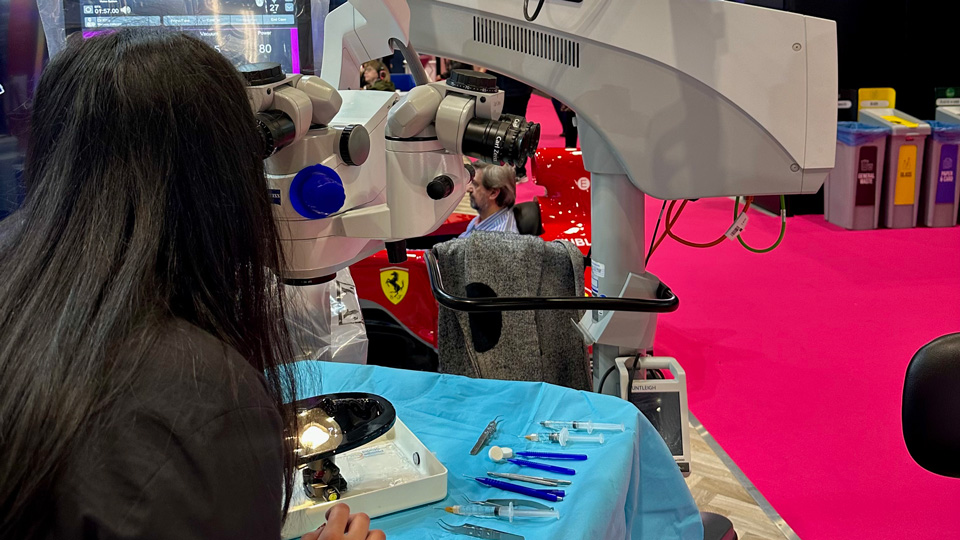
I look forward to completing my Clinical Learning in Practice placement and becoming a fully qualified optometrist.
Independent prescribing is an area of interest I am really looking forward to getting. However, I am taking it one step at a time and would love to continue being involved in optometry committees such as AOP and BCLA. My major professional goal is to expand my network and become more involved in optometry as a whole. I look forward to seeing both the hospital and commercial side of optometry.
It might sound a little far-fetched, but I would love to become IP qualified and hopefully an ophthalmic manager or director. I’ve always liked business – it was one of the fields I was considering – and I love that optometry gives me the opportunity to balance both of them.
I love my Volk lens.
When at placement, the optometrist I was shadowing described it as “a fancy magnifying lens” when explaining it to a kid; that has stuck with me. I love how such a small piece of equipment can give me such an in-depth and beautiful view of the back of the eye.
I allocate an hour a day to just myself, and I can choose what I want to do in that one hour.
This could be going for a walk in the park (when it’s not raining, because it’s Cardiff) or to the gym. It is important to set reasonable goals, for example, I can’t schedule an intense study session after having been at work all day, so that’s when I choose to unwind by spending time with my friends. That way, there’s a balance.
My three must-haves for studying...
- Anki cards are a lifesaver. I have found it so much more useful as I have learnt how to use it in the most beneficial way, especially for topics such as pathology
- Whiteboard and marker go a long way. Active recall is the best way to make things stick in your head. I can use it for reminders or something to scribble quick notes on. I even use it to summarise steps and can write over it again and again until the information sticks. It is a lifesaver during exam season
- I like making handwritten notes, and with my iPad that is possible. It is really helpful because it is easier to store unlike hardcopy notes. They are accessible anywhere.

More A to optometry
-
 “It’s rewarding knowing that I’m part of something that aims to make a difference for students in the profession”
 -
 “From the moment I stepped into the role and met the optometrist, I thought: ‘I’m going to do that job one day’”
 -
 “The main reason I wanted to become an optometrist was to make a direct difference in people's lives”
 -
 “Everyone encouraged me to study optometry”
Comments (0)
You must be logged in to join the discussion. Log in