


06 June 2025
Dr Adrian Jones has spent the day observing shoulders drop.
He has seen the change in body language among patients who have been waiting for two years to be told whether or not they require treatment for glaucoma.
“You see the relief in people’s faces,” the optometrist and director of Jones & Jones Optometrists told OT.
As part of an initiative that is designed to cut waiting times for treatment, Jones and other primary care optometrists are seeing glaucoma patients in practice who have faced delays to be seen through the hospital.
He is acutely aware that among patients who require treatment, waiting to be seen within the hospital system could result in a loss of vision.
“You are either telling people they don’t have to worry any more or that we can manage this,” Jones said.
On the afternoon OT speaks with Jones, his diary has been filled with a steady procession of the different ways that the delicate structures of the eye can go wrong: glaucoma, diabetic retinopathy, uveitis, keratitis and conjunctivitis.
What is less common in his diary these days is a routine that is performed by optometrists up and down the country, day in, day out.
“I think I’ve only performed two refractions today,” he shared.
In 2009, Jones was one of the first 30 optometrists in the UK to train in independent prescribing (IP) through a course at City, University of London (now City St Georges).
When this first cohort of IP optometrists qualified, they returned to practice in different areas of the UK with a new skillset that had outpaced the development of clinical management guidelines.
“It was quite daunting in a way,” Jones shared.
“There weren’t very many of us and we were spread out geographically, so getting peer support could be a challenge,” he said.
From the outset, Jones was able to prescribe medication to patients as part of his role within a hospital setting.
“Out in the community that was different because we weren’t allowed FP10 pads, so patients would have to pay for their prescriptions,” he said.
He described gaining the IP qualification as the beginning rather than the end of his education journey.
“When you start building your knowledge and using the qualification, that’s when it gets really interesting,” he said.
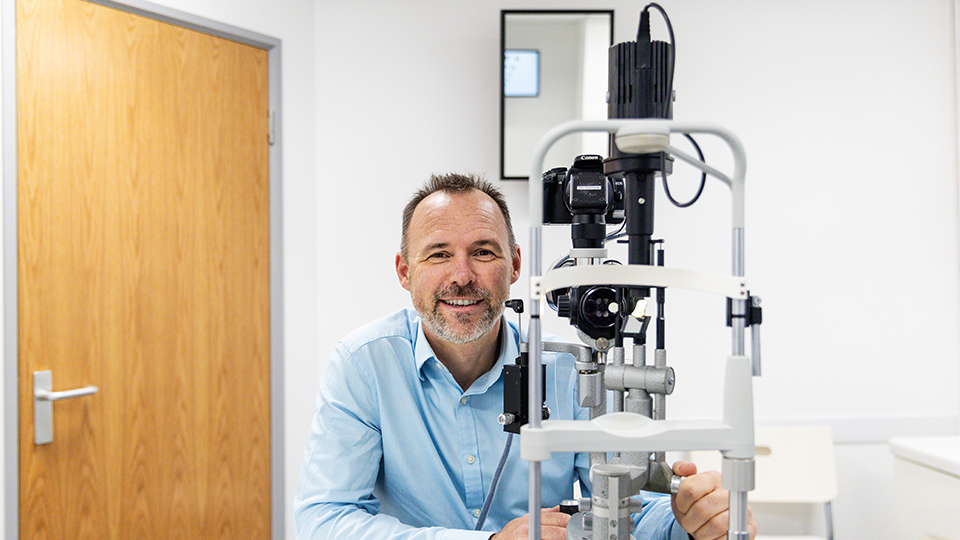
Prior to obtaining his IP qualification, Jones gained a doctorate that focused on new diagnostic procedures for glaucoma followed by a College of Optometrists diploma in glaucoma. He has been running a glaucoma clinic in practice on a private basis since Jones & Jones Optometrists opened its doors in 2006.
Jones shared that as well as making his day more varied, having additional qualifications improves the care that he is able to provide his patients.
“Patients can walk up to their IP optometrist and get the treatment they need without having to traipse across the city and sit in a waiting room for hours,” he said.
During the pandemic, Jones was one of four IP optometrists in Cardiff who helped to ease the burden on secondary care by seeing acute eye problems in the community.
Working alone at his Barry practice, Jones saw a steady stream of patients with uveitis, keratitis and the occasional foreign body from DIY or gardening.
“It started with one or two patients a day. Then, by the end of summer 2020, I was seeing a full clinic,” he said.
Jones shared that revisions to the Welsh optometry contract have helped to make the provision of clinical care by optometrists more financially sustainable.
“Financially, it’s much better for us. It takes that pressure off you to sell glasses all time,” he said.
Jones highlighted that the contract provides acknowledgement of the extended clinical services that optometrists are able to offer in the community.
“They recognise that optometry can provide these services. But they also recognise that we run businesses and we have mortgages, and so we need to get paid to do it,” Jones said.
When you start building your knowledge and using the qualification, that's when it gets really interesting
Extended glaucoma services in Fife
David Cummins is an IP optometrist and a partner of PLM Optometrists, which has five practices across Fife.
Cummins told OT that further qualifications have enabled him to provide convenient care to patients, while also enhancing his professional satisfaction.
“If your mind is switching between different things all the time, you don’t get bored,” he shared.
“Doing something new is invigorating. It adds a new dimension to your practice,” Cummins emphasised.
During the pandemic, Queen Margaret Hospital in Fife performed an audit of its glaucoma database – stratifying patients by risk.
Consequently, more than half of patients were transferred into the care of optometry practices. The lowest risk patients were transferred into practices with a General Ophthalmic Services contract, while higher risk patients were cared for by named community optometrists with glaucoma care accreditation.
Through this scheme, Cummins has around 200 glaucoma patients on his practice database – the case load is a mix of the original patients who were transferred to him during the pandemic, and new patients who have since been discharged from the hospital eye service.
He works closely with consultant ophthalmologists when deciding the best management approach for patients.
“Instead of me working in a room at the hospital with a consultant at the end of the corridor, I’m working in my practice, and the consultant is available online,” Cummins shared.
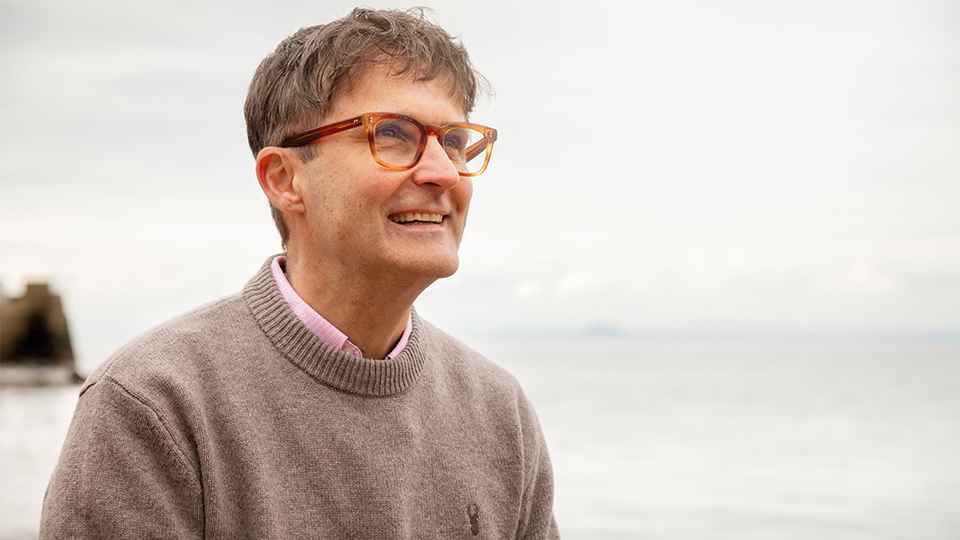
The Fife Community Ophthalmology Service sees IP optometrists from 10 practices across the county serve the acute eye care needs of its 370,000 residents.
Cummins shared that patients are able to be seen in a convenient location and relaxed setting.
“It’s probably not as daunting as it is to go to hospital,” he said.
“It works incredibly well, and the patients love it,” Cummins highlighted.
Cummins mostly sees keratoconus patients through his specialist contact lens service. He has also fitted bandage contact lenses for patients with intractable pain, tinted lenses for those with extreme photophobia and cosmetic contact lenses following disease or injury.
“What is most enjoyable about it is the impact that you can have on someone’s life,” he said.
“The difference that these lenses can make for patients is immense,” Cummins emphasised.
Cummins, who qualified with IP in 2012, told OT that the course caused him to reflect on his experiences in the two decades he had been qualified.
He gained an understanding of the fundamental principles of safe prescribing and the influence of systemic disease.
“A lot of pennies dropped. You appreciate the broader picture,” he shared.
After qualifying in IP, Cummins completed his Master’s in primary care ophthalmology through the University of Edinburgh.
He balanced part-time study alongside a full-time job and other additional roles – including as a College of Optometrists assessor and post-graduate optometry tutor.
“I don’t know how I ever saw my wife,” he said.
Cummins shared that he felt “incredibly lucky” to be able to offer specialist services on behalf of the NHS.
He acknowledged that as a practice owner, he is able to shape his own scope of practice.
“However, funding is always an issue, and I worry about the sustainability of specialist services which struggle to complete with core optometry workload,” Cummins emphasised.
Doing something new is invigorating. It adds a new dimension to your practice
Learning following qualification
Amir Afzal is an IP optometrist for Optical Express and teaches undergraduate students at Aston University.
Within months of completing his pre-registration period in 2014, Afzal embarked on a diabetic screening and imaging qualification.
“I saw qualifying as the start of my journey,” he said.
“I still had that hunger and desire to learn more,” Afzal highlighted.
In his role for Optical Express, he regularly uses IP in his management of post-surgery patients.
Before he studied IP, Afzal would regularly contact ophthalmologists in order to prescribe medication.
“Since gaining the qualification, I’ve independently made those decisions,” Afzal shared.
Afzal is currently completing a Master’s module in leadership through Cardiff University, after receiving sponsorship through the Local Optical Committee Support Unit.
He told OT that while leadership has always interested him, this skillset fell into the background during university and his early career.
“I wanted to tap back into that and develop that confidence in putting myself forward as a leader,” Afzal shared.
Afzal became involved in his local optical committee on the suggestion of his pre-registration supervisor.
He is now the continuing professional development lead for Wolverhampton LOC and a member of Dudley LOC.
He said that as an early-career optometrist he has appreciated the opportunity to gather knowledge and self-assurance as part of the LOC.
“There’s a lot to learn about aspects of optometry that you don’t see in your testing room,” Afzal shared.
The value of language skills
Afzal grew up speaking Pothwari – a dialect of Punjabi and the first language of his parents who were born in Azad Kashmir.
During his pre-registration period in Wolverhampton, he also developed his Punjabi language skills – a language spoken by his supervisor and many of the patients he cared for.
“I noticed the patients felt considerably more comfortable and often struggled with sight tests in English only,” Afzal shared.
Afzal improved his proficiency in the language by receiving tips on pronunciation and vocabulary from both his supervisor and patients.
“I continued picking up words until I had most of the terminology to manage a whole sight test,” he said.
Afzal highlighted that being able to speak with someone in their first language helps to build rapport with patients.
“That change you see in the patients' confidence, mood and trust is incredible. You can see that weight lifted of their mind that there is no longer a communication barrier. Also, communication is key, if you’ve communicated well, then that patient will follow your advice and take it on board,” he highlighted.
As a child, Lisa Probert became fluent in Welsh before she learned to speak English.
She regularly uses her language skills to enhance engagement with the sight test in her work as an IP optometrist and director of Probert & Williams Eye Care.
Probert estimated that she would spend around 80% of her day speaking Welsh, with the practice providing a Welsh language service at all points of contact from reception to dispensing.
She told OT that speaking English may be particularly challenging for those who are elderly and experiencing dementia, or have another health condition.
“I have one patient who, since having a stroke in her 40s, has really struggled to remember her English, but is quite capable of discussing her medical needs in Welsh,” Probert said.
She highlighted that some young children may only speak Welsh as it is their primary language at home and they attend Welsh medium education.
“They naturally feel much more confident speaking it during their eye tests. Being able to speak their language certainly means they take on instructions to a greater extent,” Probert said.
There are some specific technical words used within an optometry setting that do not have a specific Welsh translation – such as cataract and glaucoma.
However, Probert shared that people are comfortable slipping into ‘Wenglish’ when necessary.
“Both the patients and I will sometimes learn new words from each other,” she said.
“Bizarrely, a surprising number of completely fluent Welsh speakers seem to confuse the Welsh words for left and right,” Probert added.
She observed that patients begin to open up more when they realise that she can speak Welsh.
“Many of my patients comment on how much more relaxed they feel conversing in Welsh, and how they appreciate being able to use their first language in such a setting,” she said.
Patients who are learning the Welsh language appreciate the chance to practise their language skills, with the option of switching back to English whenever needed.
Cardiff University senior lecturer and IP optometrist, Dr Grant Robinson, started learning Welsh through an online evening class during the lockdown in September 2020.
He told OT that his short term goal is to converse in Welsh with his four-year-old daughter, who attends Welsh language school.
“She is already better than me,” Robinson shared.
“My long-term goal is to develop my fluency enough so that I can conduct an entire eye examination in Welsh,” he said.
Robinson highlighted that building rapport is a cornerstone of effective communication.
“In my experience being able to pronounce somebody’s name in native speech using the correct phonetics, or at least attempt to do this, is a great way to get the examination off to a positive start,” he said.
Practice director of Pearce and Blackmore Opticians, Clare Pearce, began learning British Sign Language (BSL) around 15 years ago while working as an optometrist in Bridgend.
“I decided to start learning sign language primarily as part of my job so I could start to communicate with deaf patients or those who use BSL as a primary language,” she said.
“Sign language also interests me – I think it is a beautiful language,” Pearce highlighted.
She learned BSL Level One through an in-person course. Friends from Pearce’s church, who are deaf, assisted her in practising her sign language skills.
“It’s quite nerve-wracking when you don’t know a language very well, but having friends you can practise with is one of the best things you can do,” Pearce said.
In terms of incorporating sign language into her practice, Pearce practised her signing skills with her BSL Level One teacher – who is deaf and came to see her for an eye examination.
“He was really encouraging when I told him why I was learning sign language. He helped to build my confidence,” she said.
As her BSL skills have developed, deaf patients have sought out Pearce’s practice as a place where they know they will be able to understand their optometrist and be understood. Pearce’s business partner is also able to converse in sign language.
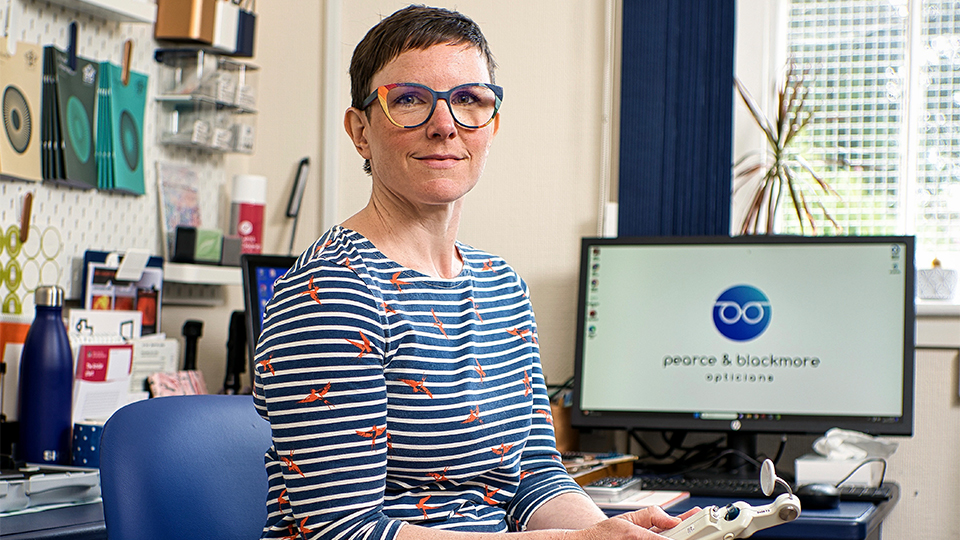
Pearce shared that understanding both sign language and the clinical aspects of eye care provides her with an advantage when communicating with patients.
“I can cut out the middleman of an interpreter,” she said.
“People can come in and get exactly the same care they would if they could hear,” Pearce highlighted.
Pearce recalled a situation where a woman came away confused and anxious after a hospital appointment for cataracts.
“The ophthalmologist was speaking to the interpreter and not looking at her and the interpreter didn't have medical knowledge,” Pearce shared.
“She felt the appointment was rushed and she was very scared,” she said.
The patient knew that Pearce could communicate in sign language and attended her practice hoping for an explanation.
“I spent the time explaining what a cataract is and what it would mean if she needed any treatment. I was able to answer her questions in her own language,” Pearce said.
“She was so happy because she had really thought that she was going blind,” she added.
Many of my patients comment on how much more relaxed they feel conversing in Welsh
In another situation, a child attended Pearce’s practice for a sight test with her father, who is deaf.
Pearce explained the steps she was taking to the child’s father in sign language, in the same way she would for a hearing parent.
“She looked at me as if to ask, ‘How do you know sign language?’,” Pearce said.
“It was such an unusual situation for this girl to be in where somebody could chat to her dad, rather than her being put in the position of interpreter,” she said.
Reflecting on steps that optometrists can take to make the sight test more accessible to those with hearing loss, Pearce shared that deaf awareness is key.
“Everyone can become deaf aware. It’s simple things like making sure you are looking at the patient and that they can see your lips, and speaking clearly but not shouting,” she said.
She has also noticed the importance of explaining to patients with hearing loss what will happen next in the sight test before switching off lights.
For practitioners who are interested in using sign language in practice, Pearce shared that the alphabet is a good place to begin.
“Then you can sign your name or the first letter of a word if you get stuck,” she said.
Using British Sign Language in practice
The employer view: investing in further learning
As the clinical training and extended roles of optometrists have expanded, employers have increased their focus – and investment – in the further education of their staff.
Learning and development manager at Leightons Opticians & Hearing Care, Claire Vernon, highlighted that the company is committed to supporting professional development of staff from the beginning of their career with Leightons.
“We take the time to understand each individual’s career aspirations and provide tailored support to help them progress along their chosen path,” she said.
Development may involve advanced clinical skills or training that focuses on personal and professional growth.
For example, the Empathic Consulting programme has been created specifically for dispensing opticians.
“This initiative encourages participants to step away from the demands of daily practice and focus on building meaningful skills that enhance their dispensing work, personal development, and long-term career potential,” Vernon said.
The company provides all employees with time allocated towards learning and self-development.
Leightons’ learning management system provides employees access to a wide variety of training modules.
“This allows team members to explore resources aligned with their ambitions and continually fuel their progression,” Vernon said.


An annual CPD Oxygen event, which features expert-led lectures, interactive skills workshops, and peer discussion sessions, supports Leightons employees to meet their continuing professional development requirements.
Vernon highlighted that continuous learning is key to long-term retention and job satisfaction.
“When individuals feel supported and have opportunities to grow, they’re more likely to stay inspired and committed to their work,” she said.
As well as meeting the clinical requirements of evolving practice, Vernon shared that the company has a focus on the development of broader skills – such as communication, empathy, and adaptability.
“We believe that a fulfilling, engaging career leads to more confident professionals, stronger teams, and ultimately, better patient outcomes,” she emphasised.
Head of professional development at Specsavers, Neil Retallic, highlighted that further qualifications are critical in enabling optical professionals to provide more care in community settings.
“By undertaking further training, optometrists can deliver enhanced services that improve patient outcomes,” he said.
Specsavers’ Advancing Clinical Excellence IP Support Programme offers a range of resources to practitioners, including educational articles, peer review sessions, revision tools, webinars and networking groups.
“Building on its success, we are now launching a parallel support initiative tailored specifically for those undertaking glaucoma-related higher qualifications,” Retallic highlighted.
He reflected that differences in local commissioning arrangements and educational pathways between the four nations of the UK influence the uptake of qualifications.
“The majority of further qualification funding for Specsavers clinicians across the UK and Ireland focuses on three key clinical areas: medical retina, IP and glaucoma,” Retallic highlighted.
“Specsavers goes shoulder-to-shoulder with practice partners to ensure that course fees for these qualifications are fully covered,” he emphasised.


Comments (0)
You must be logged in to join the discussion. Log in