


05 December 2025
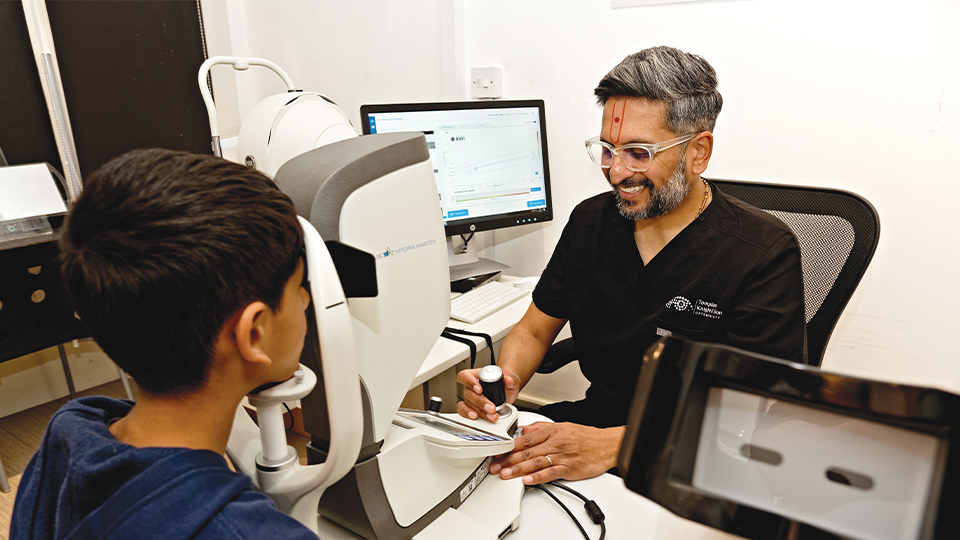
Over the course of more than a decade, Dr Keyur Patel has watched the children who come to his practice for myopia management grow up.
He has come to know not only their prescriptions, but their likes and dislikes, their favourite sports, and future ambitions.
While the children Patel sees have made progress in many areas – graduating from picture books to chapter books, from writing in pencil to pen – there is one area of their lives that he has watched stagnate with relief.
“The prescriptions are not changing hugely,” the optometrist and clinical director at Hakim Group independent practice Tompkins, Knight & Son Optometrists told OT.
“We know there is going to be creep, but that rate of creep really does slow down,” he said.
Patel has observed the relief of highly myopic parents who want to save their child from the same blurred view of the world they have before they reach for their spectacles in the morning.
“Our myopia management patients become like family,” Patel shared.
“For the parents who are high myopes themselves, they’re really grateful when we can show that we have been able to slow the growth pattern of their child,” he said.
Myopia is on the rise in the UK and internationally. In the 1960s, if you stood at the front of a UK classroom, fewer than one in 10 faces looking back at you would be wearing spectacles.
According to the Northern Ireland Childhood Errors of Refraction study, the proportion of myopic young people in the UK is now closer to one in five.
In China, Hong Kong, South Korea, Taiwan and Singapore, it is estimated that eight in 10 students are myopic by the end of their secondary school education.
Within urban areas of India, researchers have outlined how the prevalence of myopia has increased from fewer than one in 20 children in 1999, to one in five children by 2019.
As many children witness the boundary of their visual world shrinking, researchers, policymakers and industry have collaborated to turn back this global trend.
In the past five years, more than 2700 research papers have been published on myopia management.
In the UK, optometrists have access to a broad range of evidence-based interventions that slow the progression of myopia – including soft contact lenses, myopia control spectacles and orthokeratology.
The National Institute for Health and Clinical Excellence is currently investigating the cost-effectiveness and clinical efficacy of low-dose atropine eye drops for managing myopia among young people between the ages of three and 14.
Innovative public health measures aimed at combating myopia have ranged from a pilot involving a glass classroom in the Guangdong Province of China, to Five Habit Hacks for a Healthy Child – a booklet published in Singapore that educates parents on the importance of outdoor time for their children, among other healthy behaviours.
In 2010, Taipei introduced the Tian-Tian 120 [120 every day] public health campaign – where school children were encouraged to spend two hours outside each day.
In the five years following the introduction of the intervention, the proportion of children with reduced visual acuity decreased in Taiwan – reversing a long-term upward trend.
In its first global report on vision in 2019, the World Health Organization warned that anticipated increases in myopia prevalence would compound the burden placed on health services as a result of growing and ageing populations.
Our myopia management patients become like family
A matter of common sense
Patel first came across myopia management in 2005 as part of the paediatrics programme while studying optometry at the New England College of Optometrists in Boston.
The institution was previously involved in the Correction of Myopia Evaluation Trial – observing the effect of progressive addition lenses in slowing myopia progression in comparison to single vision lenses.
“The academics had a strong interest in the field and that came across in the education they provided to students,” Patel recalled.
As a mature student who had already practised as an optometrist in the UK, Patel was drawn to the practicality of myopia management.
“It seemed like something that we could use day-to-day,” he said.
“If we could slow the rate of progression of myopia and potentially reduce the risk of ocular health problems in a child’s lifetime, in my head, it made sense,” Patel shared.
Following a year-long residency in Boston, Patel returned to the UK in 2008 and worked in a refractive surgery setting before undertaking locum work.
Although he was not applying myopia management in practice, he followed advances in the field with interest.
“I would read the journal articles and go to conferences to listen to people who were head and shoulders above everyone else in the field,” he said.
Patel began to offer myopia management on a regular basis after joining Tompkins Knight & Son Optometrists in 2015. The practice received early access to both MiSight and VTI NaturalVue – the first the first two licensed myopia management soft contact lenses in the UK.
Today the practice offers patients a range of options for slowing the progression of myopia, from spectacles and soft contact lenses to orthokeratology.
A subscription-based model means that families pay a regular fee that covers all their myopia management care and products – regardless of which intervention is used.
Patel explained that as well as creating administrative efficiencies, this means that families are not influenced by price.
“We didn’t want patients choosing something that was not necessarily best for them. We have taken that out of their hands in a way,” he said.
Now that the number of myopia management interventions is expanding, Tompkins Knight & Son Optometrists takes a considered approach when it comes to taking on new products.
Patel shared that he will weigh up the evidence behind the product and the extent to which it improves the practice’s existing offering.
He added that ultimately patients are at the heart of the decision-making process.
“If there is a product that's absolutely cutting edge and doing things that none of the others can do, we will take it on, regardless of the cost,” Patel said.
Looking ahead, Patel is excited by the potential of atropine to improve the accessibility of myopia management within the UK.
“It may be more cost-effective and it will add to our repertoire of tools,” he said.
Patel highlighted that early adopters of myopia management form a tight-knit community in the UK.
“We all know each other – we're all friends. We’re always encouraging each other to be at the cutting edge because ultimately, we're doing it for our patients to offer them the best service and quality of care that we can,” he said.
We need to talk openly with everyone about myopia management, regardless of what we think a parent can afford
Mastering myopia
Since 2022, Glasgow Caledonian University (GCU) has offered an online myopia management module that runs from September to May.
The module provides optometrists, dispensing opticians and contact lens opticians with a thorough understanding of the theory underpinning myopia and its management, as well as the ability to critically appraise evidence.
Course participants learn a variety of skills, including how to construct a clinical routine for a myopia appointment as well as formulating a myopia management and evaluating treatment success.
Module leader, Dr Stephanie Kearney, led a 2024 Children study that identified cost and a lack of public awareness as the two main barriers to myopia control uptake among parents and children in the UK.
Kearney shared that there were opportunities to increase awareness of myopia management among patients through improved communication.
“Through our survey of practitioners there was a feeling that knowledge and confidence was affecting them when it came to discussing myopia management interventions,” she explained.
“That is where the birth of the myopia management module came from – we wanted to upskill optometrists, contact lens opticians and dispensing opticians so that we could increase the number of children who are being offered myopia control in the community,” Kearney highlighted.
Since 2022, 182 practitioners have completed the module. A study published in Clinical and Experimental Optometry in August this year found that practitioners were more likely to report offering a myopia control intervention to patients after attending the module.
Reflecting on her top tips when it comes to offering myopia management in practice, Kearney highlighted the value of encouraging regular eye tests for children.
“If practitioners are better able to identify children at risk of myopia and have a discussion about lifestyle risk factors, we might be able to delay the age of onset slightly, which would then reduce the amount of myopia they have by adulthood,” she said.
She emphasised the importance of discussing myopia management with all children with myopia.
“We need to tell everyone that it’s out there, give parents the evidence, explain the likelihood of their child benefitting from the intervention, and then it's up to them to decide,” Kearney shared.
“Because of the cost of interventions, there can be a feeling of guilt among practitioners when it comes to talking about myopia management. But we need to talk openly with everyone about myopia management, regardless of what we think a parent can afford,” she said.
Kearney observed that talking with parents who are concerned about their children’s eyesight can be an emotional experience.
“It's really exciting to be involved in research that tries to advance the standard of eye care for these children,” she said.

Glasgow Caledonian University senior lecturer, Dr Mhairi Day, who was involved in launching the university’s myopia management clinic in 2016, told OT that she enjoys working on research that is highly clinically applicable.
“I do feel like I’m living this dream where I’m doing research that influences my teaching and the patients. It can’t get much better,” she said.
She highlighted the importance of practitioners understanding the evidence that underpins their advice.
“They need to be able to provide balanced and correct information to parents – not over or under promising about the likely success of interventions,” she said.
Day also recommended that practitioners consider how they would measure the progression of myopia and the success of interventions.
She highlighted that subjective refraction has an average precision of 0.82 dioptres – which is not sensitive enough in the short term to detect with certainty the average annual reduction in myopia progression reported by clinical trials of around 0.24 dioptres.
By contrast, the precision of devices for axial length measurement is generally 0.06 millimetres – sensitive enough to capture the average annual reduction in progression of 0.13 millimetres reported by clinical trials.
“With axial length you can detect that mean reduction in progression that clinical trials show over a six-month period,” Day explained.
Kearney added: “We’re not trying to say that you can't practise myopia management if you don’t have a biometer. But I think practitioners need to be aware of the limitations that they’re going to come up against if they are only using refraction.”
Day highlighted that a considered approach is important when speaking with parents and children about the potential ocular health risks of myopia.
“Occasionally parents will phone us upset about the prospect of their child having a visual impairment or going blind, because of the way that information has been put across to the parent and child,” she said.
GCU research published in Investigative Ophthalmology & Visual Science in April this year provides useful pictographics (tinyurl.com/2usrvphf) that practitioners can use to explain the risks of visual impairment associated with myopia in a balanced way.
Lead author and GCU lecturer, Emma Dow, highlighted: “One of the things that I would advise practitioners to consider when talking about the risk of myopia-related diseases and visual impairment is to explain the risk in absolute terms.”
“Risks are often described in relative terms, but when we use relative risks, the numbers that we talk about are higher, and that can exaggerate the patient’s perception of risk, and lead to risk being discussed in a more misleading way,” she added.
In the future, Dow is excited about advancements in research exploring the mechanisms of myopia management.
“It would help us to understand which patients are best-suited for different types of interventions,” she said.
Dow also believes that licensing atropine in the UK for myopia management could open up new possibilities.
“It gives practitioners something else to try, which uses a different mechanism. There is the possibility of combination therapies where atropine is used alongside optical interventions,” Dow highlighted.
Hammond Opticians optometrist and director, Deven Lakhani, completed the Glasgow Caledonian University myopia management module in 2023.
Lakhani began offering myopia management in 2020. His practice offers orthokeratology alongside a range of different myopia control spectacle and contact lens options.
As a myopic child, Lakhani has memories of the “inevitable” change in prescription each time he attended a sight test.
“As a myope myself, I have always had a personal as well as professional history with myopia,” Lakhani shared.
“More than anything, I wanted to be able to help the children entrusted in my care in a way that wasn’t possible for me when I was young,” he said.
Lakhani has found that a key aspect of success in myopia management is involving children in conversations alongside their parents.
He finds that this enhances patient engagement and adherence.
“With all of these myopia management strategies, they're only as good as the compliance of the young person using them,” Lakhani said.

At Hammond Opticians, families pay a single monthly fee for myopia management which covers every aspect of their care.
“As a parent myself, we have chosen a business model that we know helps parents keep things simple and straightforward while recognising the investment in equipment and training that we have made,” Lakhani said.
He highlighted the transformative effect that wearing contact lenses can have for the confidence of young people.
Wearing contact lenses has enabled young patients who attend Lakhani’s practice to represent their county in gymnastics and thrive in school theatre.
“There is a significant change and improvement in their self-confidence that then manifest in their school and social lives,” Lakhani highlighted.
Specsavers Macclesfield optometrist, Rachel Warrington, has been offering myopia management since January 2023.
Warrington, who graduated from the University of Plymouth in 2022, shared with OT that she has learnt the importance of using an individualised approach.
Some patients will find that myopia control spectacles are a better option, while others will find that contact lenses complement their lifestyle and hobbies.
“It’s not one-size-fits-all,” she emphasised.
She also emphasised the importance of clear communication with patients and their families.
“Parental understanding is key to engagement, drive and adherence, all leading to a better overall outcome,” she observed.
Warrington added that it is important to set realistic expectations by clarifying that myopia management does not seek to ‘cure’ myopia, but to slow down progression.
Alongside potential myopia management interventions, Warrington will discuss the influence of lifestyle on myopia progression – encouraging children to take breaks from near work and aim for two hours outdoor time each day.
“When considering management options, it's always been important to engage the patient and parents in the conversation to allow for an open discussion. I also take into consideration the age of the patient, prescription, family history of myopia and also lifestyle factors for example, sports and other hobbies,” she said.
More than anything, I wanted to be able to help the children entrusted in my care in a way that wasn’t possible for me when I was young
Insight from Singapore’s inaugural myopia fellow
In Singapore, around 65% of children are myopic by the age of 12, while 80% of young men are myopic by the time they begin compulsory military service at the age of 18.
Since 2001, the nation has implemented a National Myopia Prevention Programme which sees children receive annual vision screening between the ages of five and 10, alongside a public education programme that encourages families to spend more time outdoors and adopt healthy eye habits.

Dr Li Lian Foo is clinical director of the myopia service at the Singapore National Eye Centre (SNEC) and the first ophthalmologist to complete a dedicated myopia fellowship at SNEC.
As a myopic eight-year-old, Foo remembers receiving annoyed looks from her classmates when they thought she was trying to copy their answers.
“I couldn’t see what was written on the blackboard so I would try to copy the question from my neighbour,” she said.
After her myopia was picked up through school screening, her prescription progressed from -2.00D to -6.00D until she had LASIK at the age of 25.
While myopia management was not an option when Foo was growing up, she is passionate about ensuring that the next generation make use of this opportunity.
“In Singapore, we are one of the epicentres for myopia. If myopia is left unchecked, there are implications for the quality of life and productivity of the population,” Foo said.
“We need to tackle this issue at the source to prevent it from escalating further,” she added.
Myopia around the world
19 %
of 17-year-olds in the UK are myopic
2700 +
research papers published on myopia control in the past five years
80 %
of 18-year-olds in Singapore are myopic
As a consultant ophthalmologist, she has witnessed the potentially blinding complications of patients with high myopia.
“We do see a lot of patients with retinal detachments and myopic macular degeneration, who are really starting to lose vision. There are young patients who have glaucoma – despite not having a family history,” she said.
“These are complications that could have potentially been prevented in childhood if we had intervened earlier,” Foo observed.
Alongside patients in their 30s and 40s developing retinal detachments and glaucoma, Foo has observed the discomfort that results from the weight and bulk of thick lenses, and a 16-year-old with multiple retinal holes and tears.
However, in a nation dubbed the myopia capital of the world, there remain reasons to be hopeful.
Foo shared that the myopia prevalence among seven-year-olds, as measured by school screening, hovers around 30%.
“For the first time, it has dropped to 26% - which is unprecedented,” she said.
“That drop means a lot to us. We want to share with the rest of the world that, as a result of concerted efforts with multiple stakeholders, we have started to bring the numbers down,” Foo highlighted.


Comments (0)
You must be logged in to join the discussion. Log in