


05 December 2025
The independent optical laboratory, DSW Optical, emerged from humble beginnings – the back room of a customer’s practice.
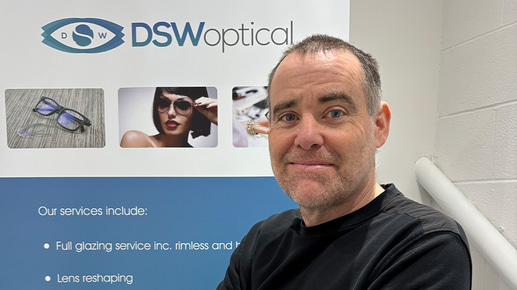
David Whittle, founder and director of DSW Optical, shared that it was encouragement from colleagues and customers that led him to establish his own laboratory.
In the 16 years since, the company has grown into a new facility and recently moved into new, connected rooms, ensuring the team can stay in touch to answer queries quickly. The company has been particularly excited to begin hosting lab visits and training.
Discussing the company’s approach, Whittle told OT: “I think talking to the customer service person or the technician when discussing things is important, especially when you are a newer business – we try to give advice on all aspects of the business, not just our own lenses.”
OT heard from Whittle on the company’s ambitions, the work that went into achieving a carbon balanced certification, and taking a positive approach to challenges.
Behind the scenes
What makes DSW Optical and its approach or its products unique?
I think it is the way we are set up. I had been in practice my whole life, working with some of the practices that are now customers. They wanted me to provide a service that they weren’t getting from the places they were using, and it seemed like a good opportunity for me to work with people I like working with. It grew out of that.
My first proper job was as a lab tech. I worked in a multiple to begin with and then in independents ever since. I worked as either a dispenser, a technician, or managing places, and then set up a lab for one of the practices I worked with.
As a lab person, you have to have worked in practice to understand what is going on in the practice. You have to have met the customers and talked to them. One thing we used to do was get people from the shop floor to work in the lab for a few days, and vice versa. It gave you a very unique perspective. You can easily think that your world is the whole world, and it just isn’t. When you start meeting the patients and see what they want of you, what you can give them and what you can’t – things can seem obvious in the lab but you have to experience it.
This gives me a different dynamic on what I want to provide. I do it because I am interested in the products and I am lucky to work with people I like and have got to know.
What is the latest service or offering you have introduced and why does it stand out?
Our lens engraving service has evolved over time in flexibility so the possibilities are endless for personalisation: from quotes, pictures, initials, to logos and more.
We have introduced a scratch guarantee on our bonded coating as it was something our practices wanted to be able to offer. We have also introduced some different lenses like tinted photochromics and new colours, and we’re looking to introduce more soon.
We can now have people into the lab to visit, so they can look through the lens and frame ranges that we provide. We can also invite a frame rep in too so they can show a range of products without having to get in practice. You have one or two companies represented from the many we work with.
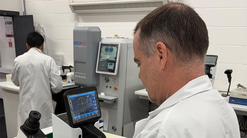
We can train people as well, something we offer to all the people we work with. We can show them the glazing equipment, how it works, the products we have and how we design them, and the various coatings. They can cherry-pick the things that work in their practice and also know what else is available. It’s new to us. We’ve always talked about it, but now we have a room specifically for it, and space in the lab to take people around properly.
When did you move into your new facility?
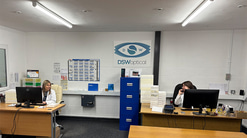
We only moved about 18 months ago. We were in the same building in smaller rooms, but we like the team to be able to talk to each other – if you’re taking an order or answering a phone call in one room and then have to travel outside to get to a different room it makes it a bit difficult to answer the questions quickly. We found we were working in just one room all the time.
Now we have this facility there is literally a window between the two rooms, so if you need something you can wave at somebody or show it through the glass. You’re always in contact with who you need to be straight away, but it gives us the space and a little bit of separation between the different areas.
It has been good but it was a lot of work. We painted the room ourselves, built the benches, got everything ready to transfer over while we were still working. I was lucky, the staff came in to help at weekends. It meant they could arrange everything as they wanted it. I think it made them feel they were actively involved in it – which I think I would have liked when I was a bit younger working for somebody else.
What are the company’s main ambitions for the next 12 months?
We want to produce some more environmentally-friendly lenses. We have access to them and have tested them. It’s quite a limited range at the moment, because it isn’t being pushed quite as much in the UK as in other countries, so getting the materials is quite difficult. We need to name them and launch properly.
There is some glazing equipment that we have bought and we’re hopefully going to have an add-on that means we can do a bit more detailed work – faceting for example.
Can you tell us about DSW Optical’s certified carbon balanced marker with Net Zero Eyecare?
We have our carbon neutral certification, and we’re trying to work on our plastic neutral certification, which is pretty difficult to do when you’re in optics but it is possible and we’re working on it.
It’s not a business choice, because there isn’t enough demand in the country for it at the moment, it’s more of a personal choice. We don’t have a huge amount of money and resources to put into it like larger companies do, but that doesn’t mean we can do nothing – we can do something. We looked into it and found it was possible for us to become carbon neutral, and if it’s possible, why not do it?
I think the beauty of a small company is when we chose to do it, we could just do it. We didn’t have to go through a team of people, we just allocated the member of staff and told him: “To what you need to do with it, and you have carte blanche to run with it.” We set an end goal, settled on who we were going to work with to do it, and said go.
What steps were involved in achieving the carbon neutral certification?
We decided to work with Net Zero Eyecare – that seemed like the fairest way of doing it in terms of cost and what we wanted at the end of it. They wanted everything – information about where the things that come to us were produced, how it was being shipped to us, how many emails were being sent back and forth, how many tea bags were used, how big the room was, how much energy we were using to heat it, how much water, the equipment bought, and what the carbon footprint of buying it was. They wanted to know how people came to work and what the carbon footprint of that was. It is literally every purchase you made, everything you did.
Of course, being in optics, there are also the offcuts of material, what you are doing with that, how you are recycling it, and what you can’t recycle. You look at every bit of energy generation anywhere that is involved in the business and then what you can do to reduce it and what you can do to offset it – because you can’t reduce it down to zero in our industry at the moment.
We spoke to Net Zero Eyecare about how we could offset carbon and the projects we could work with. One project we support is in Cambodia, where they are working on locally-built water filtration systems. It is an expense to us in the short-term, but in the longer-term it helps everybody.
How are you working towards a plastic neutral certification?
We’ve already taken steps to cut plastic waste. Through our partnership with CleanHub, we help keep plastic out of the ocean while supporting communities in the Andaman Islands with jobs in waste management and education.
We reuse plastic bags from suppliers to send lenses and frames to customers. We’re also working on donating spare glasses to a charity that sends them to Africa, where they can make a real difference.
We use dry cut machinery in our glazing and try not to use our old wet cut equipment too much. One of our current challenges is finding a way to recycle the offcuts. That’s really difficult to do but we’ll keep working on that. If we can do that, that’s a whole new world for optics, it would make a huge difference. At the minute we’re at least capturing it so it can go into landfill and doesn’t leak into the environment quite so easily.
DSW Optical
Beyond the brand
What are some of the challenges and opportunities you see in the sector?
Artificial intelligence is definitely going to bring in new products and there’s already a lot of design work going in through AI. That's a brilliant opportunity. But it also means there are less people involved in doing that themselves, and it means that the some of the larger producers have more of a control over it. It strangles part of the industry and helps other parts of the industry. You can either look at it’s a positive or a negative. Designs are going to be better for people in the longer term – that's got to be good for everybody.
At the end of the day, people want to deal with people, and the more you have AI taking over things, the more people want to deal with people and have a conversation.
We work with some eco-friendly plastic manufacturers and if you believe in their products, you can sell their products. If you just stick it through an AI generator it’s never going to do anything, because people aren't going to buy into it. They're not going to take in exactly what you're trying to tell them.
The bigger risks and opportunities are that a lot more people import things. To keep the to keep the prices down and to get access to those newer-generation things you very often need to import these days, so there isn't as much done in our country to supply the raw materials or design work. That gives you access to a huge new market, but it exposes you to fluctuations in prices and tariffs.
Some of the large producers are buying everybody up, whether it be some of the large retailers or manufacturers. That seems like a negative, but every time you do that, somebody has a new opportunity to do things differently. It's just your perception.
There’s definitely opportunities out there for people and we just need to be aware sometimes of how these risks are going to come up and what’s going to change. Some things are going to change really quickly, others are going to take years to change. As long as you are willing to be positive and to look for these as opportunities, rather than just something that's going to take your job from you, then you're going to do fine.
How does DSW Optical approach supporting the wider community?
It is mostly driven by the staff – it’s what they believe in. We have donated to local charities and a children’s hospice, and gifted school books, with money raised either through donations or walking and running events. We have also raised funds for a local gymnastics club to travel to a world championship competition.
What could you tell us about DSW Optical’s commitment to working with independent practices?
I am interested in seeing local practices work with their communities and be able to offer what they want. When I first entered optics, a very long time ago, my first lesson was this: never send a job out if you wouldn’t be happy to let your mum (or dad, sister, brother) wear it. For me that extends to the choice you offer. We try to support practices by giving them the choice, so that every customer can be treated as an individual.
DSW Optical in numbers
2009
the year the company was founded
2024
DSW Optical achieved carbon neutral certification
8
members of staff


Comments (0)
You must be logged in to join the discussion. Log in