


01 August 2025
For parents of a child on a myopia management pathway, a number one question is: is it working? OT spoke to suppliers about how practitioners can measure this, and communicate the efficacy of a treatment to patients and parents.
Anna Chen, product manager at Haag-Streit UK, shared: “Ocular biometry and monitoring the response of axial elongation to intervention is now the superior method of monitoring myopia progression.”
This is also the only method of accurately assessing myopia progression under orthokeratology treatments, she added.
The Lenstar Myopia from Haag-Streit UK is made up of the Lenstar 900 optical biometer, which enables measurement of axial length, and the EyeSuite Myopia software, which provides easy-to-understand data visualisation.
Lenstar Myopia includes the Age-Matched Myopia Control (AMMC) framework from ophthalmologist, Professor Hakan Kaymak; a tool enabling comparison of eye growth rates with emmetropic eye growth.
Periodic axial length measurements are taken every six months and compared against age and gender-matched emmetropic axial elongation rates.
Chen said: “The treatment goal with myopia management is to bring the rate of axial elongation down to demographic-matched emmetropic growth rates. That is, the expected eye growth rates under treatment should be the same as that of an emmetropic eye of the same age and gender.”
Compliance is key, Chen highlighted, adding that if interventions are not having the desired outcomes: “Ensure that your myopic patient is wearing their glasses and contact lenses as directed and for the recommended period of time to ensure they achieve the best results.”
Managing expectations
Corrina McElduff, director of professional affairs at Ocumetra, emphasised: “It is really important to remember that success is never a straight path for myopia management. It is never a one-size-fits-all. There are going to be bumps in the road.”
Factors at play might include the child’s age and genetics, lifestyle, and compliance.
It is important to set realistic expectations early, McElduff said, highlighting: “No treatment is going to stop it totally. Our goal is to ultimately slow it down.”
She recommended counselling parents and patients so that they are aware ahead of time, that there are going to be periods where progression appears faster or slower.
“Managing expectations is a very important aspect of myopia management, because the path is not straight. It is bendy and twisty. It is how we keep that patient and parent engaged throughout that period of time, which could be a fair few years,” she said.
McElduff highlighted the importance of a strong evidence base when considering the success of a particular intervention to compare children to others, like themselves, in the population.
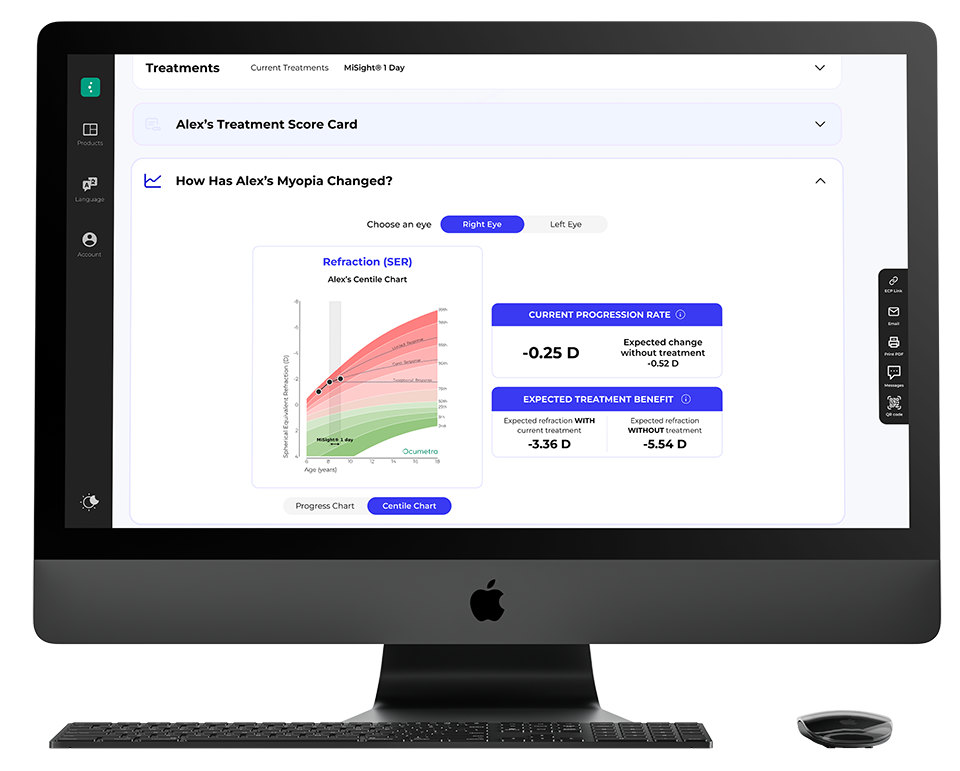
“That is where, in using data-driven tools and carrying out longitudinal monitoring, we can get a good grip as to whether that treatment is achieving its goal,” she said.
The latest addition to Ocumetra’s myopia management tool, mEYE Score, has been designed to track and visualise how a patient’s myopia and axial length is progressing over time.
Ocumetra uses predictive models based on big data to show what a patient’s expected eye growth and refractive error change could be without treatment and how an intervention is changing that trajectory, in order to calculate a percentage efficacy.
McElduff explained: “We can tell a practitioner: this is how much they have changed since they began. If we didn’t do anything, this is what it could have been.”
This can help practitioners answer the questions parents might have about the treatments, primarily: is it working?
Ocumetra’s mEYE Score helps to translate measurements into meaningful insights, McElduff said: “It helps to make the invisible, visible.”
“We’re helping to frame the conversation and help families understand the long-term value of the treatment. We’re not just taking it six months at a time at every visit, what these charts help us to show is the big story,” she said.
Making progress tangible
Lisa Field, head of optical division at Birmingham Optical, highlighted that success in myopia management depends on several factors, including the age of the child, age of onset, baseline axial length, family history, genetic factors, ethnicity, and lifestyle factors.
She explained: “For a younger child with rapidly progressing myopia, success might be slowing axial elongation from 0.4mm per year to under 0.2mm. For an older child, maintaining a stable axial length over 12 months may be the goal.”
Field recommends the use of optical biometers, such as the Nidek AL-Scan, which provides non-contact and fast measurements of axial length.
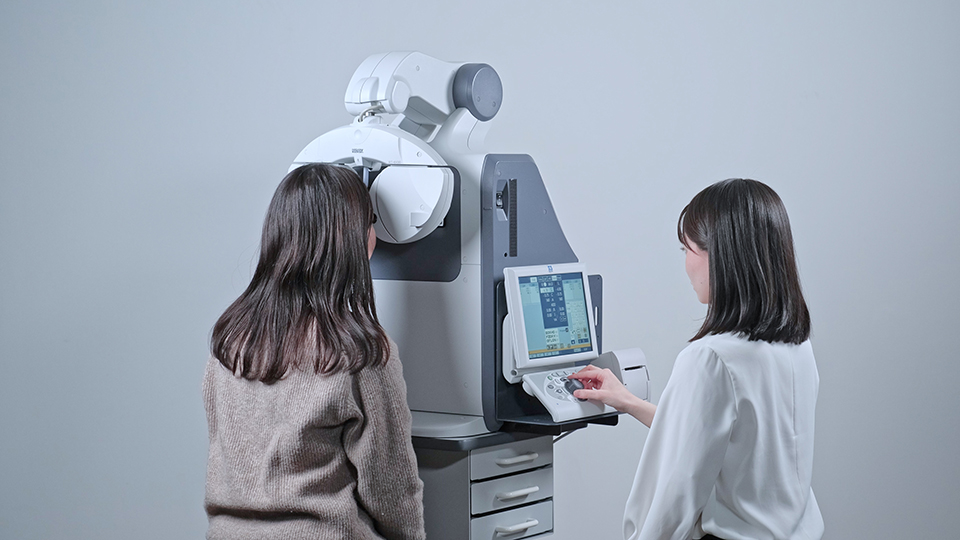
“For practitioners, this means objective data can be compared across visits. The Nidek AL-Scan's ability to provide consistent and accurate measurements supports confident decision-making when adjusting treatment plans or confirming that current strategies are effective,” she said.
Using visual aids can be helpful for explaining axial length to patients and parents. Field noted that graphical tracking is possible through consistent use of devices such as the Nidek AL-Scan.
“This helps families see trends and understand progress in a tangible way,” she said.
Field also recommended apps like PreMo and Ocumetra, as well as websites like myopiafocus.org and mykidsvision.com.
Discussing the effectiveness of growth charts, Field shared: “Many practitioners use axial length percentile charts, like height growth curves in paediatrics. Overlaying a patient’s data shows whether they are on track or progressing too quickly.”
“The benefit is increased patient and parent understanding, which translates to better treatment compliance. When families see the positive impact of interventions visually, they’re more likely to remain engaged and adhere to treatment recommendations,” she said.


Comments (0)
You must be logged in to join the discussion. Log in