


07 February 2025
Whether a career, a hobby, or even somewhere in between, for sporting enthusiasts it is all about performance.
Fortunately, there are a number of solutions for patients looking to meet their vision correction.
Essential equipment
Ludwig Eberlein, international coordination, Vision Sensation at Silhouette Eyewear, highlighted the protective functions that sports eyewear can play, sharing: “90% of serious eye injuries could be prevented by wearing appropriate eyewear.”
Aside from protection, he suggested: “It is essential to offer the best contrast for every light circumstance, to ensure detailed vision and to avoid eye fatigue.”
For an athlete, this can make all the difference when it comes to staying focused.
In 2024, Silhouette brand evil eye introduced the peaklite goggle – a lightweight design with integrated optical inserts in the filter lens using an adapter system. This removes the requirement for additional clip-ins or a second lens for this design.
Eberlein explained that there is a focus on prescription glazing throughout the frame development process, with product development and lens lab teams working closely together. Athletes are also involved in the process to test the products in real-world conditions.
“We are not just producing sports eyewear, we are producing sports eyewear as essential sports equipment,” he told OT.
When making a recommendation for sports eyewear to a patient, Eberlein shared: “Sports glasses are a classic second pair offer that must be offered proactively. Many patients simply do not know that sports eyewear with prescription lenses is available.”
Daytime freedom
Josie Barlow, head of customer support at Menicon UK, shared that in a conversation regarding a patient’s history and symptoms: “We think about people’s lifestyles, but we can sometimes be bit too focused on their job, rather than thinking about what they do outside of work which could influence what we are going to suggest.”
“We can get a holistic look at a whole person and that can give us some really good clues as to what contact lens would work for them.”
For some patients engaged in sports, ortho-k can be a positive option. Swimmers, rugby or football players and gymnasts, might all benefit from this freedom.
Barlow said: “While we talk about ortho-k for myopia progression, I think we don’t tend to talk about it quite so much with patients who would benefit from it – either from a lifestyle perspective or just being correction-free throughout the day.”
In addition to a range of soft lenses, Menicon offers the Menicon Z Night ortho-k contact lens for non-progressing myopes, and the Menicon Bloom Night for children who require myopia control.
Sharing how she might discuss the option of ortho-k with a patient, Barlow gave the example of a patient who is a regular swimmer, suggesting she might ask: “Have you thought about this type of contact lens that you can sleep in overnight? In the morning when you wake up, you’re free of spectacles for the rest of the day. That would free you up for swimming multiple times a week and you won’t have to worry about not being able to see when you’re in the pool, or going in your glasses.”
“I would explain that they could wear these contact lenses seven nights a week and they are not going to need any vision correction at all any other time of the day. They are going to be able to do everything with that one contact lens,” she said.
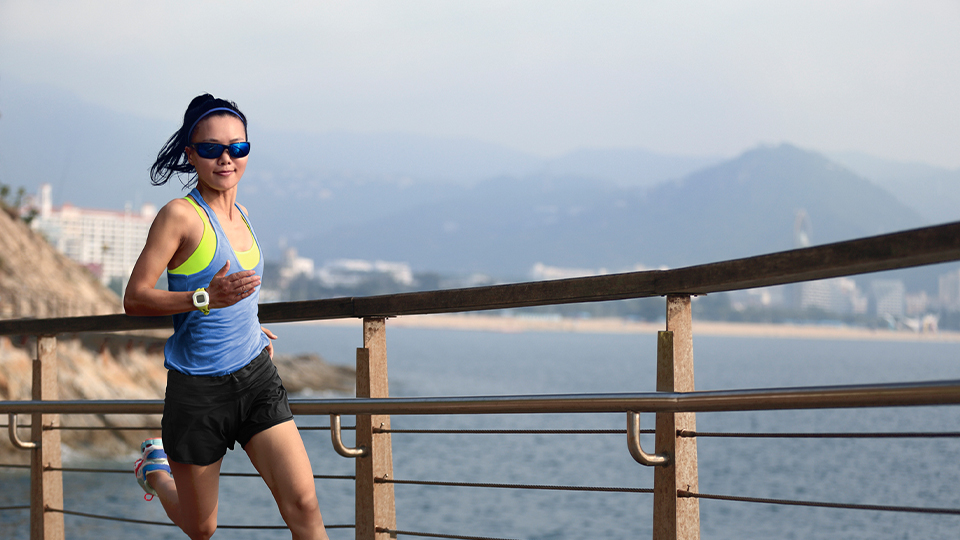
With these frames in particular, it is important to consider the peripheral visual system, Fazal shared: “It is critical for reaction time and how the individual wearer will perform.”
“This is where the challenge lies for us as lens manufacturers, because inevitably as you look off-axis to the periphery, you are going to perceive more distortion, more aberration, and induced prism where we don’t really want it,” she said.
To meet this need, Hoya has designed the Sportive range of lenses with both single vision and multifocal options, that uses a prism compensation technology to optimise the high-curved lenses for wrap frames.
The Sportive range supports wearer activities through power compensation and binocular vision design adaptation, with technology introduced to reduce perceived peripheral and prismatic distortion, Fazal shared.
The lenses are also available in a number of tints and coatings to enhance contrast and reduce glare.
When dispensing sports eyewear, ensure the frames are in line with optical performance, Fazal advised, but also that the lenses are designed to support that wearer’s need.
Advising that the practice team should be kept up-to-date on their knowledge of fitting and measurements, Fazal also highlighted the need to ask enough questions of the patient.
Fazal commented: “Are you asking enough questions about working distances? Contrast, lighting, or colour perception requirements? If they play a sport, what is the speed of objects as they move – are they static or moving? All these questions will help you to select the right sports lens.”


Comments (0)
You must be logged in to join the discussion. Log in