

01 April 2026
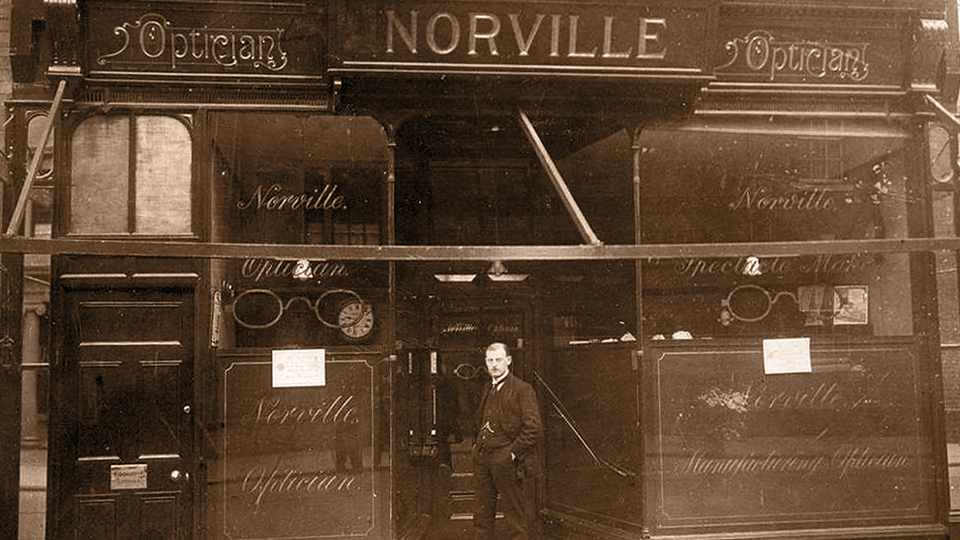
For 125 years, Norville Optical was a company that seldom said no to a request.
Norville was the patient voice on the end of the phone, the hours spent unravelling a seemingly impossible puzzle, the freedom to innovate and learn.
At its peak, the British lens manufacturer had laboratories in Gloucester, Bedford, Aberdeen, Tunbridge Wells, London, Harrogate, Bolton, Cardiff and Southampton.
As well as becoming part of the fabric of British optics, Norville was embedded within the Gloucestershire community. Multiple generations of Gloucester families worked shoulder to shoulder at the flagship site in a former Victorian shirt factory – the River Twyver ambling down from the Cotswolds to intersect with the Norville Optical grounds. Norville had a Sunday rugby team and an annual skittles competition.
“Staff did have to hit targets, but we were working in a family environment. There was a sense that you were working alongside your brother and sister,” former operations manager, Sean Donnachie, told OT.
“You were always allowed to think outside of the box,” he added.
In contrast to the age of chatbots and automated phone messages, the company offered a personal service – employing a more senior member of staff to collect and deliver orders.
“Even in London, they had an older gentleman with a bus and tube pass who delivered that service,” Donnachie recalled.
At the helm of Norville was Frank Norville, known to staff as Mr Frank, who could walk onto the factory floor and know by the faintest sound which machine needed tuning.
He instilled in staff a set of values that percolated through the company.
“He taught you values for how to hold yourself. He always said that your name should mean something,” Donnachie shared.
It was this legacy that added to the weight on Donnachie’s shoulders when he stood in front of 165 Norville Optical staff in June 2020 to tell them the company was closing.
“It was probably the worst day of my life,” he told OT.
While Norville was saved from the brink in July 2020 following its acquisition by Inspecs Group, in December last year the decision was made to close the business following a strategic review.
Alongside the loss of 44 jobs, the decision meant that Gloucester – which once had so many independent ophthalmic manufacturers it was dubbed Resin Valley – only had one remaining optical laboratory.
While the pain that accompanies the loss of Norville may feel particular, it is a story that is written across a broad swathe of industries and communities underpinned by manufacturing in the UK.
In the 1960s, one in three people working in the UK were employed in manufacturing. Today, fewer than one in 10 UK workers have roles within the sector.
Association of British Dispensing Opticians (ABDO) president, Kevin Gutsell, observed that the market share among larger lens suppliers has grown over the past 10 to 20 years as they have expanded into glazing and remote edging.
“At the same time, the number of independent laboratories in the UK has declined through closures and acquisitions, mirroring similar trends on the High Street. Larger corporate takeovers have also reduced the number of practices able to freely choose their suppliers,” he said.
“From a dispensing optician’s perspective, there is growing concern about the availability of highly specialised lenses required for patients with complex visual needs, as fewer providers now offer these services,” Gutsell said.
You never felt like it was a silly question you were asking. They always seemed to want to help
The practitioners and employees who have shared their Norville memories



The broader context
Gutsell highlighted that Norville had long provided a broad range of products from multiple suppliers, including diverse designs, power ranges, and coatings that many competitors were unable to match.
“The closure represents a significant loss for the employees affected, and I hope their expertise is quickly recognised and utilised elsewhere,” he said.
He added that former customers of Norville would need to seek alternative suppliers for prescriptions that may not easily be replicated.
“While most orders should transition without difficulty, some specialised products may not have direct equivalents. I would expect many of Norville’s unique designs and coatings to reappear in the market before long,” Gutsell said.
“Several UK suppliers are capable of filling the gap left by Norville, though building strong supplier–customer relationships takes time,” he shared.
Euromonitor International global insights eyewear manager, Natasha Cazin, shared with OT that e-commerce now accounts for 17% of UK eyewear sales.
Reflecting on the context to the Norville closure, Cazin highlighted that there is an ongoing pressure on traditional manufacturers to compete against low-cost, high-volume online competitors.
She added that the close of a key player in UK optical manufacturing pushes demand towards larger corporate or international suppliers.
“The Norville closure accelerates consolidation, reduces choice for independents, and increases the market influence of large multinational suppliers – making the operating environment tougher for both traditional manufacturers and independent opticians,” Cazin said.
She added that the closure creates challenges for independent optometry practices attempting to source specialist lenses – with practices switching suppliers and adjusting their product offering.
Data from the Office for National Statistics provided to OT shows that while the number of single vision lenses produced by UK manufacturers tripled in the decade to 2024, the price per unit halved.
Over the same time period, the number of lenses – other than single vision lenses – produced by UK manufacturers dropped from 11,284,981 to 7,699,911.
An intangible legacy
Dispensing optician and clinical educator, Eluned Creighton-Sims, first came across Norville during her studies as one of the first cohorts at ABDO College between 2001 and 2003.
“I was introduced to the Norville Prescription Companion, which people would refer to as the Bible,” she said.
When she entered optical practice, Creighton-Sims valued being able to call Norville staff to ask for advice.
“You never felt like it was a silly question you were asking. They always seemed to want to help,” she said.
Creighton-Sims added that the lessons she learned about lens design from Norville staff assisted her clinical judgement in practice.
“The knowledge that I’ve got now I wouldn't have without them. There are some aspects of production that directly influence the clinical judgments that I make, and that's because of their generosity in sharing their knowledge,” she said.
She told OT that she felt a sense of “extreme sadness” when she heard news of Norville’s closure.
“The level of knowledge that they had was very rare in the industry. I hope it is not lost,” Creighton-Sims said.
She paid tribute to the contribution of Norville staff.
“They’re not forgotten. Their legacy was not simply in the products that they made, but in how they made people feel,” Creighton-Sims said.
Optometrist, AOP Councillor and Board member, Karen Gennard, remembers travelling with other students from Cardiff to Gloucester by bus to visit the Norville factory as a student in the 1990s.
She remembers the noise and the particular smell of the glazing machines, and following the path that lenses take from blanks to hand finishing.
“It really gave you a feel for something being handmade,” she said.
Gennard has carried this knowledge into her career as an optometrist. She highlighted the importance of appreciating the significance of the prescription.
“I can understand the numbers that I generate. It's about the lens form. It's about the lens design and different tints,” she said.
“It is not just about reading letters on a chart, but understanding how the lens works on a day-to-day basis,” Gennard emphasised.
A journey through Norville’s history
The optometrist has spent her career working within Gloucester.
She highlighted that the Norville factory felt like it was part of the community.
“It was a really local workforce. A lot of the factory workers lived within the area and there were families who worked together,” Gennard said.
As an optometrist working at a Norville practice, Gennard learned about lens design and innovation from regular talks delivered by Frank Norville.
“He was really generous with his knowledge. He has a real enthusiasm for lens design and making the best product he possibly can,” Gennard said.
Hakim Group transition buddy and dispensing optician, Adrian Street, had a holiday job at the Norville factory on Magdala Road in Gloucester in 1979.
He went on to work as a dispensing optician for Norville and would occasionally deliver training at the factory.
Street recalled seeing a large amount of change within a relatively short period of time – the transition from glass to plastic lenses, and from manual processes to automation.
“When I started, I learned to do lens calculations with log tables,” he said.
Street recalled his reaction when he heard that Norville would close.
“It was terribly sad. It was a big part of my life,” he said.
The university of Norville
UK and Ireland country manager for Younger Optics, Julian Wiles, worked for Norville between 1984 and 2001.
“Everything I have learned and what I have achieved is down to the lessons I learned at Norville,” he told OT.
“Frank Norville gave a graduate his head,” Julian Wiles said.
He shared that Norville was the first British-owned private company to embark on freeform generating.
“Before that, lenses were made in an analogue way. Digital surfacing was something completely different – it was a real game changer,” he said.
When Julian Wiles started out at Norville he worked within frame sales. He brought a house within Golborne in the middle of the miners’ strike – prompting suspicion among local residents about the true identity of this six-foot tall outsider.
“I ended up in my new house without furniture surrounded by six miners’ wives, and I was showing them frames to prove I wasn’t a policeman,” Julian Wiles said.
Wiles soon discovered that his heart was not in sales but in the magic of lenses.
“If you watch the lens being made, it’s a fascinating process, because you're actually making a bespoke product in a mass-produced way,” he said.
“I don’t know of any other industry where that is the case. It’s a very individual product specifically for you,” Julian Wiles observed.
Sharing an example of the lengths that Norville would go to in order to meet an order, he recalled a patient in the 1980s who was allergic to silicon.
Norville staff forged two temple sides and bridge mounting from pure titanium at a cost of £2000 to the company.
“They were sent up to Sunderland Royal Hospital, which was a good account at the time, and the patient was absolutely delighted,” Julian Wiles said.
Hoya key account business development manager, Peter Wiles – who is no relation of Julian Wiles – worked at Norville from 1986 to 2001.
He recalled being shown a -96.00D prescription by a colleague who worked within manufacturing.
“It was two lenses bonded back-to-back,” he said.
Peter Wiles remembered being on an early morning train with Frank Norville in the 1980s when he was travelling for his training at The Worshipful Company of Spectacle Makers.
“Most people at that time of the morning would have a big cup of coffee and a newspaper,” he said.
“Frank was looking at iso plots on progressives,” Peter Wiles recalled.
When he returned to optics after three years working for a company that produced specialist steam valves, the words of Frank Norville on his final day with the company echoed in his head.
“He called me up to his office and said to me, ‘This industry really gets into your blood’,” Peter Wiles shared.
Everything I have learned and what I have achieved is down to the lessons I learned at Norville. Frank Norville gave a graduate his head
The next generation
Dispensing optician, Owen Miles, visited the Norville factory while studying towards his dispensing qualification in 2023. He relied on the company for complex dispenses once qualified.
He was able to see first-hand the effect of the care that Norville staff took producing specialist lenses.
“I would see the patient’s face light up when I gave them a pair of glasses,” Miles said.
“I’m just so thankful for all the work they did behind the scenes,” he added.
Miles shared that Norville represents what he most values about being a dispensing optician – the patient-focused craft of making spectacles.
“I’ve not been practising long, but the name makes you confident in the quality of the service that is being provided,” he said.
He added that he left his visit to the Norville factory feeling inspired about his profession.
“When you’re studying, you have this essay to write and that patient to see, and you can sometimes lose track of why you’re doing it,” Miles shared.
“When you go for a visit like that, you take a step back and think about what changes you could make in your practice and how you can better provide for the patient. It does inspire you to be the best that you can be,” he reflected.
A new chapter
Over the years, Norville lenses were fitted in diving goggles, theme park telescopes and spectacles for dogs.
They brought the world of Margaret Thatcher, Mahatma Gandhi and Queen Elizabeth into focus.
Despite the ambitious work that was undertaken at Norville, a sense of humility was instilled in staff.
Donnachie remembered working on two pairs of goggles with -22.00D lenses for a young boy who wanted to play football.
He took it in his stride that in newspaper articles on the goggles the optometrist received the credit.
“Just knowing that you had solved it was reward enough. That’s what we enjoyed,” he said.
On another occasion, Donnachie recognised the ornate, faceted pair of spectacles a woman in the supermarket was wearing. He did not remark on the glasses or introduce himself.
“I just smiled and thought, ‘I made those’,” he said.
Norville was where Donnachie had his first job interview. Until December 2025, it was the only company he had ever worked for.
Donnachie, who is now the co-owner of OpticalRD, worries that with the loss of Norville patients who require specialist lenses will miss out on vision correction.
“I hate to think that there’s going to be people out there who struggle with their eyesight,” he said.
“It's really going to become an Excel spreadsheet of whether somebody can have a pair of glasses or not,” Donnachie added.
While Norville Optical has ebbed like the River Twyver during a dry spell, Donnachie maintains hope of a resurgence.
Frank Norville has founded the independent glazing laboratory, Ellivron Optical – his surname spelt backwards.
“It would be nice to see Norville rise from the ashes somehow,” Donnachie reflected.
“Whatever happens, the spirit and ethos of Norville will live on,” he said.


Comments (0)
You must be logged in to join the discussion. Log in