


12 November 2025
Primary care was high on the agenda during the 2025 party conference season, which saw party members, journalists, policymakers and numerous other stakeholders descend on Bournemouth, Liverpool and Manchester in the closing weeks of the summer.
In Bournemouth, a low-key Liberal Democrat conference by the sea saw fringe panels discuss how the public’s perception of the NHS waiting list is skewed, how people have wildly different priorities when it comes to what they want from their healthcare providers, and why more focus on the detail of future plans is needed.
At Liverpool’s Albert Dock, a packed Labour Party fringe schedule saw primary health care take centre stage – something that, with questions around the 10-Year Health Plan and the Government’s shift towards community care still abounding, did not come as a surprise.
The AOP’s fringe event, held in partnership with Progressive Britain, saw primary care minister, Stephen Kinnock, take to the stage, whilst in the exhibition hall the health secretary, Wes Streeting, found the time to swing by the busy Specsavers stand for a chat.
Here, OT shares seven insights from party conference season – from a need for investment to realise the ambition of the 10-Year Health Plan, to how optometry needs to grasp opportunities presented.
1 More investment needed if the Government’s health ambitions are to be realised
A strong thread across the Labour and Liberal Democrat conferences was the need for further investment in primary care.

Political leadership on the 10-Year Health Plan’s shift from hospital to community is needed, AOP chief executive says
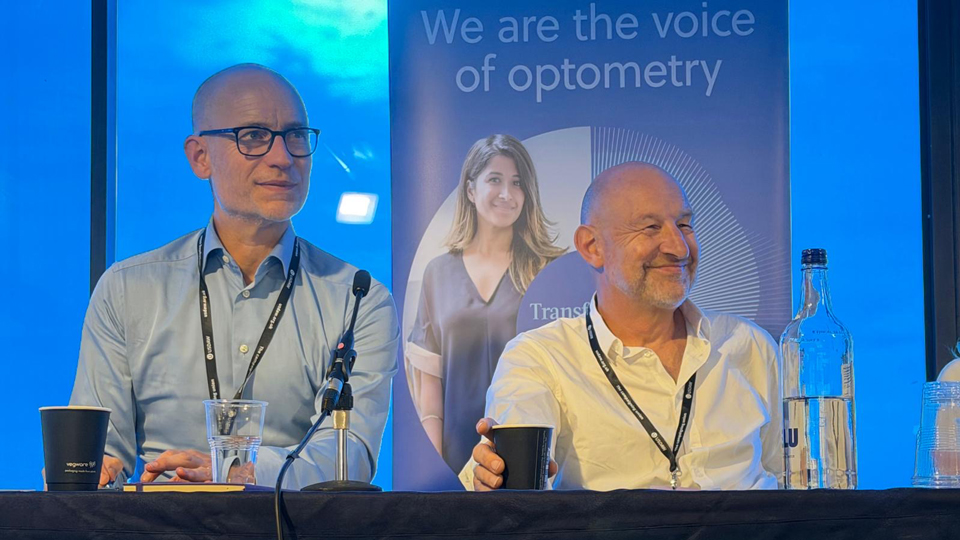
Optometry is ready to help the NHS deliver care closer to home, Adam Sampson said during an AOP panel event at the Labour Party Conference
Liberal Democrat MP and mental health spokesperson, Danny Chambers, used the collapse of NHS dentistry, which he said is causing people to present at A&E with advanced dental problems, to highlight this point.
In Liverpool, president of the Royal College of Ophthalmologists, Professor Ben Burton, told attendees at the From Hospital to Community: Transforming the patient experience panel that Labour’s much-discussed diagnostic centres would need investment if they are to succeed in bringing NHS waiting lists down.
Continuing to rely on private providers to pick up NHS work will lead to “an unconnected, fragmented community service, duplication of activity and unnecessary work being done, with costs out of control,” Burton said.
2 A shift to “neighbourhood health” involves everyone
During the Health & Care Forum’s Prevention in practice: how neighbourhood health services can Ttansform the NHS event, Kinnock expressed his belief that “optometry is absolutely a vital part of the neighbourhood health service.”Ensuring that multiple voices are included in the building of such a service was a theme that echoed across both the Labour and Liberal Democrat conferences.
At the Labour conference, Matthew Taylor, chief executive of the NHS Confederation, emphasised that often people mean slightly different things when they speak about neighbourhood health.
He also noted that the concept will not materialise unless the most deprived communities are at the centre of building it.
“If you knock on doors and you try and solve people’s problems, they won’t just be about health,” he said.
At the Liberal Democrat conference, OT spoke to Ruth Lowe, policy and engagement manager at Health Equals, a campaign funded by the Health Foundation.
Preventative healthcare needs to take into account all services that a person might encounter, Lowe said – including those tackling issues such as toxic air, unsuitable housing, and insecure work.
“Sometimes it’s like many people coming to a roundabout at the same time: who gives way and who goes first? Who leads?” she noted.
Universities with well-established healthcare teaching programmes can be influential in acting as anchors and bringing services together, Hoskins said.
3 Technology at the forefront
Speaking during the AOP’s panel event, primary care minister, Stephen Kinnock MP, said that a single point of access for digital imaging would be “an interesting and exciting tool.”
A single point of access could “support the speed of diagnosis and of patient care, and that transition from High Street to specialist when those referrals are taking place,” Kinnock said.
The ability to seamlessly share images between primary and secondary care is one of the AOP’s key asks of the Government.
The technology would improve patient access, experience and outcomes, Kinnock emphasised.
Elsewhere, Burton noted the limits of the technology that the NHS currently uses.
Duplication of work because of poor interoperability and the poor quality of optical coherence tomography scans that ophthalmologists might receive has led to “a complete, hopeless mess,” Burton said.
At the Liberal Democrat conference, Tim Gardner, assistant director of policy at the Health Foundation, questioned the detail included within the 10-Year Health Plan with regards to the Government’s promised shift from analogue to digital.
At present, there is little included that suggests a substantial difference from what exists already, Gardner said.
4 Ophthalmology on side
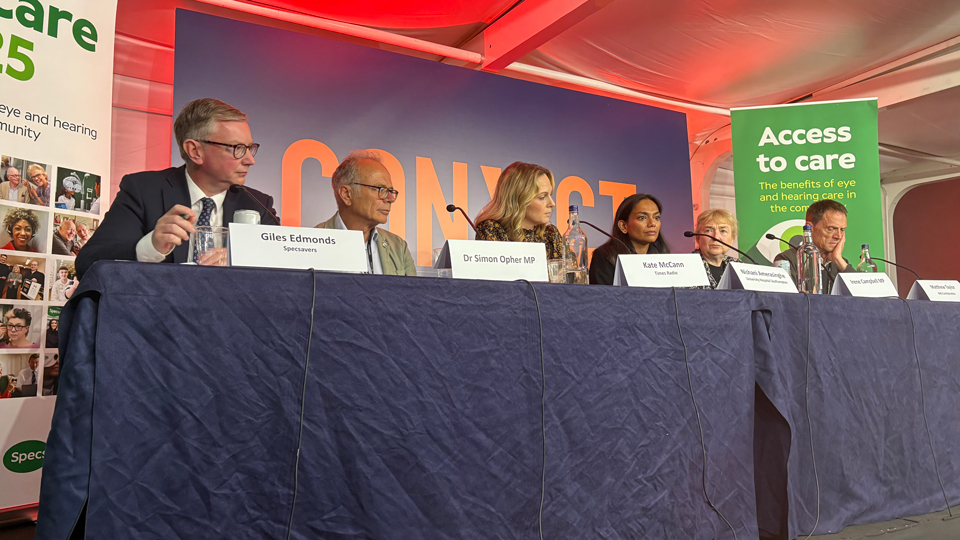
Speaking on Specsavers’ A vision for the NHS: optometry’s role in the NHS 10-Year Health Plan panel at the Labour Conference, consultant ophthalmologist, Nishani Amerasinghe, emphasised that ophthalmology is supportive of optometrists taking on further clinical work from hospitals.
“For us as consultants in the hospital, optometrists are gatekeepers,” Amerasinghe said.
She explained: “In the hospital, we are overwhelmed. We are overwhelmed with our current services, and we need help, so that those patients that require routine monitoring and early diagnosis can be picked up in the community.
“We have got a population of highly skilled health professionals in the community who are able to screen patients, and monitor them if they are low risk. So, why are we not using them efficiently?”
Amerasinghe emphasised: “That is how we feel as a group of consultants. That would give us the time and space to look after complex patients, complex diagnoses, complex surgery, where that it is needed in hospital.”
One issue that must be addressed is public awareness that an eye examination does not only test vision, she believes.
“The eye test isn’t just about glasses. That’s the problem, and the public awareness issue that we have to get out there,” Amerasinghe said.
“Most of the eye test is about picking up eye disease, so that it is picked up early and then referred on. We talk to the general public about it, and they’re like, ‘I don’t want to go to my optometrist, because if I go, I’ll need to get glasses.’”
She emphasised: “That is what people have to get over. It is our responsibility to show that actually, this is like going to the dentist and making sure that your eye health is well controlled.”
5 A Conservative focus on the economy
The Conservative Party Conference, held at Manchester Central Convention Centre, was light on healthcare policy. Instead, the opposition party focused on a promise to “stand up for fiscal responsibility,” with shadow chancellor, Sir Mel Stride, promising to “to face some hard truths” during his speech.
Conservative leader, Kemi Badenoch, outlined that her party would focus on reducing Government debt by cutting public spending.
What does this mean in reality? £47 billion saved per year, according to Stride, half of which comes from planned cuts to the welfare bill.
In the same speech, Stride also announced that his party would abolish business rates for High Street shops – which those with optical businesses working in the retail space are likely to take note of.
6 Greater accessibility is needed – on the street, online, and in the supermarket aisle
Guide Dogs highlighted the issue of pavement parking and its impact on blind and partially sighted people across conference season, whilst the Royal National Institute of Blind People (RNIB) focused on accessibility in digital as well as physical spaces.
“Our focus has been around accessibility and inclusion. That isn’t just limited to packaging – it’s across the board, including in terms of accessible technology, particularly when it does come to consumerism and people wanting to shop online,” Francis said.
She emphasised that currently, 28% of blind and partially sighted people either don’t use the internet or don’t have access to it.
The RNIB invited Google, ITV, and pharmaceutical firm Procter & Gamble to discuss how they are leading from the front to prioritise accessibility as part of its fringe panel.
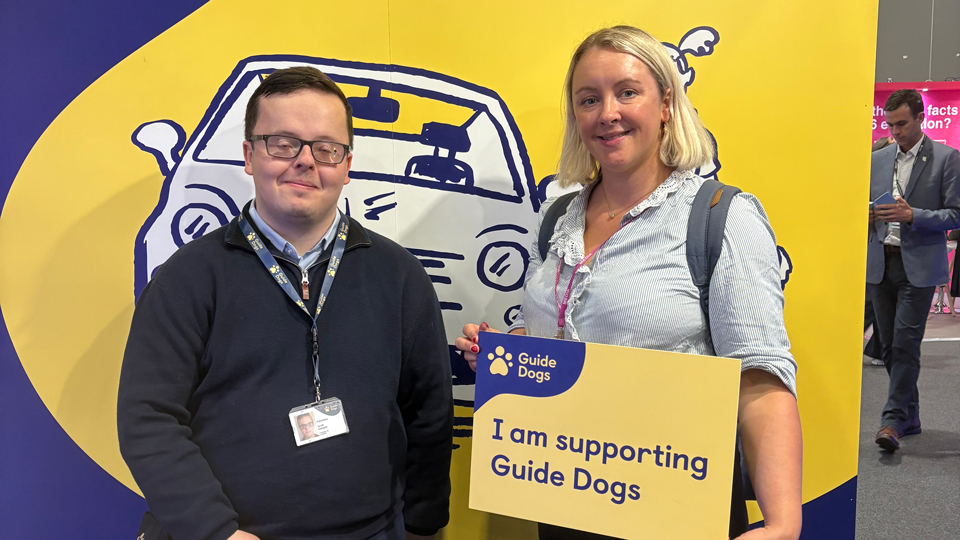
Meanwhile, Guide Dogs wants the recommendations of a 2020 consultation on the issue of pavement parking to be actioned by this Government.
“This is an issue that doesn’t just affect people with a guide dog – it affects people with disabilities; people with families out with push chairs. It’s the idea that you cannot get along your own pavement; you’re forced out into the road, into oncoming traffic,” Andrew Lennox, the chief executive of Guide Dogs, told OT.
7 The AOP view: “huge opportunities for optometry”
For the AOP, a conference season highlight was successfully speaking directly to the health ministers of the main three political parties, along with their special advisers.
Post-conference, AOP chief executive, Adam Sampson, emphasised to OT the opportunity that optometry currently has to have its voice heard.
“The position of the current government provides an opportunity for us,” Sampson said.
“They are committed to significant reform of the NHS in England. They do want to move services from hospitals into the community, and they have a full healthcare policy which has huge opportunities for optometry to have influence in some of the policies that we have been arguing for for years.”
Sampson acknowledged the concerns of those in the sector who feel that they have seen a number of similar plans before.
However, he noted that when “you have a government that is talking, using words of opportunity for the sector, it is our job to push as hard as possible to get what we want.”
He added: “Let’s be clear, we may not get it. But if we don’t try, we’re condemned to never get anything. Opportunity is the key.”


Comments (0)
You must be logged in to join the discussion. Log in