


22 April 2026
A new centre for innovation and collaboration between eye and healthcare professionals, academic institutions, and industry partners across Europe, the Middle East, and Africa (EMEA) has opened in London’s Knowledge Quarter.
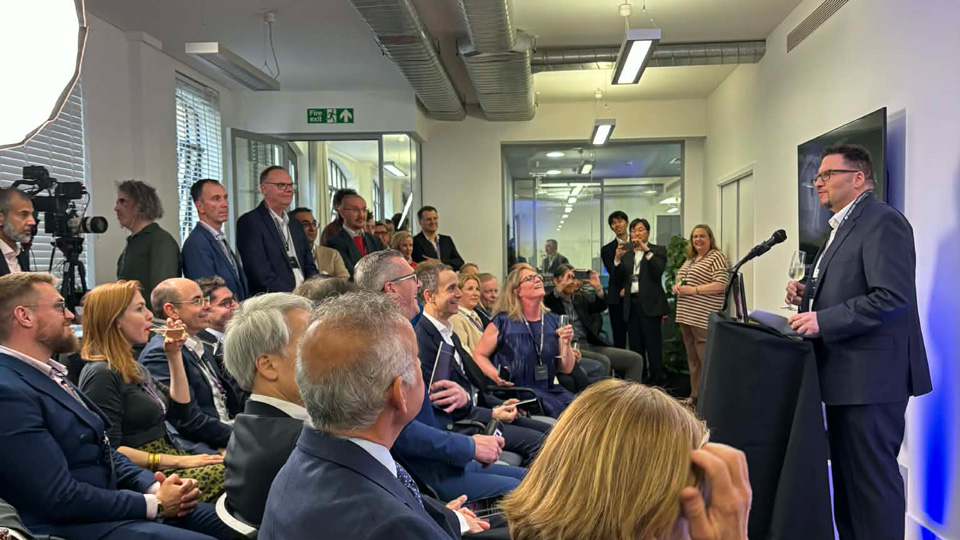
A grand opening was held on 16 April for the new Topcon Healthcare Innovation Centre (THINC EMEA).
The opening event heard from a number of speakers on progress in optical technology, the important role oculomics will have in the future of healthcare, as well as what this could mean for optometrists.
Guests also toured the facility and met with start-ups supported by Topcon, or who will be established at THINC EMEA.
This will include Cascader, a start-up created from a collaboration between Moorfields Eye Hospital, University College London (UCL) and Topcon Healthcare.
OT shares takeaways from the opening event.
Bringing healthcare innovation to life
Ali Tafreshi, CEO of Topcon Healthcare Inc. and THINC, acknowledged the work of ophthalmologists, data scientists and vision scientists in working towards a vision of ‘healthcare from the eye,’ with Moorfields Eye Hospital and University College London coining the term ‘oculomics.’
Tafreshi explained: “Healthcare from the eye is taking oculomics and operationalising it in the real world. It’s an honour to be standing here in London talking about healthcare from the eye with the Moorfields Eye Hospital and UCL team.”
Healthcare from the eye is taking oculomics and operationalising it in the real world
Hideyuki Takizawa, managing executive officer of Topcon Corporation, gave a history of Topcon, as well as the strategy and growth of its eye care business.
He highlighted that the importance of preventing eye disease will rise with the ageing population, adding: “Increasing healthcare expenditure and a shortage of ophthalmologists have emerged as pressing social challenges.”
“Topcon is committed to addressing these challenges and contributing to people’s health and happiness through the power of vision,” he said.
The executive highlighted Topcon’s developments in optical coherence tomography and integrated robotics technology, which enable everything from alignment to image capture and data analysis.
As the eye offers a powerful source of insight into overall health, Topcon is focused on “unlocking” what it calls “healthcare from the eye.”
“Topcon’s new concept, healthcare from the eye, represents the next generation medical model that views the eye as the gateway to all body health. We aim to identify health risks earlier than ever before, supporting better outcomes and smarter care,” he said.
Progress in research
Anat Lowenstein, professor of ophthalmology and vice dean at Tel Aviv University, and outgoing president of Euretina, discussed progress in research, particularly in the development of home optical coherence tomography (OCT).
The process for providing an at-home OCT would see the ophthalmologist prescribe the technology to the patient. The prescription would be sent to a monitoring centre, which sends the device to the patient and oversees compliance.
The patient would be responsible for performing an OCT daily. The images would be automatically uploaded to a cloud-based system and analysed by artificial intelligence (AI) technology.
The ophthalmologist can oversee what is happening and can access the scans, AI annotation and projection maps. They can also arrange for alerts to be set based on time or according to a certain level of fluid.
In 2024, Notal Vision’s Home Optical Coherence Tomography System received US Food and Drug Administration approval.
Lowenstein summarised a “plethora” of trials completed with the technology, which have been able to show that agreement between office and home OCT is “very high” in both the presence and absence of hyporeflective spaces.
“We’ve been able to show that patients – most of them elderly patients – are able to use the technology. They are very loyal and doing six scans per week. The scan is very, very short,” she said.
Describing the home OCT as “promising technology,” Lowenstein suggested this sets a framework for remote monitoring.
Structural challenges and three shifts for the NHS
Professor the Lord Darzi of Denham, director of the Institute of Global Health Innovation, spoke about structural challenges in healthcare innovation, and the NHS 10-Year Health Plan.
As a colorectal surgeon, he explained: “There has always been a question that stayed in my mind for most of my working life – why do we so often meet patients at the worst possible moment? I see this in my own speciality. When the damage is done, when the options have narrowed, when a little bit earlier would have changed everything.”
Centres such as THINC EMEA, offer a “genuine, practical answer” to that question, he suggested.
Referring to the independent investigation of the NHS in England, published in 2024, he noted that outcomes “fall short of what is possible – not for lack of commitment or talent in the NHS.”
“The problem has always been structural. We build systems around reactive drivers; we wait for sickness, and our hospitals are world class at rescue, but we’ve been far less brilliant at keeping people out of them,” he shared.
Darzi outlines the three essential shifts set out in the NHS 10-Year Health Plan, and how centres such as THINC EMEA support these moves.
First, he described the shift from hospital to community: “For decades, the hospital has been our default – right for acute crises, but wrong for routine monitoring of long-term conditions such as glaucoma checks, diabetic screening and macular disease.”
These require good imaging, skilled assessment and timely reviews – not hospital theatres – he said, adding: “They belong closer to where people live. That is the heart of this centre: accessible, connected, and community-based.”
The second shift is analogue to digital, and Darzi shared: “The eye is medicine’s greatest case study of digital transformation. Here we can see blood vessels and nerve tissues directly, not invasively, at an extraordinary resolution.”
Highlighting the quality of imaging data and AI analysis, he said: “The real question is whether our systems are ready to use it.”
THINC EMEA brings together UCL research, Moorfields clinical leadership, and Topcon’s imaging expertise into partnership, he noted.
He suggested this model of partnership “turns promising technology into real clinical pathways, because innovation without implementation is just a paper. The NHS needs the full chain – THINC builds it,” he said.
The final essential shift for the NHS is from treating sickness to prevention.
Darzi said: “Vision loss is preventable. We see the warning signs in images long before patients lose sight.”
“We have effective treatments and we act in time. Too often we fail, not because the science let us down, but because the system let the patient down: the missed risk, the delayed appointment, the unreviewed image,” he observed.
THINC EMEA is designed to help break that pattern, he suggested: “To find problems earlier, to connect patient care faster, to move from occasional checks to smarter monitoring.”
Reflecting on why centres like THINC matter, he shared: “Britain has outstanding science and clinical institutions. What we often lack is the connective tissue between discovery, engineering, industry, and patient care.”
THINC, as a home to start-ups and companies like Cascader and Foresight Research, build that bridge, Darzi said: “It is a model of academia, industry, and the NHS working in close partnerships. In today’s health service, that is a necessity.”
Darzi emphasised the importance of the human relationship between clinicians and patients, adding that technology does not replace trust, but that “deployed wisely, it strengthens.”

Code to clinic
Pearse Keane, professor of artificial medical intelligence at UCL Institute of Ophthalmology, and a consultant ophthalmologist at Moorfields Eye Hospital NHS, spoke about the journey from “code to clinic” and the founding of oculomics start-up, Cascader.
The journey began with a collaboration between Moorfields and Google DeepMind which developed an AI system for macular OCT scans.
“We showed a proof of concept that this AI system that we had was as good as some of the world’s leading experts in looking at macular OCT scans,” Keane said.
This research was published and garnered a great deal of excitement, however, Keane said: “It turns out going from code to clinic is a little bit harder.”
From this collaboration, a research group in Moorfields and at the Institute of Ophthalmology at UCL was established, and in 2020, the group coined the term ‘oculomics.’
Keane outlined further research projects that the group has been involved with, including in Parkinson’s Disease and Ret Found.
In May 2025, the spin-out of Cascader from Moorfields, UCL, and funded by Topcon, was announced.
Keane noted that Moorfields, supported by its biomedical research centre, has built a data pipeline, Insight, which holds more than 35 million images.
“We add five million images per year automatically and we’re the world’s largest ophthalmic imaging bioresource,” he said. “We have more than 10 million images from Topcon in this repository. We think that is going to be key to our efforts.”
Cascader’s initial focus will be on macular diseases, such as age-related macular degeneration, building on the work led by Moorfields and UCL’s Institute of Ophthalmology, including the collaboration with Google DeepMind.
Keane shared that Cascader is excited to bring its technology to places like Moorfields, but particularly to the High Street.
“It’s all about getting this in the community, exactly in line with the 10-Year Plan. We’re even more excited about shared care between optometry and ophthalmology for the future,” he said.
Remarking on the rollout of OCT scanning in community optometry across the UK, Keane suggested this presents an opportunity: “Imagine if every GP in the country had their own MRI scanner or CT scanner. This is the opportunity we have right here.”
Earlier this year, Cascader announced a partnership with Specsavers.
Bringing optometrists on the journey
Michael Bowen, director of knowledge and research at the College of Optometrists, spoke about supporting the role of optometrists in the future of connected care.
Considering this support begins from a point of education and training: “What is the capacity that the profession needs to have in five or 10 years’ time to engage with this?”
Bowen described a need to be more responsive and “fleet of foot” in education and training of optometrists, adding that the pace of development in eye health research and innovation is picking up.
“We have to make sure that we build the capacity for optometry to keep pace with that and to feel comfortable with that pace,” he said.
“We also need evidence about the acceptability to the bulk of the profession – to the optometrist who is at the LED screen face of the practice slit lamp – we need to make sure that they feel comfortable and confident, that the considerations of their working environment have been taken into account in the development of these technologies,” Bowen explained.
Looking at patient access will be important, and Bowen pointed to the distribution of primary care practices in England.
He explained: “We know that they have pressures on them due to the way we structure our eye health care and primary care, that means they are not always located in the communities or close to the communities that maybe need that care the most, and are most at risk from some eye diseases due to deprivation.”
Bowen said: “We need to make sure that we can both enable access on a very equitable basis, but we also need to be confident that those data sets are truly representative of the populations that we want them to serve, making sure that we can get those patients who maybe aren’t accessing our services at the moment, into those systems, into those processes, and into the research.”
The College of Optometrists is closely involved with the UK National Eye Health and Hearing Study, which will provide baseline data to understand the prevalence at a population level of eye health and hearing health in the UK.
Bowen emphasised the importance of cooperation and collaboration, sharing: “I think there’s been a long history of successive UK Governments deeply underfunding eye health research, despite the impact that eye health has on the NHS.”
“We’ve been batting well above our weight for a long time in eye health research, and to have a centre like this will just give that real boost,” he said.
The need for action
Cathy Yelf MBE, chair of Action Against AMD and former CEO of the Macular Society, spoke about approaches to tackling age-related macular degeneration and, in particular, finding ways to prevent the early stages from progressing to the later blinding forms.
Action Against AMD is made up of Macular Society, Blind Veterans, Sight Scotland and Sight Scotland Veterans.
The organisation takes three approaches to its work: collaboration, exploring drug repurposing potential, and using data from primary care sources to explore the earliest manifestations of, and the progression of, age-related macular degeneration (AMD).
Yelf pointed out that it is estimated that the number of people with some form of AMD is around 200 million people currently, but is expected to rise to 300 million people by 2040.
By 2040, many of those people will have early stage AMD, Yelf said, which is why preventing progression from early to late stage is so important.
There has been progress in the 20 years since the arrival of anti-VEGF treatments for wet AMD, but Yelf pointed out, it is still not curable and most of it isn’t treatable. Many therapies that do exist are burdensome, expensive, or treat the late and end stage of the disease, when irreversible damage has already occurred.
Even if therapies to treat early-stage disease can be found, Yelf suggested that there is a lack of ways to measure the success of early-stage intervention.
Action Against AMD aims to use primary care data to identify markers of disease progression and efficacy of early-stage intervention.
We must succeed in this. A diagnosis of AMD is utterly life-changing
Made up of four charities, Action Against AMD represents a large population of patients, Yelf said, sharing: “We are quite an important channel through which we can engage patients in this work.”
“In our experience, patients are keen to share their data, provided two things are fulfilled: one is that they trust the people who they are giving their data to, and secondly, that they believe the data will be used for the benefit of patients and not to generate corporate profit,” she said.
As charities, members of Action Against AMD ensure patient interest comes first, that their data is secure and will be used for the benefit of patients, and that responsible research groups are able to access the data safely and affordably to bring patient benefits faster.
“Because we must succeed in this. A diagnosis of AMD is utterly life-changing,” Yelf said.
Yelf added: “If we don’t find new ways to prevent and treat age-related diseases like AMD, dementia, Parkinson’s, and cardiovascular disease, we are going to break health systems all over the world, not just the publicly-funded ones we are lucky enough to have in the UK.”


Comments (0)
You must be logged in to join the discussion. Log in