


04 March 2026
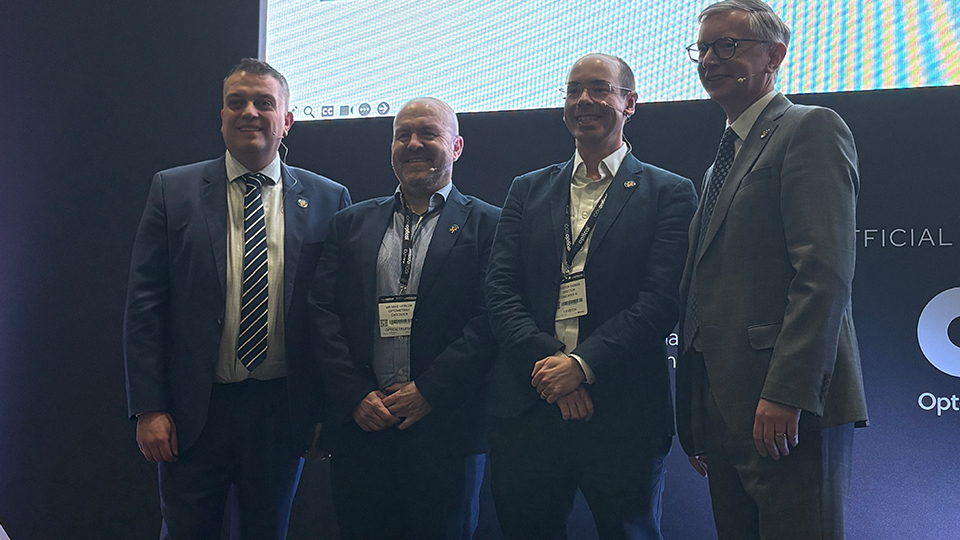
Specsavers announced a partnership with medtech company Cascader at 100% Optical 2026 (Sunday 1 March).
Speaking on the main stage, consultant paediatric ophthalmologist at Moorfields Eye Hospital and Cascader chief executive, Peter Thomas, announced that the partnership will work to understand the tools that help practitioners in community practice to deliver care, and how products that meet those needs can be delivered.
The aim is to ensure that as many patients as possible benefit from AI, Thomas told attendees.
The partnership will investigate the best ways to implement AI tools in practice to support clinicians and could “transform eye care in the UK and globally,” Specsavers said.
The company’s role is to transform research into “clinically and operationally useful products,” Thomas said.
Being able to provide care without a patient having to be in the same room as a practitioner with a specific skillset “puts us in an incredibly powerful place, where we can massively expand the kind of eye care we’re able to deliver in settings outside of a traditional hospital,” he explained.
A new model of care
Mike Horler, optometry consultant at Cascader, told 100% Optical attendees that by 2050, the number of 80-year-olds will triple, whilst the number of 65-year-olds will double.
This is significant because the Government’s priority of moving from hospital to community care, as outlined in the 10-Year Health Plan, is a key opportunity for optometry, Horler said.
There will be an “evolution in pathways of care” over the next 10 years, Horler believes.
He also explained the concept of the ‘AI chasm’ – the specific point where a piece of technology is working effectively, but before it has reached mass deployment – to attendees.
AI tools have the ability to provide real-time advice and guidance and could help to refine referrals whilst allowing the optometrist to remain the primary decision maker, Horler said.
Horler identified oculomics, where AI could potentially be used to help diagnose system conditions, as a potential area where tools could be helped.
He also acknowledged the glaucoma secondary care waiting list in England, where he noted that patients at both high and low risk are currently sitting “in the same big referral queue.”
AI could help to refine the waiting list and could allow up to 30% of low-risk cases to be seen in primary care, Horler believes.
AI tools for macular disease are currently the “gold standard,” Horler added, whilst tools for glaucoma are a work in progress, and oculomics is the new frontline for AI technologies.
We are fully committed to working with Cascader to learn how to deploy AI technology, at scale
A continual refinement of patient care
Thomas said that the partnership between Cascader and Specsavers is “aimed at finding out what is the best way for us to implement these cutting-edge AI capabilities into optometry, so we get maximum benefit for our patients and for our clinicians who will be using the products.”
During his 100% Optical presentation, Thomas noted that healthcare sees continual refinement in how it delivers care to patients – as is demonstrated by the new Moorfields Eye Hospital site, which is due to open in 2027.
Giles Edmonds, clinical services director at Specsavers, said that the partnership with Cascader will allow Specsavers to “truly innovate pathways of care for glaucoma in the UK.”
Edmonds said: “By working together as a sector, can we meet the eye health challenges we face – such as the glaucoma tsunami, with cases predicted to rise as the population ages.”
He added: “We are fully committed to working with Cascader to learn how to deploy AI technology, at scale.”
The partnership will allow Specsavers to address the ‘AI chasm’ and iron out issues that might provide a barrier to deployment at scale, Paul Morris, director of professional advancement at Specsavers, said.
The aim is to ensure the technology is available to as many people as possible, Morris told attendees.
“AI is evolving into a powerful clinical partner that augments a practitioner’s existing skills,” Morris said, adding: “It provides a safety net that enhances diagnostic confidence, reduces errors, and allows optometrists to deliver better patient-centred care.”
Thomas added: “We see huge potential for AI to support earlier detection, screening and proactive management, driven by systemic health insights from optometry consultations, images and data.
“Working with Specsavers will help us to better understand how to deploy this kind of technology far and wide, in the UK and beyond.”

100% Optical 2026
Practitioner wellbeing, brand collaborations and artificial intelligence took centre stage at 100% Optical 2026


Comments (2)
You must be logged in to join the discussion. Log in
Don Williams09 March 2026
Congratulations to Specsavers and Cascader on what appears to be a highly significant partnership for the future of community eye care. The real challenge in AI is not simply developing promising algorithms, but translating them into safe, scalable and clinically meaningful tools that genuinely support practitioners and improve patient pathways.
It is particularly encouraging to see the emphasis on augmenting clinician decision-making rather than replacing it, especially in areas such as glaucoma where service demand continues to rise. If implemented well, this kind of partnership has the potential to help bridge the gap between innovation and real-world deployment in optometric practice.
As a clinician with a strong interest in AI, currently halfway through a Master’s in Artificial Intelligence and having also completed the Oxford University AI programme, I find this development especially encouraging. The profession needs exactly this kind of collaborative ambition if AI is to deliver practical value for patients and clinicians alike.
ReportLike0
Anonymous06 March 2026
So this will farmed out to the minimum wage optical assistant. The “Optom” still knocking out 10 minute remote quickies. I can this being transformative. Really.
ReportLike18