


24 April 2025
Solutions and best practice in eye care accessibility were the focus when the optometry profession came together in Bristol last week (17 April).
Specsavers and Vision Care for Homeless People (VCHP) were the hosts of the Removing barriers to eye care for those experiencing homelessness event, which was held at the Mercure Bristol Grand Hotel.
Politicians, eye care practitioners, and charity, sector body and local NHS representatives joined those with lived experience of homelessness for the afternoon event, which saw various speakers take to the stage to discuss issue surrounding eye care accessibility.
Speeches were followed by a panel discussion, featuring VCHP founder and chair, Elaine Styles, chief optometric adviser to the Welsh Government, David O’Sullivan, director of policy and strategy at the Federation of Dispensing Opticians (FODO), David Hewlett, and MP and Green Party co-leader, Carla Denyer.
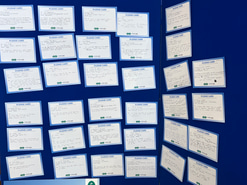
An afternoon tea was then served to guests, who were encouraged to make a pledge to remove barriers to care for homeless people.
A ‘pledge wall’ displaying the promises made was on display throughout the afternoon.
Three GOS amendments to create “nationwide change”
The event was introduced by Specsavers’ director of professional advancement, Paul Morris, alongside chief executive of VCHP, Hannah Telfer.
Specsavers and VCHP have been working in partnership to improve accessibility in eye care for a number of years.
For the past two years, they have also collaborated with Expert Focus, a group of individuals with experience of homelessness in Bristol.
In a pre-recorded video message, Dame Mary Perkins, founder of Specsavers, thanked Expert Focus for their work, which has included help in developing an out of hours clinic at Specsavers’ Merchant Street practice.
“Our expert group told us how things could change, and we listened,” Perkins said.
“They told us that clear vision isn’t a luxury for someone experiencing homelessness – it is essential for personal safety, for finding work and identifying housing opportunities, [and for] assessing vital services.”
She added: “They have helped us to make a positive difference.”
Specsavers’ aim is to influence government policy in this area, Perkins said.
Telfer noted that 354,000 people are experiencing homelessness in England, and that 90% of those who visited VCHP clinics in 2024 required glasses.
Barriers include a fear of the potential cost, ineligibility for NHS funding, lack of signposting to the correct services, fear of being judged, and other urgent needs taking priority, Telfer said.
Jo Osborne, Specsavers homelessness programme lead, gave attendees an overview of the work that Specsavers is carrying out around homelessness and care accessibility.
Partnerships are key to providing care, Osborne said, as is training Specsavers practice colleagues in how to take trauma-informed approach to communicating with patients.
Specsavers’ free eye care offering is now hybrid and includes vouchers, out of hours clinics, and community outreach, Osborne said.
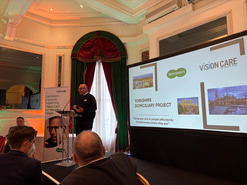
Tony Wing, development manager at VCHP, then provided an update on the charity’s Yorkshire domiciliary pilot, which ran from March 2024 – March 2025.
The pilot, which saw pop-up clinics visit hostels and day centres across West and North Yorkshire, carried out 271 eye examinations and reached more people than VCHP’s London Skylight and Manchester clinics combined in the same period, Wing revealed.
He added that 88% of those who attended clinics during the pilot said that they would not have accessed eye care otherwise.
Telfer emphasised the three changes that VCHP would like to see to the General Ophthalmic Services (GOS) contract: free eye tests and glasses for those experiencing homelessness, a removal of the pre-visit notification for NHS domiciliary services in hostels and homeless shelters, and for patients to be eligible to receive free replacement NHS glasses if their current pair is broken, lost or stolen due to their homelessness.
These changes would create “full scale nationwide change,” Telfer said.
She highlighted that, during the Yorkshire domiciliary pilot, only 7% of those seen were eligible for an NHS eye test in Yorkshire under the current guidelines, while 56% had lost or broken their glasses or had them stolen.
Current guidelines mean that these patients would have had to wait 18 months for their next NHS eye test before being eligible for replacement glasses, Telfer said.
The MP’s view
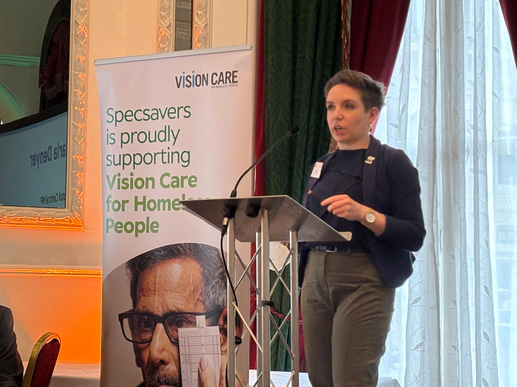
Carla Denyer, the co-leader of the Green Party and MP for Bristol Central, told attendees she believes that VCHP’s asks are “a no-brainer.”
People experiencing homelessness are regularly discharged from hospital with unmet health needs, whilst homelessness amongst refugees has doubled in the past year, Denyer said.
“These are people who don’t have access to some of life’s most fundamental needs: a safe, warm and secure home, and vital health care,” she said.
“These are individuals, like all of us, who need to be able to access those services, but aren’t able to speak to a GP when they need to, and aren’t able to access eye tests, or something as simple as glasses.”
She added: “The unmet health needs of the homeless community have real, heartbreaking consequences. The average age of death for this group is just 47 for men and 43 for women.
“We can and we must do something about this. We cannot stand by and allow this situation to get worse.”
Denyer praised the work of local charities in her constituency, but emphasised that although it is “great that these organisations are filling the gaps, frankly, those gaps have been left by government – and it should be public services that are providing them.”
Denyer will ask the Government to continue the work already started by those attending the event, including working with those with lived experience of homelessness, she said.
She added: “It should go without saying that services need to treat people with kindness and respect.
“When you’re facilitating a service for homelessness, you’re not just delivering an eye test – you may be the first medical professional that that person has met, or it may be the first clinical environment that they’ve stepped into for decades. It’s so important to make that a positive experience, if for no other reason than it might make them more likely to do so again.
“All of this requires significant action from government, if we are going to build the fairer society that we want.”
Green Party MPs are pushing the Labour Government in this direction, including making an amendment to the King’s Speech to ensure that health services are properly funded, Denyer said, adding: “That’s all part of the bigger picture that I and my fellow Green Party MPs are pushing for with this new Labour Government, to get them going in the right direction.”
She will be taking examples of best practice from other nations back to Parliament, she said.
Speaking to OT, Denyer added: “The pilot that that we have talked about today is incredibly eye-opening, if you’ll excuse the pun – how much of a no-brainer it is, and how much more we can help people if we bring services to them.
“I wanted to celebrate the fact that Bristol was the first place that this kind of service was tried, and to hear about what I can do as an MP to help.
“I’ve heard really loud and clear what we can do to help, so we will be following this up.”
Removing the pre-visit notification
Morris began the panel discussion by asking O’Sullivan how the Welsh Government has tackled the issue of removing the pre-visit notification for domiciliary care, and what difference this change has made.
Referencing the new WGOS contract, which came into effect in October 2023, O’Sullivan noted that “Part of what we have done is change our core services for optometrists and the delivery of services in Wales.”
Removing the pre-visit notification was an important part of providing equity of service across both domiciliary and practice settings, O’Sullivan said.
He added: “We needed to change our regulations in Wales to enhance what we were doing, to bring together our services.”
Hewlett noted that FODO “has always stood for eye care for all,” and said that the organisation’s members would react positively if the change was brought forward in England.
The safeguarding justification for the pre-visit notification in domiciliary services is “a bogus argument,” Hewlett said.
Its removal comes down to lack of time within the Department of Health and Social Care, Hewlett told attendees.
He added that Wales and Scotland are more enlightened than England with regards to the issue.
“Every few years we have an opportunity to actually change things, and I think possibly we’re coming up to one of those now. The key thing is to keep pushing,” Hewlett said.
“Persistence is the thing,” he added, noting that he is currently seeing “green shoots” that might mean a potential change is on the horizon.
O’Sullivan noted that collaboration is key to any large-scale change.
“A service should be built in for the needs of the patient, not for the needs of the Health Board,” he said.
“In Wales, we have taken a collegiate approach when we look at designing services. You collaborate widely, and you ensure that you have the people in the room who are relevant, to be able to provide that service.”
He added: “We had contract reform change in Wales, and we had a wide, collaborative approach to that. That’s the first step – get everybody in the room that can make a difference, and have the patient at the very centre of what you’re trying to do.”
Styles emphasised that contracts cannot be updated area by area, and that “a national change,” rather than piecemeal, is needed when it comes to the prior visit notification.
“We have so many optical practices in this country. We have a lot of caring practitioners who will make that next step, to make those contacts in their community, but we need the bureaucracy to change so that we can actually make that difference,” she emphasised.
Hewlett noted that changing regulations is “an important first step” and that “change to GOS is primary,” but that this must come alongside other things.
“We have to educate and bring people along with us, to actually access the care they need. That's a very, very important part of what we’ve got to do,” he said.


Comments (0)
You must be logged in to join the discussion. Log in