


06 August 2026
Milestone anniversaries are often recognised through speeches where people discuss grand ideas: the legacy of an institution; its record of achievements and influence.
As Aston University celebrates the centenary of its optometry department, OT chose to take a slightly different approach – delving beneath these abstract ideas to discover the tangible, everyday objects that hold personal significance for individuals whose professional careers have been shaped by optometry at Aston University.
A seemingly mundane item can act as a touchstone for the collective experiences that join alumni past and present.
From a lab coat to photographs and a distinctive parquet floor, OT uncovers the memories behind a series of 12 objects associated with the Aston University optometry department.
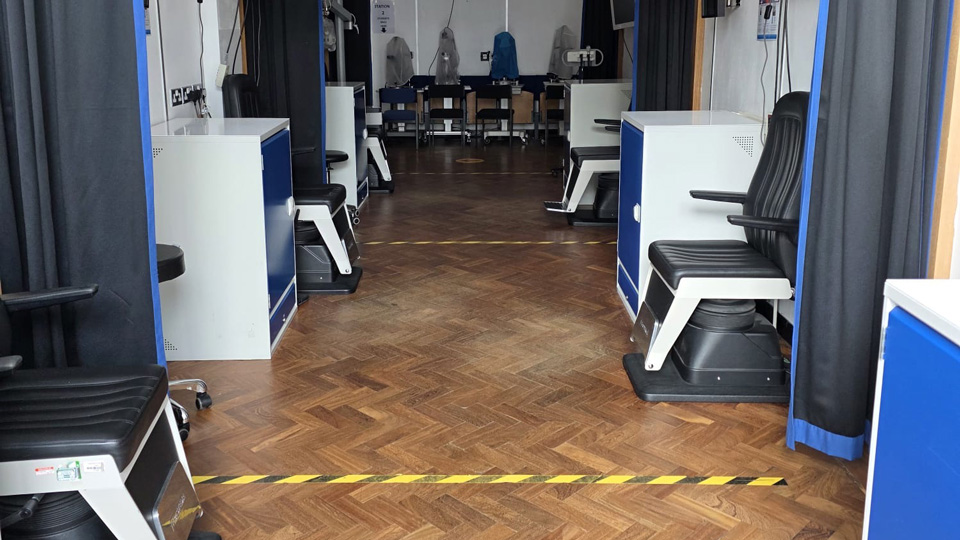
Exhibit 1: parquet floor
OT clinical editor, Dr Ian Beasley, on the distinctive décor that formed a backdrop to his optometric education
“The most enduring memory of my time at Aston University is the 109 clinic, where the majority of our clinical teaching took place. It was instantly recognisable by its distinctive parquet flooring and the curtains that framed the clinic bays. For those of us who trained there, those features became part of the backdrop to formative clinical experiences, nerve-wracking assessments and the transition from student to graduate. The original curtains that I remember from my student days in the early to mid-90s have long since been replaced, but the parquet flooring remains to this day.”
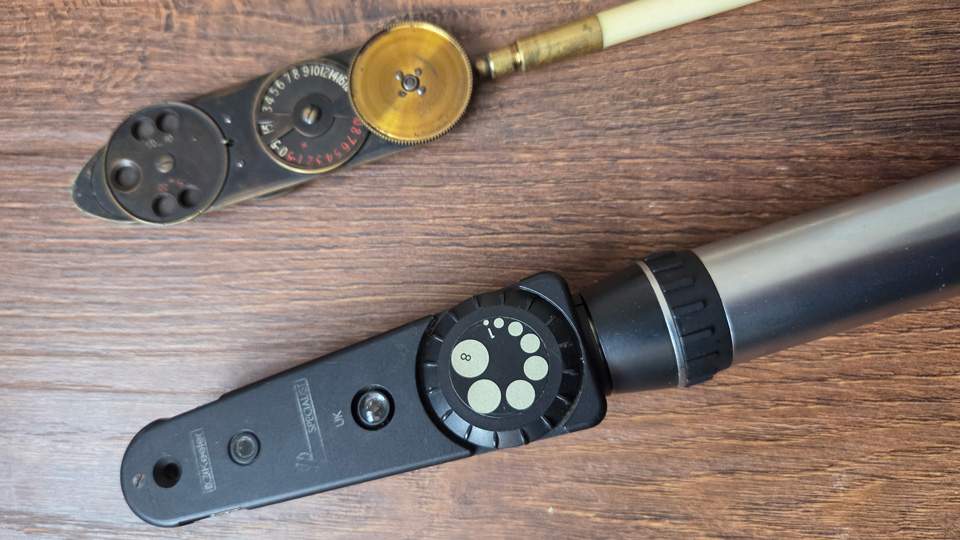
Exhibit 2: ophthalmoscopes
Aston University academic Professor Shehzad Naroo on an antique ophthalmoscope that is older than the optometry department itself
“In the picture you can see my own Keeler specialist ophthalmoscope that I bought in my second year as an optometry student. You can also see an antique direct ophthalmoscope that I purchased in an antique shop near Lichfield Cathedral around 15 years ago for £25. I thought it was a bargain and it is a great conversation starter. It is pretty much the same design as the Keeler specialist ophthalmoscope, but needs an external light source and is over 100 years old. When optometry training started at Aston University, this would have been the instrument of choice.
“When I started my optometry programme at Aston University the very first practical session, in week one of year one, was direct ophthalmoscopy. It was a really proud moment for all of us when we bought our own ophthalmoscope and retinoscope. Sometimes students say to me that it is a very expensive purchase, and that is true, but I remind them that it will last them their lifetime as an optometrist.
“In my pre-reg year I had a horror moment when I decided to open the back of my beloved ophthalmoscope to clean some dust out from the eyepiece. As I loosened the screws all the tiny focusing lenses fell to the floor. I managed to find them all and sent them to the supplier who repaired it – a lesson learnt the hard way for me. I know these days a lot of optometrists prefer to use indirect such as Volk, but personally I like to use both. The field of view may be better and stereoscopic with a Volk but the magnification is better with a direct.”
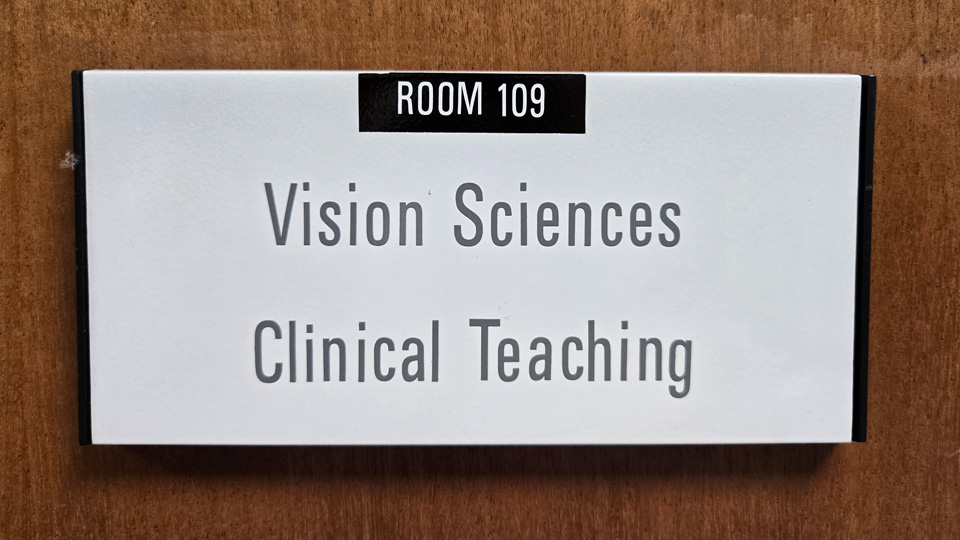
Exhibit 3: door sign
Aston University academic, Professor Leon Davies, on an entranceway that generations of trainee optometrists have passed through
“I have chosen the sign to the door ‘109’, which is the pre-clinical teaching space at the Aston University optometry department. Why? To anyone outside Aston, it would mean very little, but for those of us who studied there in the Vision Sciences building from the mid-80s, ‘109 clinics’ became part of the shared language of our training. It was more than just a room number; it represented the beginning of our practical journey in optometry and a memory that instantly connects Aston alumni.”
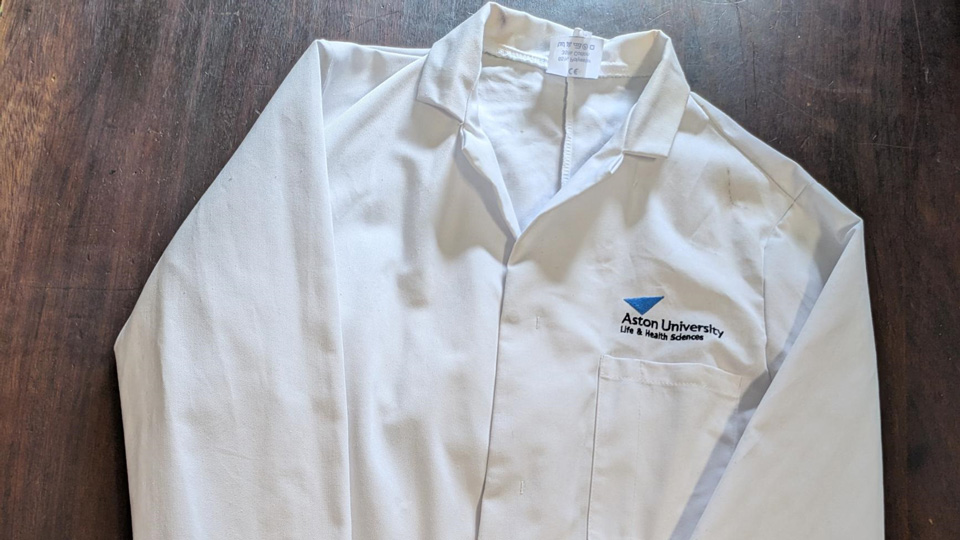
Exhibit 4: lab coat
Aston University teaching fellow, Dr Fiona Baker, on attire that helped optometry students to shift their mindset
“I remember with fondness the white lab coat that as students we had to wear for all clinical work. Putting the lab coat on flicked the switch to a more professional attitude, transforming us from mere students to eye care practitioners. These white coats have since been replaced by polo shirts, following the requirement to be ‘bare below the elbow’ in a clinical setting. On reflection, the white coats didn’t stay white for long, with the inevitable drips of fluorescein combined with the relative infrequency of student washing and let’s not discuss the ironing, or rather lack of...”
Putting the lab coat on flicked the switch to a more professional attitude, transforming us from mere students to eye care practitioners
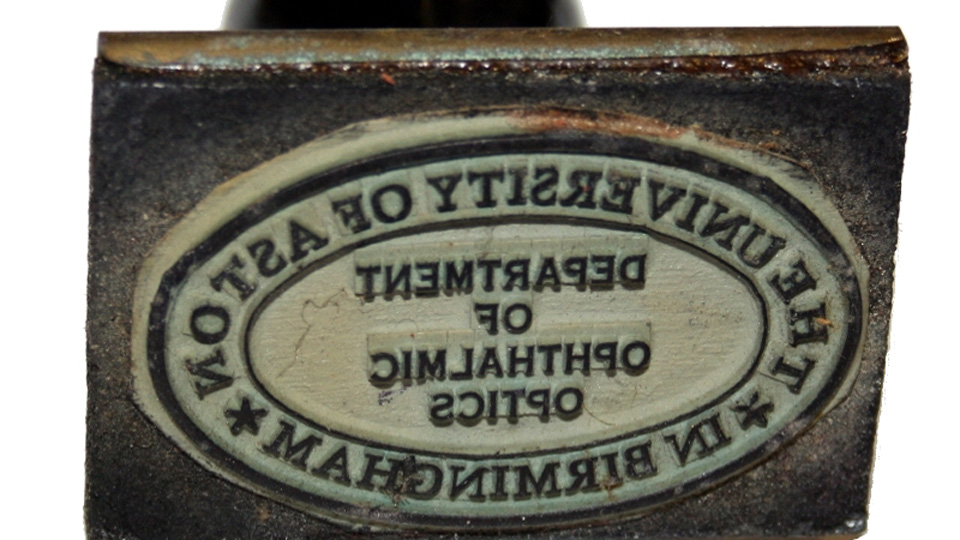
Exhibit 5: ink stamp
British Optical Association Museum curator, Dr Neil Handley, on a stamp that illustrates how names for both Aston University and optometry have changed
“This Aresco ink stamp for the Department of Ophthalmic Optics points to an older name used for the parent institution between 1966–1997: The University of Aston in Birmingham. It also reflects the older two-word term for optometry, meaning it most likely dates from the first half of that time period. Once an official item of some clerical importance, it has lost all practical use and is now merely a nostalgic item. It was preserved firstly in the optometry department’s own museum curated by Tony Sabell, but in 2016 it was transferred to the museum at the College of Optometrists in London.”
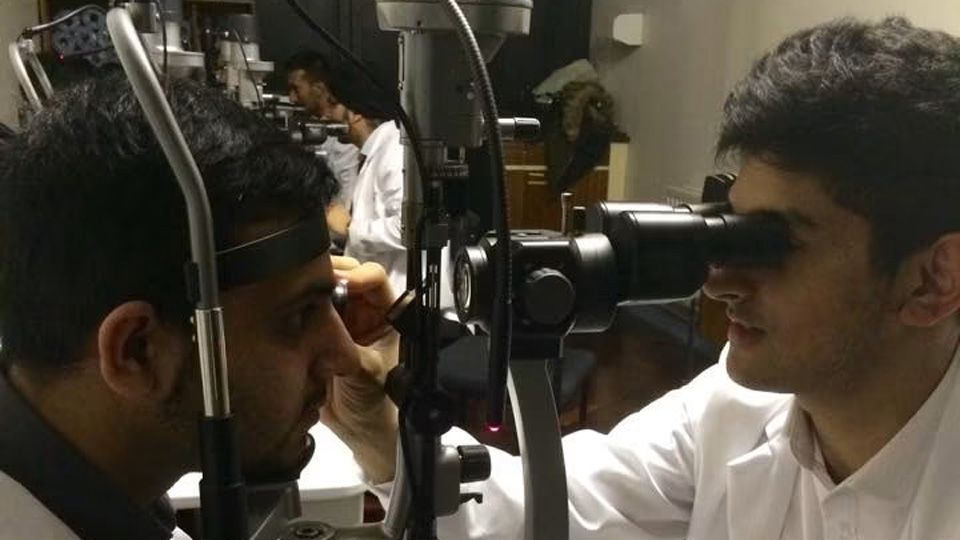
Exhibit 6: photograph
IP optometrist, Hassnain Safdar, on a photograph taken during his second year as an optometry student when he impressed peers with a hidden talent
“This photograph was taken during my second year at Aston University. During our Further Investigative Techniques clinics, some of my peers came to know about my ability to do different accents. Our lecturers and demonstrators included Dr Janis Orr and Prof Leon Davies. They asked if I could impersonate Janis’ Scottish accent and Leon's Black Country twang. The whole clinic, both staff and students, ended up in stiches – although I am still unsure to this day if Leon has forgiven me!”
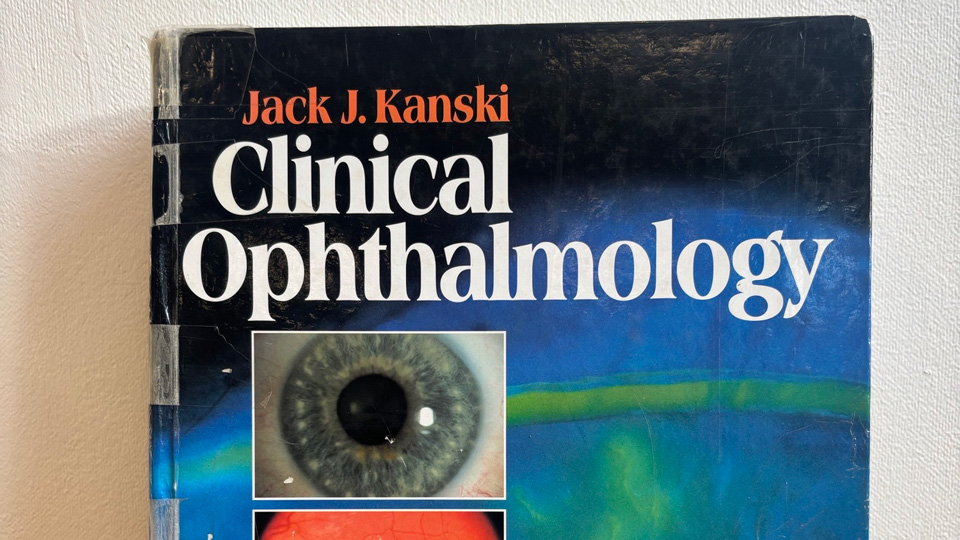
Exhibit 7: Kanski's Clinical Ophthalmology
Head of optometry and audiology at Aston University, Dr Amy Sheppard, on an iconic textbook
“This is a very battered copy of Kanski’s Clinical Ophthalmology, which I bought 25 years ago as an undergraduate, from the lovely bookshop we used to have on campus. It has had to be sellotaped together as I have used it so much: as a student, pre-reg, and beyond. There were far less material and images available online at that time, so we were really reliant on buying textbooks, and this was the ultimate one to own as a student. My parents could not comprehend a book costing more than £100 when I asked them to give me the money for it!”
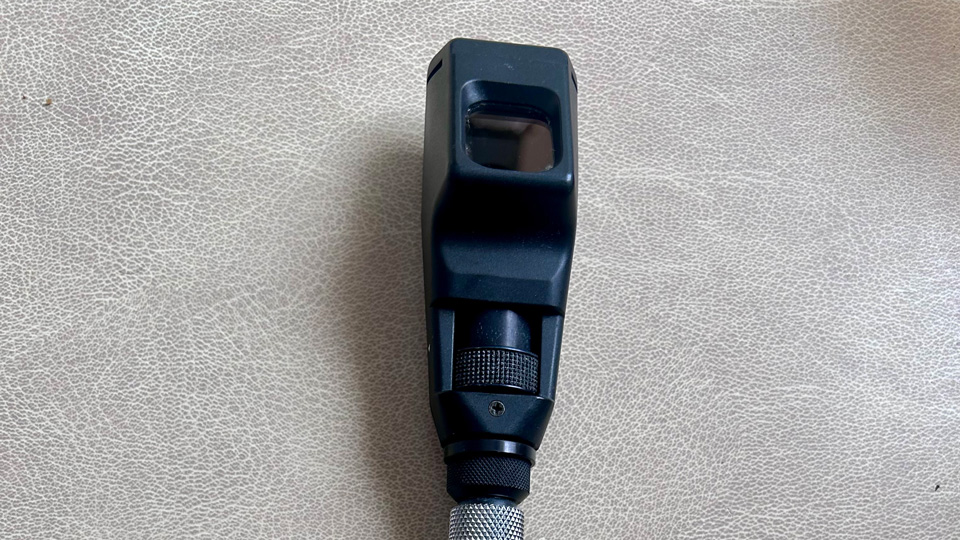
Exhibit 8: retinoscope
Senior teaching fellow at Aston University, Dr Olivia Hunt, on saving money by working as a lifeguard to buy her first retinoscope
“This is my retinoscope that I bought as an undergraduate. It was something that I saved up for ages – in a previous lifetime I worked as a lifeguard, so I worked at an outdoor pool all summer and saved up for my kit. Over the years, things like my ophthalmoscope have changed but I still have my ret. I use it on a weekly basis in my teaching.
“The retinoscope came in its own box,which I still have. The box is realIy battered but the retinoscope has lasted surprisingly well. It has been a constant in my career. I remember learning how to use it and not being that good initially. Now, students ask me, ‘How can you just do it?’ For me, the retinoscope is about remembering myself as a student. We all learn something for the first time.”
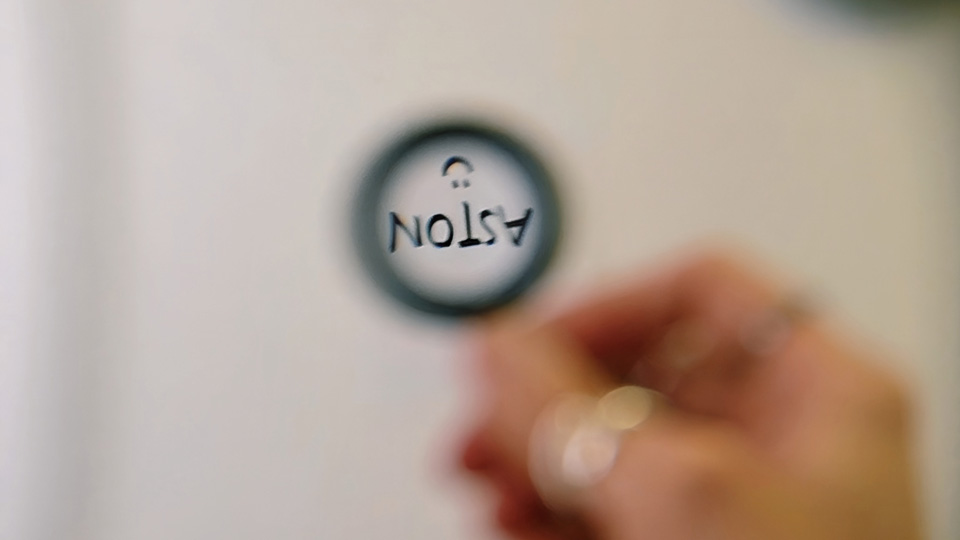
Exhibit 9: lenses
Aston University senior lecturer, Dr Sam Strong, on the optometry department’s strong sense of community
“For my object, I’ve chosen a couple of lenses held in a Keplerian telescope configuration to image a sign I made. It was Professor Leon Davies who first trusted me to lead on the delivery of some basic optics teaching – and now it's genuinely one of my biggest passions. When I think of Aston, I think of the community and the support for both staff and students. When people believe in your ability to do something, it can be truly life altering.”
When people believe in your ability to do something, it can be truly life altering
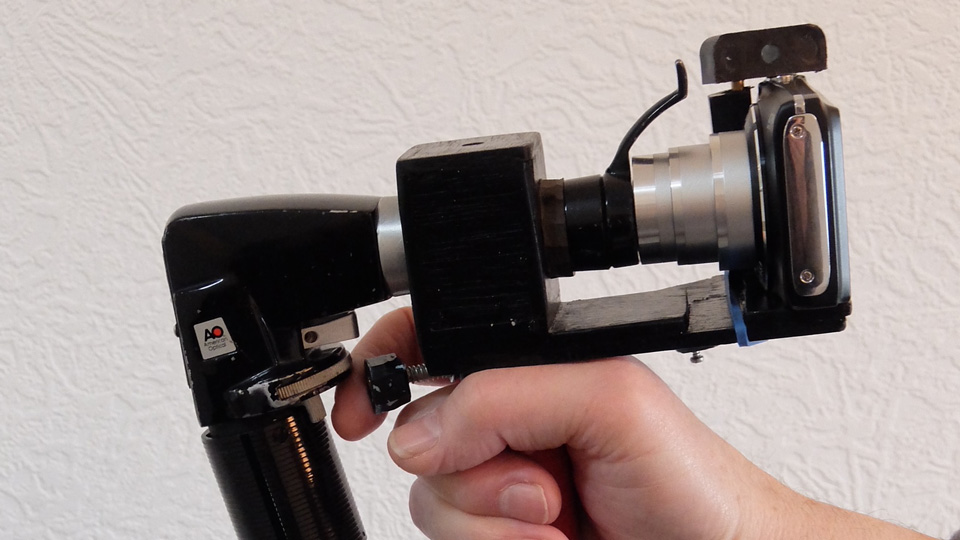
Exhibit 10: a repurposed ophthalmoscope
Retired Aston University lecturer, Dr Colin Fowler, on using ingenuity to save optical equipment from becoming obsolete
“During my career teaching in the Aston University optometry department, it would sadden and frustrate me that useful items of equipment became unusable for various technical reasons.
“This American Optical indirect ophthalmoscope from the 1970s fell out of use after the bulbs became unobtainable. I initially converted it to LED bulb and battery power. I then added an extra handgrip, and an attachment for a small digital camera, so that fundus photographs could be taken. The total cost of the conversion parts, not including the camera, was about £15.”
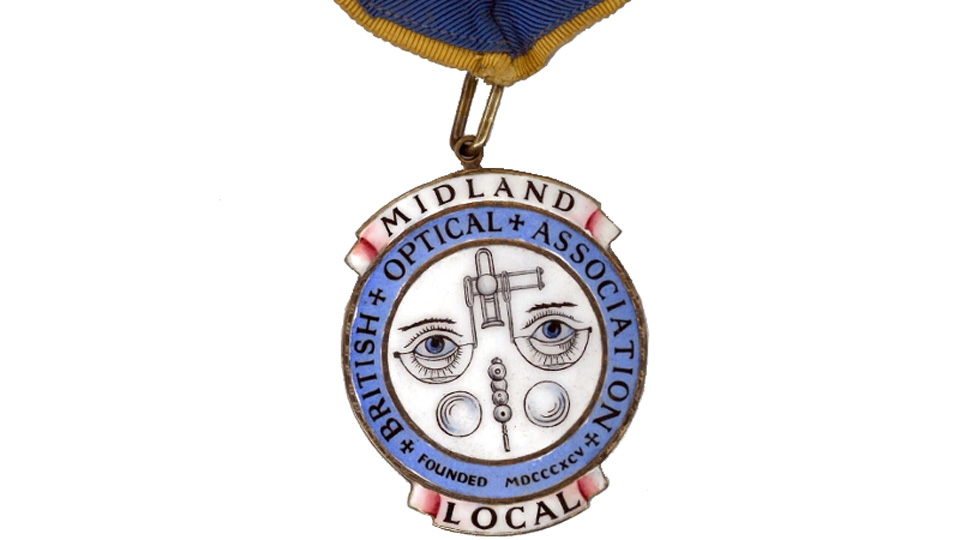
Exhibit 11: Life President’s Badge
British Optical Association Museum curator, Dr Neil Handley, on the regional pride attached to a historical emblem
“This is Robert Green's British Optical Association (BOA) Midland Local Association Life President's Badge, presented to him by the British Optical Association in 1963. He donated the badge to Aston’s departmental museum in 1980, on his 80th birthday. It now resides in the British Optical Association Museum at the College of Optometrists.
“Green was equally proud of his local and national service to the profession and wanted to mark the fact that the BOA Midland Local Association had been the driving force behind the establishment of the first courses in optics to be provided in Birmingham in the mid-1920s. Green himself was from Warwick and later practised in Hall Green. He first qualified professionally in 1921 after seeking instruction outside of his home region.”
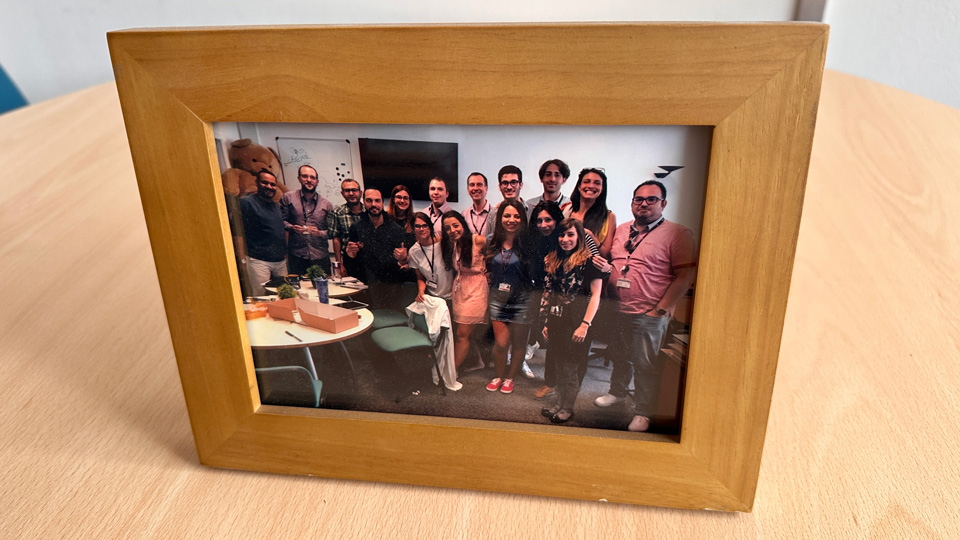
Exhibit 12: framed portrait
Aston University Professor James Wolffsohn on a photo that symbolises what can be achieved through collaboration
“This picture is of the Aston members of the European Dry Eye Network. The network is funded by the European Union and involves universities from Spain, Poland and the UK as well as an industry partner from Germany. It embodied Aston’s collegiate working environment with collaboration between biology, biomedical engineering and optometry – providing world class training for students now in industry and academic jobs around the world. The resulting research not only led to academic peer-reviewed publications, but also to measurable impact, providing patients with better quality of care.”

A century of optometry at Aston University
OT speaks with staff and alumni as Aston University celebrates 100 years of optometric education


Comments (0)
You must be logged in to join the discussion. Log in