
20 July 2026
Collaboration across community optometry, hospital eye services and independent providers must sit at the heart of efforts to tackle growing follow-up delays in ophthalmology, according to a new report.
What’s the problem?
A new report published by ophthalmology provider Newmedica highlights how in England around one in 12 patients awaiting first appointments for specialist treatment are in ophthalmology.
The report notes that more than 11.4 million people are awaiting follow-up care across all specialities, yet there is no requirement to record and publish data on follow-up waiting times.
This lack of transparency is leading to patients being ‘lost in the system’ and facing deteriorating health due to long delays. Conditions such as glaucoma and age-related macular degeneration (AMD) depend on timely monitoring and, in the case of AMD, regular treatment to prevent potentially avoidable sight loss.
“Patients and commissioners need clear visibility of this data,” highlights Nigel Kirkpatrick, consultant ophthalmologist and medical director at Newmedica, adding: “It would empower patients to be able to make more informed decisions about their care.”
“Health commissioners can plan effective services informed by data to meet patient need for wet AMD and glaucoma for example,” suggests Kirkpatrick.

A partnership between ophthalmology and community optometrists
Kirkpatrick continues: “The system performs best when each part of the pathway is working in alignment. That means effective collaboration between community optometry, hospital services and independent providers to meet patient need.”
Kirkpatrick emphasises: “Independent ophthalmology providers, working in close partnership with community optometrists, are ready to play a key role in the solution – supporting more integrated pathways that bring diagnosis and treatment closer to home while easing pressure on NHS hospital services.”
Patients and commissioners need clear visibility of this data
The Newmedica report also notes how in Wales and Scotland, shared care glaucoma services have, for example, been commissioned across every health board – supported by investment in upskilling primary care optometrists.
Kirkpatrick says: “We could scale these types of safe, efficient services to meet demand in England with commissioning that supports higher qualifications and equipment for primary care optometrists and full IT interoperability.”
Is capacity the issue?
The report notes capacity does exist – but it is not always deployed in line with need. “This limits access to care and increases clinical risk,” says Kirkpatrick.
He adds that Newmedica is committed to developing the optometry workforce to support capacity with expertise – including placements and CPD for community optometrists. This is alongside supporting the training of the next generation of consultant ophthalmologists and wider teams at Newmedica.
The report further highlights the expectation of Selective Laser Trabeculoplasty (SLT), a laser treatment recommended by NICE, which should be routinely offered as a first line treatment for chronic open angle glaucoma and ocular hypertension, alongside drops.
“Throughout the independent sector, SLT is now embedded within modern glaucoma pathways, including at Newmedica,” says Kirkpatrick.
Independent ophthalmology providers, working in close partnership with community optometrists, are ready to play a key role in the solution
What needs to change?
Newmedica is calling on politicians and policymakers to make patient choice a reality by equipping commissioners with the data, flexibility and incentives to commission high-quality care wherever it exists. It is also calling for practical steps.
- Mandatory publication of waiting times, including follow-up care
- Consistent commissioning of NICE-recommended treatments
- Full IT interoperability across providers.
Kirkpatrick concludes: “As patient and eye health champions, it’s a message that we’ll continue to share as we engage with politicians, policymakers and commissioners having launched the report in the Houses of Parliament.”
England’s ‘blind spots’ identified in the report
Waiting list pressure across many integrated care boards (ICBs) rose by 10–30% during 2025. Variation in care delivery suggests underuse of existing capacity. AMD injection rates – which prevent further sight loss – range from 2.6% to 14% per 100,000 people, against an expected rate of 10%, indicating differences in access rather than need.
“We are seeing a structural blind spot in how data is captured and used. If follow-up delays are not visible, the concern is that they are not prioritised. That has direct risks for patient outcomes,” says Kirkpatrick.
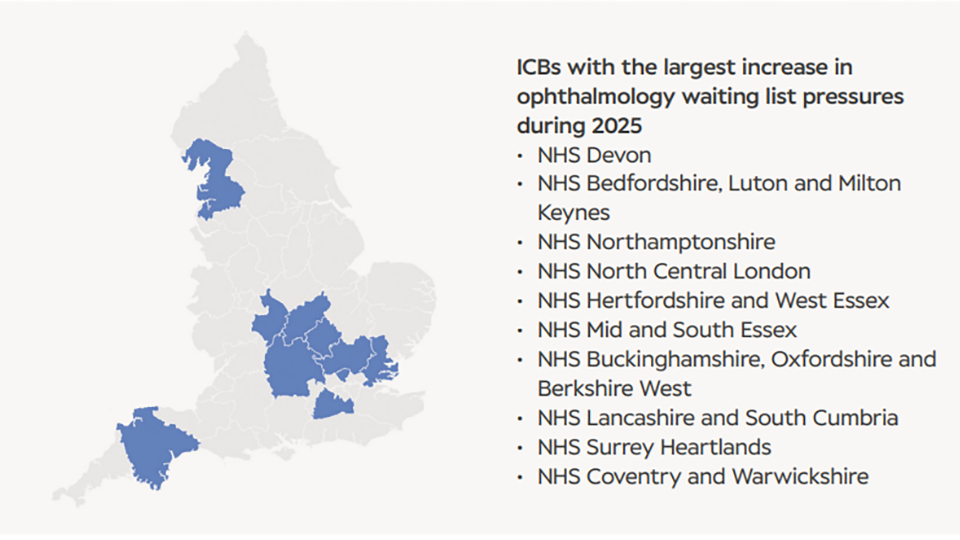
Against a backdrop of rising demand and constrained access, Newmedica commissioned Cambridge Economics Policy Associates (CEPA) to assess waiting lists and gaps between disease prevalence and treatment at ICB level.
Five metrics – covering wet AMD, glaucoma, cataract, outpatient activity and overall eye care burden – were analysed using publicly available data, including the UK Eye Care Data Hub. Findings show demand for care is outstripping treatment capacity, with referral growth exceeding completed pathways across most ICBs in 2025.
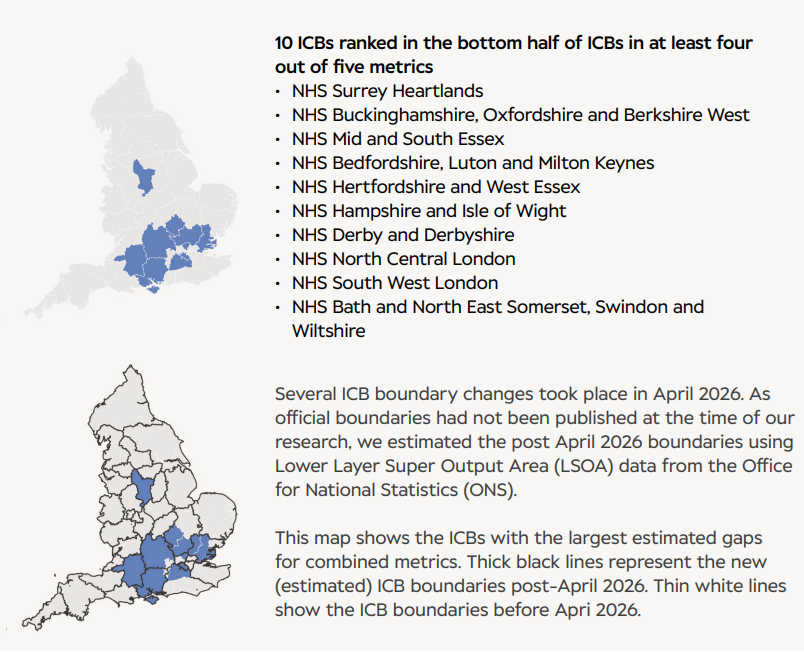
When combined, the metrics highlight clusters of underperformance, particularly across London and the South East. Surrey Heartlands, Buckinghamshire, Oxfordshire and Berkshire West, and Mid and South Essex, rank in the bottom half of ICBs across all five measures.