

Josh Raden on how the volunteering trip began
I didn’t expect a routine patient conversation to change the direction of my year – let alone lead to a team of us travelling to rural Uganda with suitcases full of spectacles. But that’s exactly what happened.
Kate Oakley, founder of Planting for Hope, first came into our clinic at Newmedica Worcester as a patient. During a follow-up conversation, she began sharing the story of a charity she’d been involved with for more than 15 years. She showed me photos, page after page, documenting the transformation of a rural Ugandan village: schools built, communities formed, lives changed. I remember just sitting there, listening.
What struck me most wasn’t just the scale of what had been achieved, but what was missing. When I asked about eye care provision, the answer was simple: there wasn’t any, and that moment stayed with me.
As a team at Newmedica Worcester, we’re used to fundraising. We support good causes, but this felt different. I felt like we had the opportunity to do something hands-on, something that used our clinical skills, not just our capacity to donate. So we made a decision: we would go.
What followed was months of preparation. We collected over 4000 spectacles and spent evenings sorting, measuring and categorising them so they could be used effectively in the field.
The response from colleagues was incredible. What started as a small idea quickly grew, with interest coming from across practices. In the end, we assembled a multidisciplinary team, all driven by the same goal: to make a tangible difference.
Robina Sharif on providing sight tests
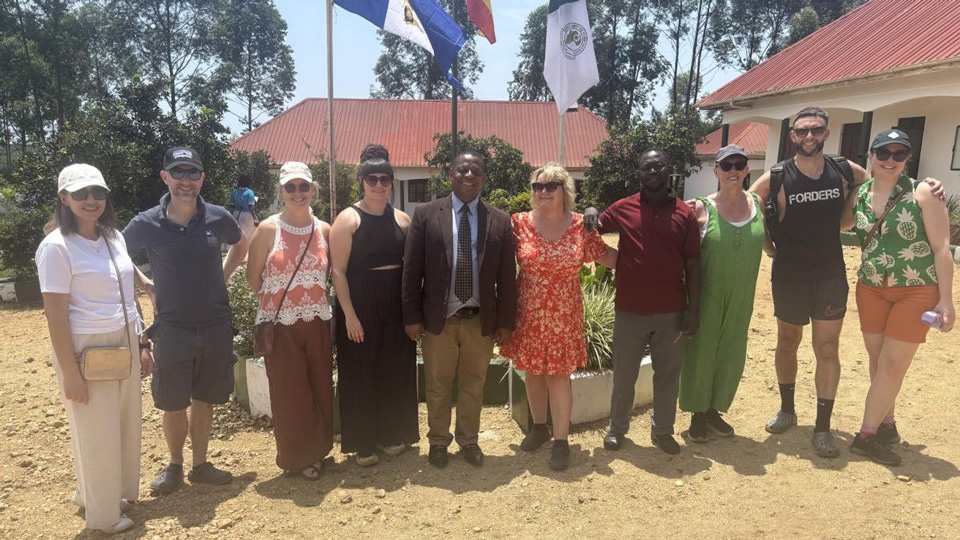
When we finally arrived in Uganda after travelling for more than 24 hours, the reality of what lay ahead set in. Our base was a school in the village, and within a day we had transformed classrooms into makeshift clinics.
When it came to testing, there was no automated equipment, no controlled lighting, and at times no electricity at all.
We relied on retinoscopes, trial frames, and the core skills many of us hadn’t used in years. It was challenging, but also incredibly grounding. It reminded me that, at its heart, optometry isn’t about technology, it’s about people.
Over the course of a few days, we carried out around 400 eye examinations and dispensed approximately 100 pairs of glasses. We also identified 39 patients with cataracts, and these people will now hopefully be able to access further care.
One moment that will stay with me was a young girl who had been struggling at school and was thought to have learning difficulties. When we examined her, it became clear she had a significant refractive error. When we corrected her vision, her reaction was immediate. She looked around the room, taking everything in, as if she were seeing it properly for the first time.
That helped me realise the impact of what we do. That intervention didn’t just improve vision, it changed the trajectory of that person’s life.
There were countless other moments like that. Patients arriving who had never had an eye test before. Adults receiving their first pair of glasses. People waiting patiently for hours, translating, and working together as a community. That sense of community is something that has really stayed with me.
Despite having so little in terms of resources, there was an overwhelming sense of dignity, patience and gratitude.
We want to expand our reach into surrounding villages, and increase the number of patients who we can see
Josh Raden shares future ambitions
The experience also highlighted the barriers that still exist. While we were able to diagnose conditions like cataract, access to treatment isn’t straightforward. For many, the challenge isn’t just clinical, it’s logistical. Getting to a hospital can be a big obstacle, and that’s something we’re already thinking about for the future.
We’ve raised around £14,000 from this initial project, which is being invested into sustainable improvements within the community there, including a new school kitchen and solar power. But clinically, we have started to think about how we can bridge that gap between diagnosis and treatment, and we’re now planning our return.
The aim is not just to repeat what we’ve done, but to build on it. We want to expand our reach into surrounding villages, and increase the number of patients who we can see. We also want to explore ways that we can support access to the hospital and surgical treatments for to those who may need it.
It reminded me why I became an optometrist in the first place
Robina Sharif reflects on the experience
Personally, this experience has been a reset. It reminded me why I became an optometrist in the first place. At its core, optometry is about helping people to see. And in some parts of the world, that can be transformational.
This wasn’t just a trip – we hope it can become the start of something much bigger.
About the authors
Robina Sharif 
Optometrist
Robina Sharif is an optometrist and clinical director at Specsavers Bromsgrove

Josh Raden
Operational director
Josh Raden is an operational director and business partner at Newmedica Worcester and Bromsgrove


Comments (0)
You must be logged in to join the discussion. Log in