


04 December 2025
It was only through serendipity that Tom Mackley found his professional passion.
“It was almost by accident that I ended up with a specialism in glaucoma, and I have done all the postgraduate qualifications now,” the hospital optometrist and clinical lead for glaucoma at Primary Eyecare Services told OT.
“In the past I thought people had to be super talented and A-grade students to get involved in this,” Mackley said.
“But that’s not the case – you just need someone to spark an interest,” he added.
In the face of long ophthalmology waiting lists, optometrists are ideally placed to lend a hand to the 700,000 people with glaucoma across the UK.
Mackley describes himself as a “big advocate” of using the optometry workforce to help manage glaucoma patients in both primary and secondary care.
“Almost anyone capable of an optometry degree and qualification as an optometrist can get involved in glaucoma care if they are given the proper guidance and instruction,” he emphasised.
He highlighted that there are large numbers of optometrists compared to ophthalmologists, and optometry practices are located close to where people live.
“We might not be specialist surgeons, but we’ve got a lot of knowledge about the disease already as part of the standard training, and we're generally quite good communicators,” he shared.
Mackley added that an optometry practice can be a better environment for reassuring and counselling patients about the condition.
“A hospital can be a difficult place to be given information about a complex eye condition – to assimilate that, take it home and rest easy with it,” he said.
In the past I thought people had to be super talented and A-grade students to get involved in this. But that’s not the case – you just need someone to spark an interest
Getting to grips with glaucoma
Independent prescribing (IP) optometrist and director of Kirk Road Eye Care, Johnathan Waugh, told OT that his experience working in hospital as an optometrist had shifted his perspective on glaucoma.
“I was perhaps a little bit overconfident before I started working in hospital,” he said.
“I realised that glaucoma is a much larger and more nuanced condition than I had thought previously. It doesn’t always behave in the way you think it is going to,” he added.

Waugh shared that while visual field tests and optical coherence tomography scans are useful, it is important to avoid an over-reliance on this technology.
“It’s still very important that you physically check the optic nerve – ideally dilated – and that you check your pressures with applanation tonometry,” he said.
Waugh also highlighted the value of becoming adept at gonioscopy in glaucoma care.
“I’d encourage people to try and get to a workshop, or find somebody who knows what they’re doing and learn that technique. Gonioscopy can be very useful in deciding which patients to refer and monitoring change,” he said.
IP optometrist and director of Cameron Optometry, Ian Cameron, highlighted the value of further qualifications in gaining clinical confidence in glaucoma.
“The NHS Education for Scotland Glaucoma Award Training, which we completed as a prerequisite for joining the Community Glaucoma Service, was outstanding – a strong balance of theory and hands-on experience. It left us much better equipped to manage glaucoma,” Cameron emphasised.
Tips for a good glaucoma referral
Specialist optometrist at Royal Shrewsbury Hospital and head of clinical proposition at Newmedica, Jagdeep Singh, shared that key information he would expect to see in a glaucoma referral includes the reason for referral alongside relevant risk factors – such as family history, ethnicity and medication.
“A good glaucoma referral includes clear, concise, and relevant clinical information to enable colleagues in secondary care to carry out triage and manage the patient effectively,” he said.
Singh added that the referral should feature a detailed assessment of the optic nerve head, including comments on the cup-to-disc ratio and any relevant glaucomatous signs.
He shared that diagnostic tests such as intraocular pressure (IOP) – preferably using Goldmann applanation tonometry – optical coherence tomography (OCT) and visual field test results are also useful.
“It’s essential to include the level of urgency and ensure the patient is aware of this too,” Singh emphasised.
He highlighted that IOP is a key consideration when it comes to glaucoma referrals, particularly if IOP is elevated above normal limits or shows significant asymmetry between eyes.
However, Singh emphasised the importance of considering IOP alongside other clinical indicators, such as optic nerve head appearance, cup-to-disc ratio, neuroretinal rim thinning, notching, or disc haemorrhages.
“Visual field test results are also crucial, particularly if there are reproducible defects suggestive of glaucomatous damage,” he said.
Singh noted that optometrists should consider patient-specific risk factors that have the potential to influence the likelihood of disease progression – including age, ethnicity, family history of glaucoma and the presence of systemic conditions such as diabetes – when deciding referral urgency.
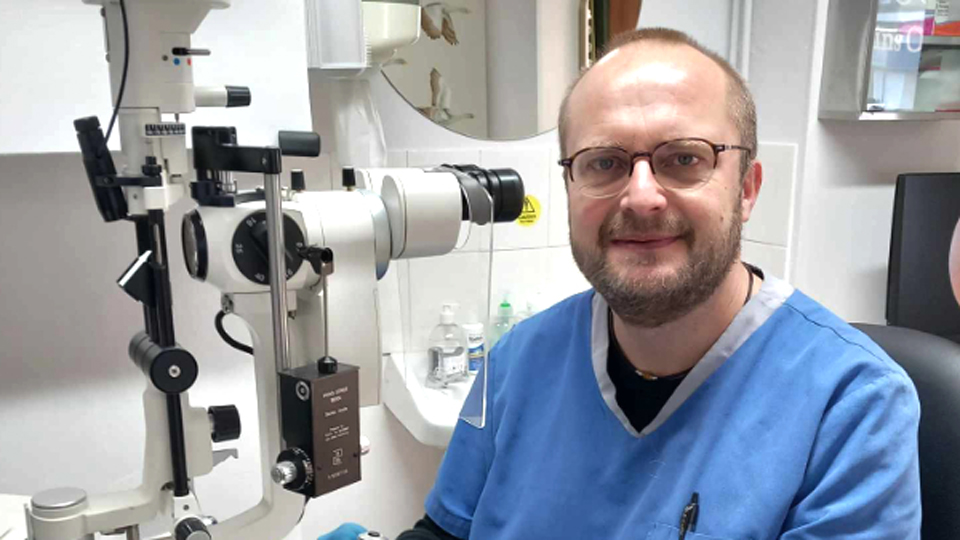
IP optometrist and practice director, Ed Adkins, has offered glaucoma repeat reading and glaucoma monitoring service at Adkins Opticians in Norfolk since the services were introduced in 2014. He highlighted that glaucoma is usually a slowly progressing disease.
“With borderline cases, monitoring with a shorter recall to detect any change is always going to be preferable before referral,” he said.
“However, the clear-cut definite cases with clear optic nerve changes and repeatable field defects should always be referred at the time of initial detection,” Adkins emphasised.
NHS Lothian principal optometrist, Patricia Halpin, has delivered hands-on experience to optometrists in managing glaucoma patients as part of the NHS Education for Scotland Glaucoma Award Training.
Halpin highlighted that when considering a glaucoma referral, optometrists should keep in mind three key points.
They should assess the patient’s risk factors that influence the likelihood they have glaucoma or will go on to develop it, and consider whether there is a differential diagnosis.
“Consider the quality of the field measurements the patient has done, how reliable they are and whether they match with the disc appearance,” Halpin said.

Consultant ophthalmologist and Newmedica glaucoma service lead, Richard Stead, highlighted the importance of considering what information is relevant to the referral.
“There are two ends to the spectrum. Sometimes you will have a referral with such brevity that there is almost nothing there. But then you can also have a referral that provides so much information you can lose important details,” he said.
Stead, who also has an optometry degree, highlighted that OCT has given optometrists the ability to pick up signs of early disease.
“If they have historical OCT data and can show change over time, that is really powerful,” he emphasised.
A word on suspected primary angle closure
Stead encouraged optometrists to review the updated clinical management guidance on primary angle closure suspects developed in partnership between the College of Optometrists and The Royal College of Ophthalmologists.
This guidance states that optometrists should only refer patients to ophthalmology if limbal anterior chamber depth is less than 25% or an anterior segment OCT shows irido-trabecular contact, in combination with one of a list of specified criteria.

Stead highlighted that there can be a reluctance not to refer patients with narrow angles.
“In the past it has been engrained in us that we need to perform laser on these people. But actually, the evidence is now showing that may have resulted in over-treatment,” Stead shared.
“If there are none of those additional features, in all likelihood, we’re not going to treat them,” Stead said.




Comments (0)
You must be logged in to join the discussion. Log in