


28 October 2025
Robert Campbell, 67, is emphatic that routine eye testing is “essential.”
Campbell had been feeling unwell for some time when his appointment for a routine eye test at Flint Optometry came around in January 2025.
It was during this appointment that optometrist, Claire Williams, made the referral that led Campbell to receive treatment for blood cancer.
He told OT: “When you go to the opticians to get your eyes tested, the last thing you expect to be told a week later is that you have got blood cancer.”
Campbell has generously shared his story with OT, with the aim of encouraging more people to have regular eye tests.
What led you to have an eye test? Before you went for a sight test, had you experienced any symptoms and how had this affected you in day-to-day life?
Robert Campbell (RC), 67, patient of Flint Optometry: It was a routine appointment. I have glaucoma, so I go every 12 months to get my eyes tested.
I had been ill since April 2024 and I started to go downhill health-wise during that year. Towards the end of the year I noticed, amongst other things, I was getting blurred vision, but I knew I had an appointment in January.
What did the optometrist find, and how did they explain the next steps to you?
RC: During the appointment Claire was examining my eyes and said I had bleeds at the back of my eyes. She asked if I had any trouble with my vision and I explained that I’d had blurred vision and had been having a lot of burst blood vessels in my eyes, but I’ve had them before, though not as many as I had had recently. Claire said she would refer me to New Cross Hospital.
I asked if the bleeds were unusual and if there were a lot of them. Claire said there were quite a few and, to be honest, you shouldn’t be having them.
Did you have to undergo further treatment and what has the outcome been?
RC: I was referred to New Cross Hospital and had an appointment three or four days later where I had some blood tests done. A few days later, I was called back in and the consultant told me I had lymphoma.
The cancer is in the protein of my bone marrow. It’s something that can’t be cured. I had six months of chemotherapy. Since then I’ve had a lot of problems with infections because I’ve got no immune system.
When you go to the opticians to get your eyes tested, the last thing you expect to be told a week later is that you have got blood cancer. It was a shock.
It has to be put out there amongst the general population how important it is to get your eyes tested
Have your views on the importance of sight tests and eye care changed as a result of this experience?
RC: Cancer was the last thing on my mind. I thought there was a problem with my eyes.
I’ve spoken to a few newspapers about this to tell people: if you’re having trouble with your eyes in any way – vision, pains, anything to do with your eyes and are feeling generally unwell – go and get your eyes tested. I was under the GP from April. My doctor is marvellous – he knew there was a problem and I had had an endoscopy and a colonoscopy and was referred to rheumatology. But if I hadn’t seen Claire, I don’t think I would ever have found out what it was.
The importance of getting your eyes tested is crucial – especially if you’re feeling unwell at the same time as having problems with your eyes. Just go and get tested.
It has to be put out there amongst the general population how important it is to get your eyes tested. Some people go for years and don’t get their eyes tested. They don’t know – there could be damage to the back of the eyes that is going unnoticed. Regular eye tests, in my opinion, are an essential. The more people who get their eyes tested, the better. There are things that an optometrist can find that the doctor can’t. They say the eyes are the window to your soul – they are also a window to your health.
How has the experience changed your life or affected you?
RC: Cancer changes everyone’s lives. I do count myself lucky – I'm out of hospital; I live a relatively normal life. But it does change your life.
Claire is a lifesaver. I’m very grateful to her for picking this up. When I saw Claire in January, I was getting to the stage that I was really unwell. I think I do owe her my life.
It was very rewarding to hear that his medical team felt my prompt action had had a real impact on his treatment journey and prognosis
What did you identify during the sight test and what was your reaction?
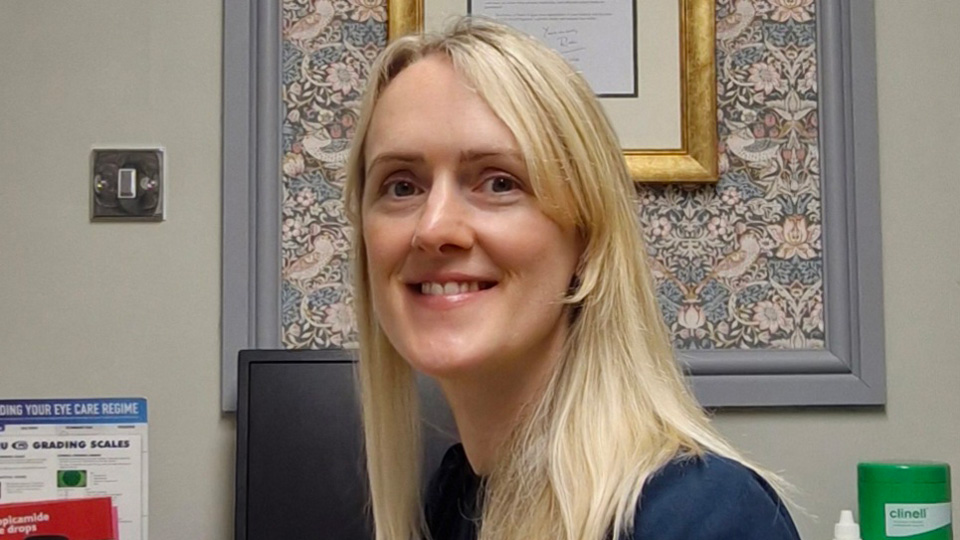
Claire Williams (CW), optometrist at Flint Optometry: At the start of the eye test, I noticed that Mr Campbell had been quite reticent when I was asking about his general health, as if there was something he didn’t feel comfortable sharing or was withholding. I also noticed he did not appear to be a ‘well’ man – his skin tone, posture, movements, and overall demeanour – which concerned me.
During slit lamp biomicroscopy, I noticed some peripheral haemorrhages. I dilated his pupils to get a clearer view and discovered an extensive peripheral ring of haemorrhages in both eyes, around a third of which were Roth spots. I was immediately very concerned that this could be an indicator of a very serious health problem, such as blood cancer, and wanted to further question him about his general health and wellbeing.
How did you approach explaining what you had identified/suspected?
CW: I explained to Mr Campbell that I had found a number of small bleeds at the back of both eyes. I told him that, while these can be linked to conditions such as diabetes or high blood pressure, they can sometimes indicate something more serious. I then re-questioned him about his recent general health and asked how he had been feeling in recent months.
Mr Campbell then shared with me that he had been quite unwell for a number of months and was becoming progressively worse as time went on. He had been seeing his GP for a while, who had sent him for a colonoscopy and endoscopy, which had both come back clear; and about a month prior to his sight test, his GP had referred him to Rheumatology, but he had yet to hear anything.
At that point, I explained that I wanted to refer him directly to the hospital for them to see him the following week to action further tests to investigate the cause of the bleeds and why he had been so unwell.
What were the next steps that you took, and what was the significance of these steps to this case?
CW: I was very concerned about my findings alongside how unwell Mr Campbell was, and especially with how long he had been unwell for without diagnosis or treatment of the underlying cause. I phoned the Urgent Eye Clinic and explained my findings and concerns to the Sister.
I emphasised that, whilst I appreciated that this was not an ophthalmic emergency, I was very concerned about the possibility of a serious underlying health problem, such as blood cancer, that had potentially been left untreated for some time.
Given how long Mr Campbell had been unwell and how much time had already passed with inconclusive investigations, I felt strongly that his care needed to be fast-tracked and I felt by getting him seen urgently within ophthalmology, they could then internally refer him directly and urgently to other hospital departments to establish a diagnosis and start treatment as soon as possible. The Sister shared my concerns and agreed to book him in for a few days later.
When did you hear about the results of your referral and how have you been involved since?
CW: About a month after the referral, I phoned Mr Campbell to check on his progress. He explained that, as I had hoped, he had been fast-tracked through various hospital departments, had numerous tests carried out, and just over a week after my referral, received a diagnosis of ‘Lymphoma in the bone marrow’ and was started on treatment.
Since then, I’ve kept in touch with him through follow-up care. It was very rewarding to hear that his medical team felt my prompt action had had a real impact on his treatment journey and prognosis.
What would be your three top tips to other practitioners when making a referral?
- Make sure you are taking a holistic approach to patient care; be aware of signs that may sometimes be subtle and make sure to ask lots of questions and actively listen to the patient so you don’t miss anything that may be vital to accurate and appropriate management and referral
- Communicate clearly with the patient. Explain in simple terms why you are making the referral – strike the right balance between reassurance and not panicking the patient, while stressing the importance of further action. Give them time to ask and discuss any questions or concerns they have
- Provide a concise but detailed referral. Make sure all relevant detail is included in an easy-to-read way: sectioned, paragraphed, or bullet pointed – rather than one continuous block of prose, so that nothing gets missed and all the key information is highlighted.


Comments (0)
You must be logged in to join the discussion. Log in