

05 December 2025
I didn’t do so well in my A-levels, and I didn’t know what I was going to do.
My father went to have his eyes examined, and was choosing a new pair of glasses and talking to the dispensing optician, whom he knew quite well. This chap said, ‘Why doesn’t he train to be a dispensing optician?’ My dad came home and said, ‘Well, why don’t you train to be a dispensing optician?’ And I said, ‘Okay.’
I worked as a dispensing optician for three years, and enjoyed it.
I then started the contact lens course, by correspondence, and found it really difficult. I thought, ‘three years part-time doing the contact lens course. If I go three years full-time, I could do optometry, and then still do contact lenses at the end of that.’ It was a segue, really. I realised that the only other way to progress in my career would be to take the optometry route instead.
I went on to do my optometry degree at City, University of London (now City St George’s), followed by my pre-registration placement at David Clulow on the King’s Road in Chelsea.
After I qualified, I worked at Auerbach & Steele in Chelsea for a few years. I was living in Surrey, and the commute was getting to me, so I left and joined Visioncare Research, with Graeme Young and his team, in Farnham.
Visioncare Research does research into contact lenses and intraocular lenses. I always enjoyed contact lenses, and it was something I really wanted to do, so it was an interesting time. I thought I knew a lot about contact lenses, but once I met Graeme, I realised I knew absolutely nothing.
I was a research associate and I worked part-time in clinical practice.
The research side allowed me to look at contact lenses in more detail than I was doing in practice. It gave me a chance to see contact lenses in a slightly different light and understand them better. I also joined the British Contact Lens Association (BCLA), in 1997.
I moved to Leightons Opticians and Hearing Care in 1999 and opened my franchise in 2001.
I had had a couple of people ask if I’d be interested in owning a practice. Much like falling into optics, I’d never really thought about it. But the more I did, the more I thought it might be a good idea. My wife is a dispensing, so the idea was that she could be the dispensing optician, I could be the optometrist and contact lens practitioner, and we could make it work. Now, my business partner is my wife.
Starting a practice from scratch is hard work and carries additional pressures.
The benefit is that you can stay close to what’s happening – from a practice perspective, but also from an accounting and financial perspective. You can amend things in a positive way. You can turn things around quickly. It’s not like turning a barge – it’s like turning a dinghy. You can try new things and decide whether or not they work.
At the beginning, we tried quite a lot of things. We were the first practice in the Leightons portfolio to have a retinal camera, the first to have a topographer, the first to have optical coherence tomography, and an Optos device. We had quite a lot of firsts.
It’s not like turning a barge – it’s like turning a dinghy. You can try new things and decide whether or not they work
We started offering orthokeratology (ortho-k) in 2010, and that was our first myopia intervention.
It was a very slow burn. It was something that parents hadn’t heard about. The profession hadn’t really heard about it, either. We were just hearing anecdotal evidence, and the BCLA and conferences were starting to cover myopia more.
A big moment in myopia education was in 2015, when the BCLA conference spoke about myopia and what we could do to manage it. That, I think, was the big turning point: we had something beyond ortho-k; we could use off-license contact lenses to help slow down myopia. It was gaining momentum, and the amount of research and education we had access to meant that we could speak more confidently to parents about it.

I could not live without
Optometrist, Indie Grewal, has been offering myopia management for over a decade. Here, he explains its importance
In practice, I was constantly educating myself and reading papers about it.
But also, I was constantly educating parents. Every time they brought their children in, I would remind them that we had spoken about it last time and tell them about any research. With any strategy that you can employ in practice, if you haven’t got the research behind it or evidence-based practice, it makes it much harder to talk to patients about it, but also to encourage them take action.
I became a fellow of the BCLA in 2014, and joined the Council after that.
There was huge benefit in having a group of people around me who were invested in contact lenses in the same way I was. We had academics and practitioners, in both contact lenses and anterior eye. Sitting around a table with a group of people who are like-minded is really powerful.
In 2017, I completed my independent prescribing (IP) qualification.
It was BCLA members and fellow colleagues, who had an interest in contact lenses in anterior eye, who suggested that I should really be doing IP.
Sitting around a table with a group of people who are like-minded is really powerful
There are three occasions where I’ve been nervous about the stability of the practice.
The first was September 2001, after the 9/11 attacks, when we didn’t know what the outcome was going to be. The second was the financial crisis in 2008, where we had a big crunch, and suddenly we had to ask whether we were going to experience repercussions.
However, COVID-19 was on a completely different scale, because it directly impacted us and everybody around us. We were closed, and we didn’t know when we were going to reopen.
The benefit of having specialised in myopia management, having fitted contact lenses, and having an integrated Direct Debit business, meant we had a passive income coming in. It allowed us to hunker down and sit tight. Whilst we were very nervous, once we understood that we could carry on indefinitely with just our Direct Debits coming in, that was a massive reassurance. During lockdown, I also became BCLA president.
Currently, I consult for CooperVision two days of the week in the myopia management space.
This role is one of the highlights of my career so far. I’m educating, but it is educational for me as well: it ensures I’m on top of the latest research, because I’m then sharing that with practitioners. My role is to take research, read it, understand it, decipher it for optometrists and colleagues, and give them the tools to be able to communicate that to patients.
One of the mistakes I made when I first started out in my myopia management is that I would read research and then just regurgitate it to patients. I learned very quickly that that was the wrong thing to do. What I needed to do was read the research, understand it, and then make it patient or parent-friendly.
This role is really interesting, because I’m able to bring to industry a real insight from the ground floor of optometry.
I’ve learned a lot from industry, but I hope industry has learned a lot from me. I can say to them, ‘actually, that messaging doesn’t work. Maybe this is the way that we should be messaging it.’ Or, ‘here is a gap in the market that I think needs to be fulfilled,’ where previously they might have missed that opportunity.
I’ve learned a lot from industry, but I hope industry has learned a lot from me
There’s a lot of competition out there for us as practitioners.
We’ve got online purchasing; we’ve got lots of competition in the High Street. But I think the way to retain interest is to educate people every time they come back. One of the things that my patients like is that when they come in, they’re looking for the new thing I’m going to share with them. What new technology have I got to examine their eyes? They really do like that.
When you have a new piece of technology, having the time to explain it to patients is really important, because they leave educated. That’s the value that they receive in coming to me as a practitioner, rather than anybody else on the High Street.
I’m going to be 60 next year, and I’d like to think that I can still carry on doing my job in the way that I always have: constantly educating, constantly being educated, but also always moving forward.
I hope I can still carry on doing that within my profession. Also, I’d like to sail more. I’m not doing enough of that at the moment.
About the author
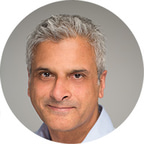
Indie Grewal 
Optometrist and practice owner
Indie Grewal is a specialist optometrist and contact lens practitioner, a past president of the BCLA, and owner of Leightons Opticians & Hearing Care in St Albans


Comments (1)
You must be logged in to join the discussion. Log in
Nicholas Rumney30 January 2026
I've known Indie for over 20 years and he has been an inspiration to us old f**ts as well the younger practitioners and researchers coming through. There is a real skill in widening your portfolio into research and professional development whilst being grounded in every day practice. It's also great to see the early adoption of myopia control in Coopervision portfolio. Everyone benefits. Its funny. Only ten years after the BCLA Myopia special (I was conference coordinator) where we brought Ian Flitcroft to the wider UK optical audience along with Kate Gifford and, in almost his UK swansong Brien Holden, we can see that this has become as mainstream as Independent Prescribing. Well done Indie.
ReportLike1