


31 March 2026
Optometry Wales mentor of the year for 2025 and partner at Osmond Drake Opticians, Marc Drake, has been mentoring optometrist Guru Samineni at his Penarth independent practice throughout his independent prescribing (IP) placement.
Our experts
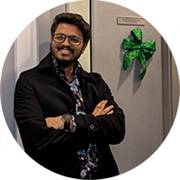
Name:Guru Samineni
Occupation:Optometrist at six Specsavers practices in Cardiff
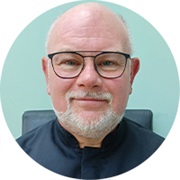
Name:Marc Drake
Occupation:IP optometrist and partner at Osmond Drake Opticians
How long have you been mentoring IP placement students?
Marc Drake (MD): Independent prescribing (IP) training is evolving at a fast rate. When I completed my own placement, it was hospital-based. Now, in this area of Wales, the work done in the hospital is less relevant to IPs, because a lot of the IP work is being done in the community.
To start with, people were sent to me to be signed off on skills tests whilst they were studying. That evolved into a formal mentoring scheme. I’m now facilitating part of the IP course, which has evolved into being monitored by Cardiff University. It is quite formal now, whereas it was much less formal a couple of years ago.
How did you go about establishing the mentor/mentee relationship?
Guru Samineni (GS): I chose Mark as my mentor, because even before I knew him in person, he was one of the optometrists who would write back to us to discuss diagnosis and management. It gave us confidence in what we had missed, or what we had seen.
At the start of your IP training, if you suspect a diagnosis, you might not know if it is correct or not, until a peer writes back to you with their thoughts. Marc’s level of clarity was what I appreciated the most, and his approach to diagnosis and management was also very similar to what I had back home, with my consultants.
At the start of your IP training, if you suspect a diagnosis, you might not know if it is correct or not, until a peer writes back to you with their thoughts. Marc’s level of clarity was what I appreciated
What makes a successful mentor, in your experience?
MD: It depends on what sort of mentoring you’re doing. I’ve got friends who have been very successful in business, who have had independent mentors at various times during their careers. That’s 360-degree mentorship.
The mentorship I’ve been doing with IP placement students is focused on trying to prepare them for working independently as an IP optometrist. For that, the main thing is empathy: having been through the process myself, and having a good level of knowledge, so that I can point people in the right direction.
Also, being organised. I have a list of specific things that I want trainees to be able to do by the time they finish with me. A lot of these things are not clinical – they are more to do with patient management and admin.
You have got to be constructive and positive: if you’ve got somebody who is struggling in a certain area, not hammering down on them all the time. And being patient: if you’ve got a mentee who is not managing patients in necessarily the correct way, and then repeating it, remembering that they are out of their comfort zone, and out of their usual environment. They are the main traits that are useful for a mentor.
GS: I have had lots of mentors. I did my optometry undergraduate degree in India, and then I did a fellowship in glaucoma, so I had many mentors back home – especially related to glaucoma.
A mentor should make their mentee feel that they’re in a safe place. When they’re teaching, they should not presume from the start that they know everything. They should start by establishing what the mentee knows and where they stand on the basics. From there, they should start building the mentorship process upwards.
Are there any differences in mentoring IP students when compared to mentoring full-time members of staff?
MD: It’s about goals. If you fancy being a captain of industry, or whatever it was you want to do, and you want a mentor, you need somebody who is completely independent, so they don’t have an agenda.
I do have an agenda with my IP mentees. I sit down talk to them, and say, ‘by the end of this, I want you to be self-sufficient. You know where the prescription pads are. You know how to all of this. You can go away, and do it yourself.’
With people in-house, it’s slightly different. Again, we try to agree an agenda, or a set of goals. I will say: ‘This is where I want you to be. Do you want to be there as well?’ Hopefully, we’ve got enough middle ground that we can move forward. With people within my own business, I’m leading on that. With true mentorship, I imagine it’s more driven by the mentee.
It’s all about goals, and what you want to get out of it. With an IP, that’s fairly set. We know what success is, whereas with people in-house that can vary depending on their role and motivation.
It’s all about goals, and what you want to get out of it. With an IP, that’s fairly set. We know what success is
Are there differences between having a mentor who is in that role to develop a specific skillset, for example glaucoma, as opposed to a wider one?
GS: Yes. When I had mentor related to glaucoma, it was only related to glaucoma drugs, looking specifically into glaucoma and its side effects. For example, if we administer drops of anti-glaucoma medication, we will only look at the side effects of anti-glaucoma medications.
With an IP mentor, you are looking at a wider perspective. You are looking into things that could cause other problems, or systemic side effects. You’re actively looking into what kind of medications they are taking, and then relating it to the eyes. You don’t want to give something that will cause problems to the patient in the long-term. The conversations with the mentor are broader, from that perspective.
What specific things are you working on together at the moment?
GS: Because of my previous experience, I know what signs I am looking for in terms of IP. I am currently putting into place how to record correctly on a prescription pad, and what dosage and which drugs to diagnose, related to NHS local guidelines. This is mainly what Marc is helping me with.
Obviously, the end goal is to treat the patient, but Marc and my other IP mentors all have different styles of prescribing. That is helpful, as an IP student: there is not only one thing that is right; you can work in different ways to attain your goal. I like that - I don't believe there is only one way forward. I like to know all the different ways to treat patients.
Have there been any challenges during your journey as a mentor, or any learning curves?
MD: You have to try and manage the mentee in the in the correct way, depending on their personality and whatever behaviour you want to address. It hasn’t been an issue for me, but you might, for example, have to take somebody aside and say, ‘You’re not dressed smartly enough.’ That sort of behaviour is not a clinical issue, but if they keep doing it, that is a challenge.
The other problem we’ve got at the moment is lack of patients. When I started mentoring IP students, there were four IPs in Cardiff and Vale, so my patient numbers were high.
Associated with the growth of IP, and placements being part of that, there are now probably 30 IPs in Cardiff and Vale. The number of referrals we are getting is dropping off quite considerably. At the moment, I do a session that is fully IP, and I’ll have a mentee with me. In the future, I’m going to have to do shorter sessions, dotted throughout the week, in order to keep it going.
GS: My knowledge and my experience come from India, because that’s where I initially trained as an optometrist, and the perspective I was taught from. I qualified in the UK two years ago. Although I had experience from my UK pre-reg placement, my IP knowledge comes from India. My learning curve is understanding what generic drugs you have over here, and to treat patients appropriately. Basically, to know the NHS guidelines and the local guidelines fully.
What have your biggest learnings been as a mentor?
MD: The mentees are also attending placements elsewhere, particularly Cardiff University. The comment, ‘My other mentor would treat this condition in this way. Why are we doing something different?’ is a great one, because it opens your mind up to what other people are doing. You’re thinking about other alternatives, and keeping your mind open to new things. You also learn other people’s expectations of patient management, and how patients are managed clinically and non-clinically, which helps to keep you up to date.
How would you suggest those who might benefit from mentorship go about finding a mentor?
MD: In Wales, Health Education and Improvement Wales (HEIW) organises IP mentors, and they also organise forums for newly qualified optometrists, where they can discuss running a service or clinical cases with their peers and with a facilitator.
Generally speaking, the way forward would be to contact your local optical committee (LOC). If people ask for something, the LOC, or in our case Optometry Wales, will probably consider what can be done.
In Wales, we also have a buddy programme. If you’re a sole practitioner, you can approach Optometry Wales, and they will find somebody to help you – whether that is their optometric adviser, or someone else with a certain level of experience or expertise. Through that system, I have received calls from people in the past. You can’t necessarily solve their issue, but you can give them a sounding board.
Why did you choose to become a mentor?
MD: The reason I became a mentor was to forge better connections with young people – people who might have a different outlook, because they’re generally newer in the profession.
It means I’ve got a new perspective coming in. I’ve got two IP workmates, so it’s not like I haven’t got colleagues to discuss things with. But sometimes having fresh eyes is quite nice, whether it be clinically and or just generally.
A lot of my mentees are young people, working in multiples, who I would have very little experience with otherwise. It’s good to chat to them about the different ways of practising optometry out in the big, wide world.


Comments (0)
You must be logged in to join the discussion. Log in