


13 November 2025
More than 270 hospital and specialty optometrists travelled to Novotel London West for a series of lectures, peer reviews and short paper presentations at the weekend.
Delegates to the AOP’s Hospital and Specialty Optometrists Conference (8–9 November), supported by headline sponsor Bausch + Lomb, gained insight on a range of key clinical topics. Below, OT presents a selection of insights from the event.
1 Alternative treatment approaches in glaucoma
Queen’s University Belfast Professor Augusto Azuara-Blanco discussed a range of emerging treatment options for glaucoma during his HSOC presentation – including the potential therapeutic effects of cannabinoids.
Azuara-Blanco and colleagues will be commencing a 10-person trial in 2026 where glaucoma patients receive an oral synthetic cannabinoid. The trial has been funded by Glaucoma UK.
“It is currently used within trials for people with cancer and anorexia – so it is safe,” he said.
Azuara-Blanco also outlined research that is exploring the therapeutic potential of nicotinamide – a derivative of vitamin B3 – in glaucoma.
Azuara-Blanco highlighted that nicotinamide has several advantages as a therapeutic approach – it is safe, inexpensive and accessible.
“We are expecting a decision on this within five years – it may seem like a long time, but believe me, five years is nothing. The typical cycle of a glaucoma trial is 10 years, so we are halfway through. It is very exciting,” Azuara-Blanco said.
2 Refining wet AMD referrals at Bristol Eye Hospital
Optometrist, Ben Phipps, outlined how an enhanced macular referral pathway at Bristol Eye Hospital had reduced waiting times for treatment.
A new digital pathway where optometrists can send OCT scans, fundus images, and a summary of their clinical interaction with the patient through the Opera referral system has reduced unnecessary hospital appointments.
Phipps shared that an audit of 373 referrals found that only around one in four patients required a hospital visit.
Analysis of data from the new pathway found that there was a median waiting time of eight days between a referral being received and the patient having treatment.
“That is significantly better than the national ophthalmology dataset, which reports that 40.3% of the time people are having injections within 14 days,” he highlighted.

How Bristol Eye Hospital has improved wet AMD referrals
Ben Phipps spoke about an enhanced macular referral pathway at Bristol Eye Hospital during his HSOC presentation
3 The evolving role of optometrists within glaucoma care at Moorfields Eye Hospital
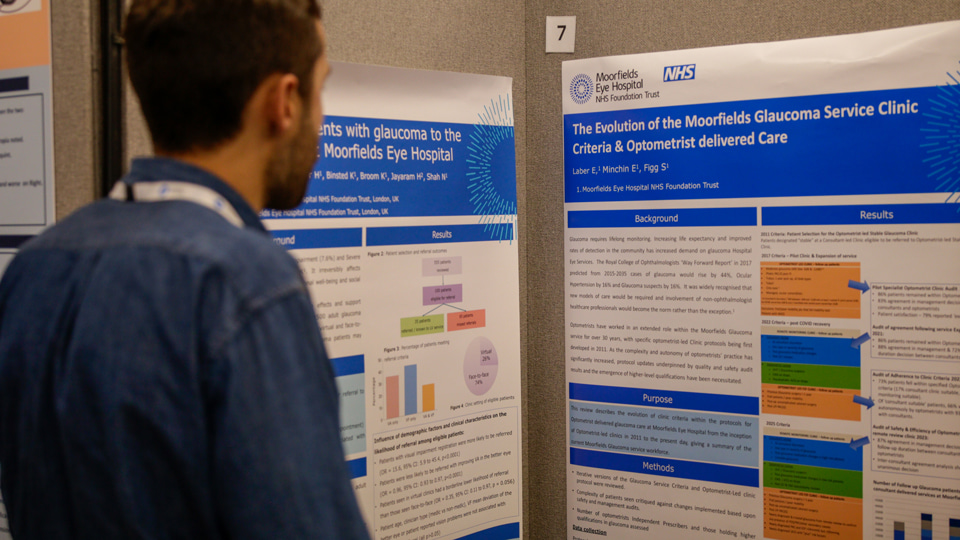
Independent prescribing optometrist, Emma Laber, provided a whistlestop tour of how optometrist involvement in glaucoma care has evolved at Moorfields Eye Hospital.
She highlighted that between 2005–2023 the number of optometrists working in glaucoma clinics at Moorfields Eye Hospital increased from 13 to 95.
Optometrists have increasingly played a role in delivering selective laser trabeculoplasty and diagnostic virtual reviews.
Laber noted that one in four optometrists working within the Moorfields Eye Hospital glaucoma service hold both a glaucoma diploma and independent prescribing qualification.
“Has that made any difference for service delivery? Yes, I am pleased to say. At last count, in October, we now deliver over 200 clinical sessions per week across the trust,” she said.
She added that at the City Road site, optometrists deliver around half of virtual reviews within the glaucoma service and a third of face-to-face visits.
“Those numbers don’t include those who are seen by optometrists working in a consultant-led model,” she said.
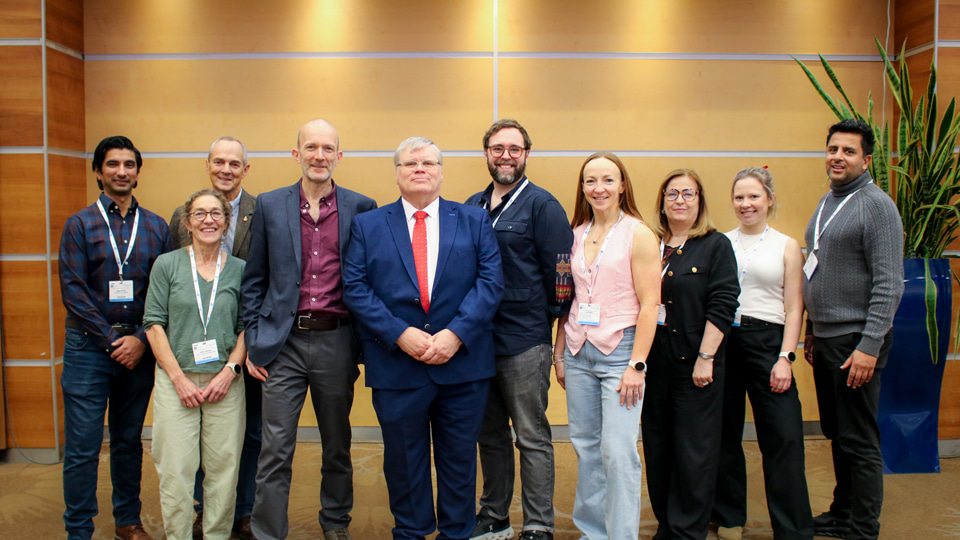
Behind the scenes at HSOC


4 The influence of neurodiversity on visual behaviour
Professor Rachel Pilling, a professor of special needs and learning disability eye care at the University of Bradford, outlined to delegates how neurodiversity can influence visual behaviour.
She explained that most children with autism have difficulty regulating the flow of sensory information – what they can see, hear, touch, taste and smell.
“We have a sensory mixing desk in our brains that is all the time adjusting – it is tuning out information that is not important in that moment,” she explained.
“Some people with autism can’t do that. All that information is coming at them all the time,” Pilling added.
She outlined how children with autism will adapt to this flow of information in different ways – for example, central processors will only focus on one part of the visual information before them, while off-centre processors may view objects side-on to reduce sensory input.
Position processors find it difficult to use their vision to determine where they are in a space, so they may walk with their hands away from their body or trail their hands along a wall.
Single channel processors are hypersensitive to multiple sensory inputs and may experience vision ‘blackouts.’
5 A closer look at the safety and efficacy of medical retina digital clinics
Moorfields Eye Hospital specialist optometrists, Megan Casey and Alice Sidorowicz, discussed the results of a retrospective audit of patients seen across six sites through medical retina digital clinics.
The six sites included Brent Cross, City Road, Ealing, Hoxton, Northwick Park and Stratford.
Of the 7032 scheduled appointments that were included within the analysis, one in five patients did not attend their appointment.
Among those seen through a digital appointment, only around one in four (24%) required a face-to-face appointment. Among those seen face-to-face, 35% went on to receive treatment.
Optometrists were responsible for undertaking 36% of reviews within the pathway.
“The advancement of multi-modal imaging techniques – for example, OCT imaging and ultra-widefield imaging – has changed the way that patients can be safely monitored and reviewed within ophthalmology, optometry and the medical retina service,” Sidorowicz highlighted.
She added that to address the challenge of the increasing volume of patients who need to be reviewed, Moorfields Eye Hospital developed a medical retina digital clinic pathway.
Sidorowicz shared that within this service patients have a series of tests and clinical images captured at one of six hubs. The results are then reviewed remotely by a clinician.
Casey highlighted that the service had reduced unnecessary face-to-face appointments – freeing up capacity within these clinics.
“With optometrists and other non-medical professionals carrying out these virtual reviews it frees up consultant time,” she said.
“In the future we will be looking at the effect of image quality on face-to-face follow up rates,” Casey shared.
6 Andrew Tompkin receives honorary life membership of the AOP
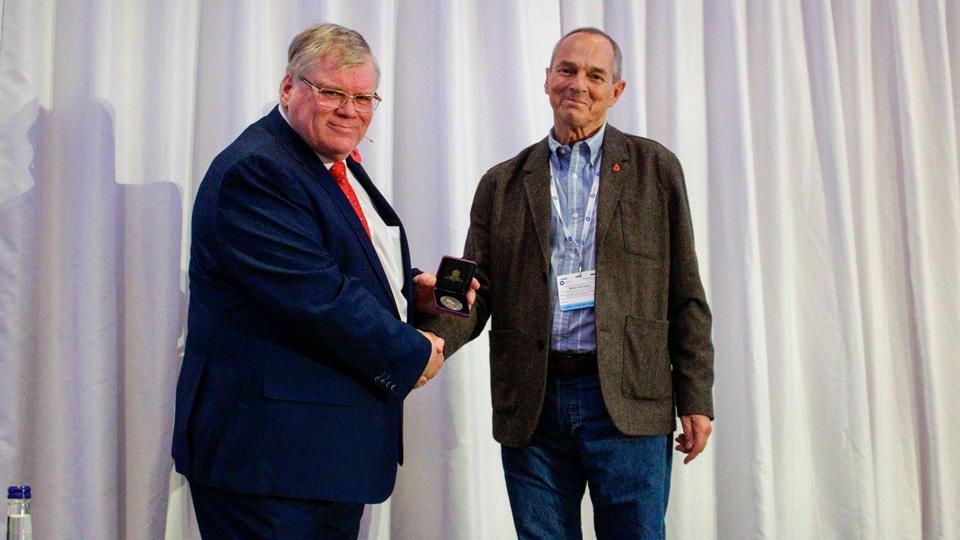
St Paul’s Eye Unit consultant optometrist, Andrew Tompkin, was recognised with an honorary life membership of the AOP at HSOC.
Tompkin has served as secretary of the AOP Hospital Optometrists Committee (HOC) since 1991.
Leicester Royal Infirmary optometrist and fellow HOC member, Martin Rubinstein, paid tribute to Tompkin ahead of his Woodward memorial medal lecture. He noted that Tompkin has worked within the NHS for more than 45 years.
“It is a pretty remarkable achievement,” he said.
Rubinstein noted that Tompkin completed his pre-registration year at Birmingham Eye Hospital. He later accepted a job as head of department at St Paul’s Hospital [now St Paul’s Eye Unit] in Liverpool.
90
the number of pre-registration optometrists Andrew Tompkin has supervised
After becoming general manager of St Paul’s Eye Unit, he completed an MBA and became a chartered manager. Tompkin now works as divisional head of ophthalmology support services.
He has supervised more than 90 pre-registration optometrists during his career.
Rubinstein highlighted that Tompkin has worked tirelessly for the AOP, with much of his work going on in the background.
“A major component of his AOP work has been leading the development of this conference over many years,” he said.
“Some of us will remember Andrew arriving at the conference venue in his car absolutely loaded to the brim with boxes of paper, programmes, extension cables and office equipment – including a photocopier one year,” Rubinstein recalled.
Rubinstein shared that colleagues have valued being able to draw from Tompkin’s wealth of experience and knowledge.
“I know that many of us here, and many of the AOP team, have often been stuck on a question and someone will say ‘Call Andrew – he will know the answer’,” Rubinstein said.
“He always does, or he will know how to find out,” he added.

Alternative treatments for glaucoma
Synthetic cannabinoids and nicotinamide were alternative treatment approaches discussed by Professor Augusto Azuara-Blanco at HSOC


Comments (0)
You must be logged in to join the discussion. Log in