


15 October 2026
For the first 16 years of her career as a qualified optometrist, Risha Patel worked in High Street practice. It was a role that she describes having a genuine love for. However, during a secondment as a learning and development specialist at Boots Opticians, she discovered a passion for education and mentoring, which ultimately led to her stepping out of the testing room and exploring opportunities in industry.
During Patel’s secondment she particularly enjoyed the ability to support pre-registration students. “Helping others develop their skills and confidence was incredibly rewarding and sparked my interest in professional education,” Patel told OT.
Finishing the secondment, with some encouragement from her husband, Patel “took a leap of faith,” leaving her High Street role and entering industry.
Today she works full-time as a professional education and development manager at Johnson & Johnson.
“Johnson & Johnson gave me the opportunity to combine my experience in eye care with education and mentoring, while building a career that fits both my professional ambitions and family life,” Patel said.
As a professional education and development manager, Patel’s position is varied, which is one of the aspects of the role she enjoys the most.
“I work with teams across sales, marketing and analytics to understand customer needs and shape educational strategies,” she shared.
“A big part of my role is developing and delivering education for independent eye care practitioners – from online CPD to face-to-face events,” she added.
Patel also forms part of the contact lens company’s conference team, which sees her support bringing learning to life, delivering education at events such as 100% Optical.
“No two days are the same, and I love that the work ultimately helps eye care practitioners deliver better care for their patients,” Patel said.
No two days are the same, and I love that the work ultimately helps eye care practitioners deliver better care for their patients
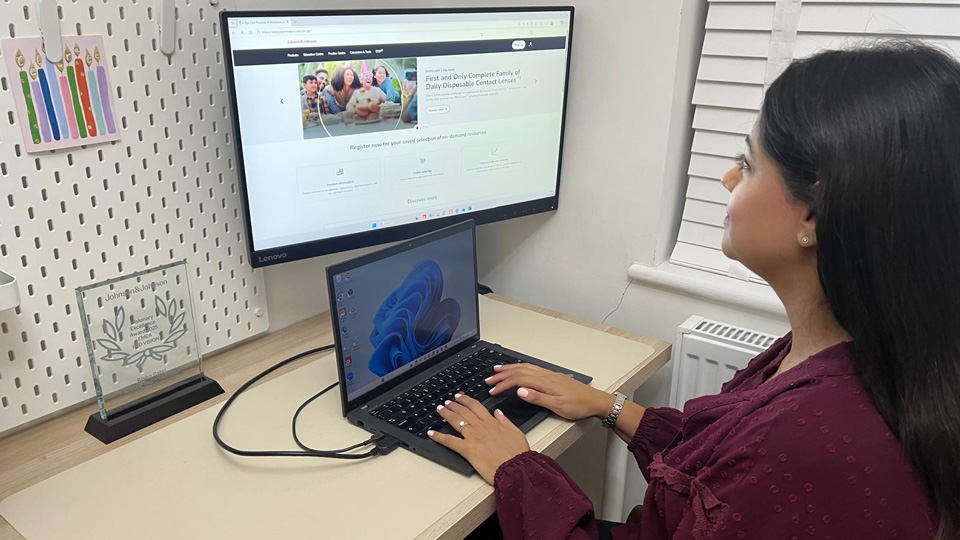
Having spent two and a half years working in industry now, Patel shared that one of the most rewarding aspects of moving from clinical practice into industry has been the opportunity to influence patient care on a larger scale.
“As an optometrist, I could directly help the patients I saw each day, which was incredibly fulfilling. However, in my current role, I have the opportunity to educate hundreds of eye care professionals through CPD events, conferences, and online learning programmes,” she told OT.
Recalling a moment that has stayed with her in her role, Patel shared the story of delivering a CPD session that explored improving conversations about contact lens upgrades that was based on real patient interviews.
“Afterwards, a practitioner told me they had started using the techniques in practice and were having more meaningful conversations with patients. That was when I really felt the scale of the role. As an optometrist, I could help the patients in front of me. Now, by supporting eye care practitioners, I can indirectly influence the care of many more patients,” she said.
Sometimes the best opportunities come from being curious, saying yes to new experiences and being willing to take a leap of faith
Advice and misconceptions
During 100% Optical this year, Patel spoke to a number of optometrists who were keen to understand what a role working within industry involved.
One of the biggest misconceptions about working in industry, Patel said, is that it means stepping away from patient care.
“For me, it has been the opposite. I use my clinical experience every day – it just shows up in a different way,” she said.
Patel noted that some also believe industry roles are purely commercial or sales focused. However, she emphasises “there are so many different paths – from professional education and clinical affairs to research, marketing, medical affairs and training.”
“It definitely doesn’t mean sitting behind a desk all day. My role is varied, collaborative and often very hands-on, which is one of the things I enjoy most,” she added.
Patel’s advice for practitioners considering a move into industry is: keep an open mind.
“As optometrists, we develop so many transferable skills – communication, problem-solving, education, project management and relationship building – and they are valuable in many different industry roles,” she said.
The optometrist also encouraged others to “look for opportunities to explore what energises you.”
She explained: “For me, a secondment in learning and development helped me realise how much I enjoyed education and mentoring. Training, presenting, mentoring students or getting involved with professional bodies can all help you work out where your interests lie.”
Patel also advises practitioners not to underestimate their clinical experience when exploring opportunities in industry. “You’re not leaving optometry behind, you’re using it differently,” she said.
“Sometimes the best opportunities come from being curious, saying yes to new experiences and being willing to take a leap of faith,” Patel emphasised.

Where can optometry take you? Academia
Lecturer at City St George’s, University of London, Ravi Ladani, shares his path into academia and demystifies the role of an optometry lecturer


Comments (0)
You must be logged in to join the discussion. Log in