


21 February 2026
Many locum optometrists will find that their weeks are filled with a mixture of community work – in busy High Street multiples, family-owned independent practices, and a wealth of settings in between.
For a change of pace, though, locum optometrists who have previously focused on community shifts might want to consider looking at secondary care – either locuming or contracting in the hospital eye service, or with an independent service provider.
Locum optometrist, Rachael Chung, also holds a contract as a hospital optometrist at Liverpool’s Alder Hey Children’s Hospital. She told OT that locuming on the High Street and working in the hospital eye service gives her a perfect balance, three years on from qualification.
“This is my dream job,” she told OT: “I didn’t realise how much I would love working in paediatrics.”
However, she added: “I think, if I did it full-time, I’d lose the ability to speak to adults like adults.”
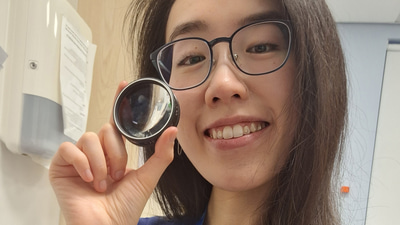
Locuming was supposed to be a temporary stopgap, Chung explained, whilst she looked for a suitable resident role locally.
However, she found that she enjoyed the freedom locuming entailed – including having the option to travel to London for shifts once a month.
“I really love being my own boss,” Chung said.
At the same time, she describes stepping into the hospital eye service a year ago as a “breather” from the commercial aspects that she would always be considering when locuming on the High Street.
“I could purely focus on clinical needs,” she told OT, adding: “You have time to discuss more thoroughly with colleagues.”
Chung emphasised that the High Street and the hospital are different environments.
“I feel very supported in hospital, particularly because there are ophthalmologists down the corridor,” she shared.
Technology and pathology in hospital versus in practice
Locum optometrist, Roma Malik, started locuming at Newmedica in Nottingham a year ago, after being introduced to the opportunity locally.
“It felt like a natural progression, to broaden my secondary care experience,” Malik told OT.
Malik noted that the technology locums are required to use at Newmedica is dependent on the clinics that they choose to work in – for example, locums could potentially be performing gonioscopy procedures if they work in glaucoma-focused clinics.

Optical coherence tomography (OCT) and Goldmann applanation tonometry are routine parts of her practice at Newmedica, Malik told OT.
She also noted that the hospital group can provide training and opportunities for further development, based both on clinical needs and the locum’s own areas of interest.
When compared to community practice, “the case mix is broader and more pathology-driven,” Malik explained, adding that working alongside independent prescribing (IP) optometrists and ophthalmologists helps to enhance clinical decision-making.
“The main benefit is the accelerated learning curve and exposure to complex cases in a supportive, multidisciplinary setting,” Malik believes.
She added: “It’s an excellent way to upskill, maintain clinical confidence in managing pathology, and stay aligned with the evolving scope of optometric practice.”
Seema Rauniar, who locums in the community and holds a resident position one day a week as a specialist optometrist with Princess Alexandra Hospital NHS Trust, noted that locums can be at a disadvantage when it comes to upskilling and continuing professional development, due to not having a practice support system behind them.
“If I didn't have my residential hospital position, I think I’d feel a little bit lost about where I was and development,” she said.
Chung noted that, whilst her hospital work in purely paediatric, Alder Hey’s resident ophthalmologists have wide-ranging skills – so she will utilise them for their knowledge outside of her specific hospital clinics.
On the other side, she explained that she will encounter cataracts in practice – which she would never see in the hospital setting.
In terms of skills, Chung observed that, whilst retinoscopy is a core training skill that all optometrists master during their pre-reg placement, it is something that is easily lost in community practice because carrying it out is not required on a daily basis.
Retinoscopy is something that is a valuable part of a hospital optometrist’s toolkit, and this benefits her during her locum shifts in the community, Chung believes.
“I benefit a lot clinically and commercially by double-checking results, because I am quite confident in ret, and that’s purely because I use the retinoscope to see children day-in, day-out, when I’m at the hospital,” she explained.
She added: “Retinoscopy is definitely underutilised – it is a skill that I use in both settings, and it really helps me in primary care.”
Confidence building
OT is interested in how working in the hospital helps practitioners when they are locuming in community practices.
“I’m so much more confident when I’m in primary care,” Rauniar told OT.
A recent case of anterior uveitis, diagnosed in community practice during her locum shift, might have presented a challenge had she not been familiar with the condition from the hospital, Rauniar explained.
“Because I work in the corneal clinics, and I work in the emergency eye clinic in the hospital, as soon as that came in, I knew exactly what I needed to do. I knew the signs, the symptoms, what I was looking for, and where to refer,” Rauniar told OT.
She added: “It helps that I’ve got good connections with other hospitals as well, so I knew that I could get that patient in straightaway with the right person.
“I spot more corneal problems now, because I work in the corneal clinic. I’m much better at spotting very early changes in the cornea.”
She added: “It has benefited me so much. It really makes my week a lot more interesting.”

Chung noted the particular confidence in prescribing that hospital work has given her.
“Because I’m a paediatric optometrist at the hospital, it definitely gives me a lot more confidence with prescribing – especially atypical cases, but also in general with children when locuming,” she explained.
She added: “It gives me a lot more confidence, including in reassuring parents what might happen in hospital, what treatment might be required, and what that timescale looks like.”
Rauniar recalled an early experience working in the emergency eye clinic, where a patient with swollen discs was complaining of bad headaches.
“Being new to the emergency eye clinic, I thought she had papilloedema,” Rauniar shared.
The calmness of the ophthalmologist in explaining why the condition was actually a pseudo papilloedema provided a strong learning curve about what can be treated in the community and what needs to be referred to hospital, Rauniar explained.
“When I see patients in clinic, in the community, I think a lot more about whether I should be referring them or not,” she said.
She emphasised: “There are definitely tell-tale signs where you want to refer them, such as ringing in their ears, vomiting or whooshing and dizziness.
“There are different things that you have to look for on the OCT, for papilloedema – a break in the Bruch’s membrane, for example. I never knew any of that, until I started working in the hospital.”
Rauniar added: “It has really given me a different perspective on optometry.”
Chung told OT: “You see a lot of interesting pathology in in hospital. I’m coming up to three years qualified, and I feel more confident than I would have at this stage if I hadn’t gone into hospital.”
She added: “Each side informs the other. I become a better, more well-rounded practitioner overall because of working in both settings.”
Differentiating yourself as a locum
Chung noted that working in a hospital setting can allow any primary care optometrist to upskill clinically.
She also believes that displaying hospital eye service experience can help practices differentiate between the locums they are looking to take on for shifts.
“It’s another string to your bow,” she told OT.
The hospital eye service at Alder Hey is currently trying to facilitate an enhanced care pathway for paediatric school screenings, Chung revealed.
During these conversations, she explained, her ability to consider both environments is beneficial.
“Working in both hospital and primary care helps me respect both sides of the profession,” Chung told OT.
“I can be a voice from the primary care side for the hospital.”
Likewise, Rauniar shares that working in hospital has given her a strong appreciation for the work that takes place in community optometry.
“Within a few weeks of working within the hospital, I realised what a good job we do in the community. It’s so streamlined, from pre-screening to seeing patients on time,” she said.
Rauniar explained that working in the hospital particularly helps with locuming in practices in deprived areas, where locums might see a lot of pathology.
“The hospital is a really good add-on, to help with your community locuming work. Also, it just makes the job a little bit more interesting,” she said.
Rauniar added: “When I tell patients I work in the hospital as well, it does instil confidence in them.”
Chung also believes that being able to tell patients and their parents or carers that she also works at Alder Hey Children’s Hospital, which is well-regarded locally, can offer them more confidence in her management.
“We’re caring for people’s health primarily, and being a locum and keeping my hand in everyday primary care informs my hospital practice, and vice versa. I truly think patients can see that,” she said.
Chung added: “From the primary care point of view, patients can sometimes get frustrated with hospital services in general. To be able to reassure both sides and act as a bridge, I consider a privilege.”


Comments (0)
You must be logged in to join the discussion. Log in