


31 January 2026
The first year as a qualified optometrist can be a learning curve.
Hours spent listening to lectures and poring over textbooks has led to this next step in the career journey – newly qualified optometrists out in the working world.
As early career professionals, optometrists are putting theory into practice. Day by day they are developing the habits that will shape the type of practitioner they become.
Below, OT has curated insight from optometrists at different stages in their career who reflect on their lessons from this formative time.
Having the courage to ask questions
Urquhart Opticians optometrist Holly Shearer qualified in 2022 – spending her first year as a qualified optometrist working between practices in Lanark and Eaglesham.
Shearer told OT that one of the key lessons she learned as a newly qualified professional was never to be afraid to ask for help.
“When newly qualified there’s still a lot out there that you haven't experienced yet and no one expects you to know everything. Ask colleagues for advice or even just discuss a case with them,” she said.
“You never stop learning this way,” Shearer added.

Her first year of qualification also reinforced the importance of having a thorough history and symptoms discussion.
“Taking five minutes to properly listen to the patient before starting any tests often saved time in the long run. A clear understanding of symptoms helped guide testing more efficiently and led to quicker, more accurate diagnoses,” Shearer said.
Optometrist and practice director of Peter Ivins Eye Care, Craig McArthur, split his time between working for Black & Lizars and the hospital eye service when he first qualified in 2008. In his role at Black & Lizars, he provided mobile cover across more than 20 practices.
McArthur valued the breadth of experience he gained through his varied roles.
“This gave me exposure to a wide range of practice sizes, patient demographics, and professional colleagues, including optometrists, dispensing opticians, ophthalmologists, and support staff,” he said.
Taking five minutes to properly listen to the patient before starting any tests often saved time in the long run
Reflecting on the insight he gained early in his career, McArthur highlighted the value of being surrounded by experienced colleagues in different roles.
“I was fortunate to work alongside exceptional clinicians such as Peter Ivins, Colin Black, and Morven Campbell, as well as highly skilled dispensing opticians like Martin Stevenson and Scott Currie,” he said.
“Being around practitioners performing at the highest level every day normalises excellence and accelerates your development,” McArthur shared.
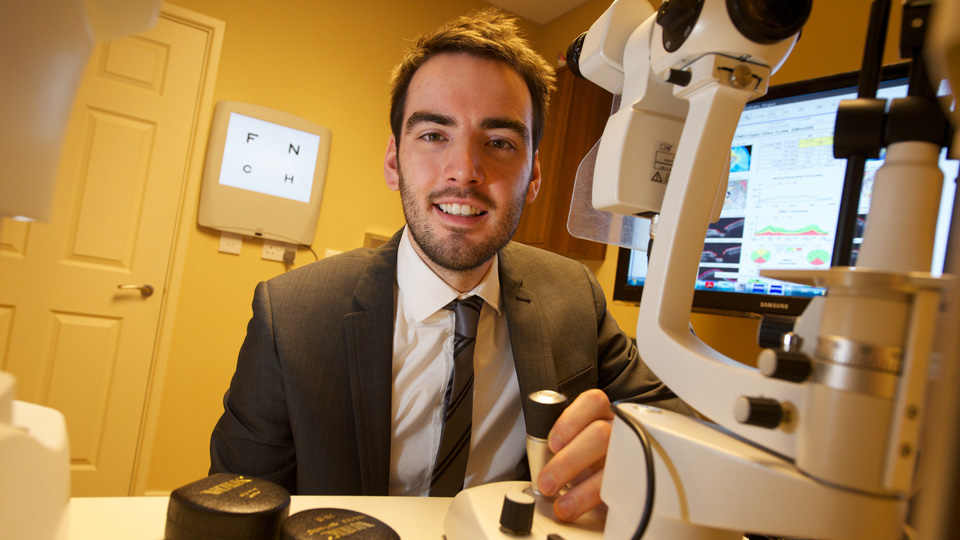
He observed that the best optometrists observe their colleagues closely and imitate their approach.
“The best optometrists are also the best thieves – they steal turns of phrase, communication techniques, and clinical tricks from experienced colleagues,” McArthur reflected.
“Working across so many practices, as well as in the eye hospital, exposed me to numerous brilliant clinicians whose skills shaped my own,” he said.
Reflecting on light bulb moments early in his career, McArthur recalled a non-verbal pre-school child with autism who had previously had a traumatic experience with cycloplegic refraction in another practice. The patient had untreated accommodative esotropia.
McArthur described how he was able to obtain an accurate prescription while prioritising the child’s comfort using a laser star projector that he borrowed from his nephew – who was a toddler at the time.
“Using the projector and music to hold his attention on the wall, I was able to perform an accurate Mohindra retinoscopy in complete darkness except for the moving laser star patterns,” he said.
McArthur successfully prescribed spectacles which resulted in improved control of the patient’s strabismus and measurable improvement in visual acuity over the following year using picture-matching techniques.
“The family still attends my practice 15 years later, and the laser projector is still in my consulting room. Sometimes children need not only your clinical knowledge but also creativity and a willingness to think outside the box,” he emphasised.
If you think you know it all, you’ll never develop and the early years are exactly when you want to be voracious
Exploring different areas of practice
In her first year of qualification in 2024, optometrist Lizzie Shaw worked at Moorfields Eye Hospital before taking up a role as a resident optometrist at Addenbrooke's Hospital.
Shaw’s advice for fellow early career professionals is to experiment with different modes of practice.
“Don’t be afraid to try everything and anything to find which areas of work suit you best,” she said.
“There is no better time to try,” Shaw added.
She highlighted that working in a hospital glaucoma clinic during her first year of qualification opened her eyes to the full patient pathway.
“Working in the hospital glaucoma clinic really helped me to feel much more assured when working in practice - having a clear knowledge of what was happening on the other side, and being given more in-depth detail was invaluable,” Shaw said.

Cameron Optometry managing director and IP optometrist, Ian Cameron, qualified as an optometrist in 2004.
He told OT that early in his career he was “a total nerd and unashamed of it.”
“I grabbed every chance to see weird and wonderful cases, chased down anything I didn’t understand, and probably mildly annoyed every practitioner I worked with by asking a million questions,” Cameron said.
Cameron’s sense of curiosity – while potentially testing the patience of his colleagues – enabled him to learn fast.
“If you think you know it all, you’ll never develop and the early years are exactly when you want to be voracious,” he said.
“You want to be the person who says, ‘I don’t know, can you show me?’ rather than the person who quietly just guesses,” Cameron advised.
He highlighted that often the optometrist who patients talk most highly of is not the person with the most clinical knowledge but the person who listened carefully and delivered explanations with kindness and compassion.
“Emotional intelligence often outranks head knowledge in the patient’s eyes. If you can learn to combine both early on, you’ll thrive in your career,” Cameron said.
Dealing with uncertainty
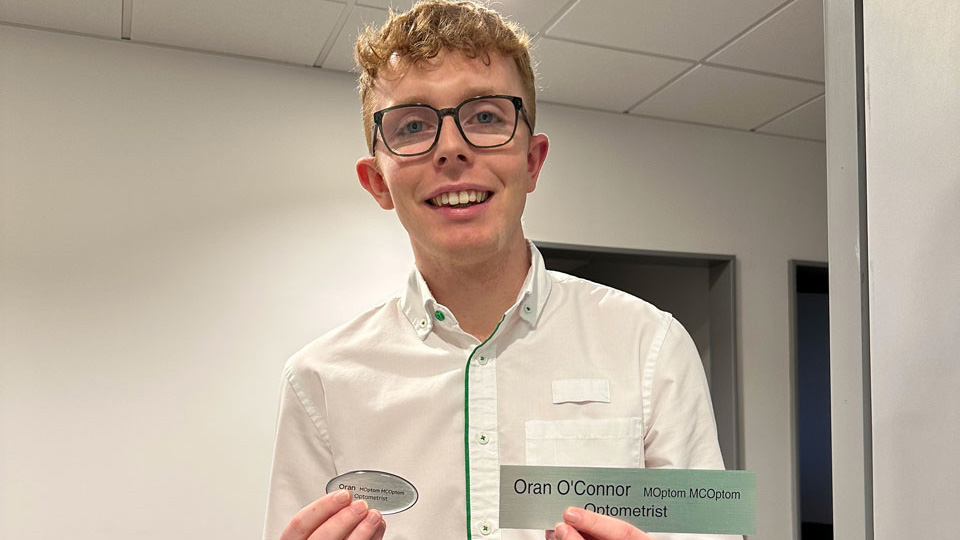
Oran O’Connor continued to work at Specsavers Newtownards – the practice where he completed his pre-registration year – following qualification in 2024.
O’Connor shared that he experienced a lot of growth during his first year as a qualified optometrist.
“As a newly qualified optometrist I began to see more acute eye problems through Northern Ireland Primary Eyecare Assessment and Referral Service. This made me come to the realisation that it is OK not to always know exactly what the issue is – the important thing is that it is managed safely and effectively,” he said.
Another key takeaway during the year was the importance of effective communication.
He highlighted the value of learning to manage unrealistic expectations as well as treat patients with empathy when delivering bad news.
Locum optometrist, Frank Eperjesi, split his time between working for the hospital eye service and as a locum optometrist during his first year as a qualified optometrist in 1991.
Eperjesi shared that a key realisation while working as a locum optometrist for a multiple practice was that the employed optometrists were taking a different approach to eye examinations.
“The resident optometrists were much more efficient than me. I realised that I’d been doing a full routine test like I’d been taught at university on every patient, and the residents were conducting eye examinations led by signs and symptoms,” he said.
Eperjesi learned that it was OK to ask for help even though he was a qualified optometrist.
“I also learned the importance of planning my travel if my locum session was in a new practice, to make sure I arrived in plenty of time,” he said.


Comments (0)
You must be logged in to join the discussion. Log in