


24 September 2024
National Eye Health Week (NEHW) marks a fresh opportunity to promote important messages to the public around their eye health and highlight the role of optometrists.
The 2024 awareness week runs from 23–29 September, and focuses on the following themes: routine eye tests and screening, enhanced primary eye care services, children’s eye health, colour vision, sight after sixty, affordable eye care, and living well to see well.
Read more about the plans for NEHW 2024 here.
OT heard from eye health charities, optical businesses, and practices, about planned activities and key messages in NEHW.
Glaucoma UK puts eye health on the list of essentials
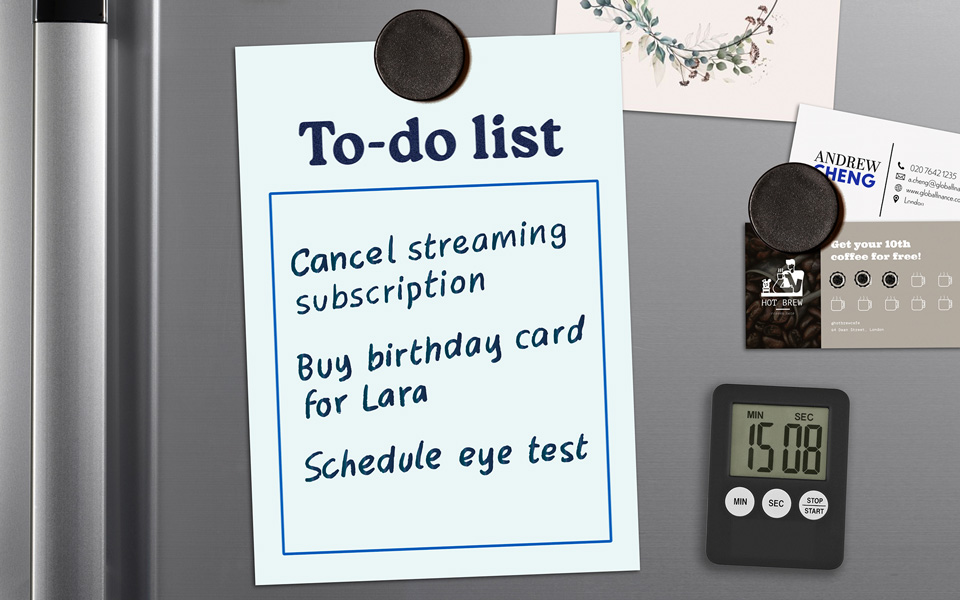
Glaucoma UK has launched a new campaign for NEHW, which focuses on integrating eye health into daily routines.
Your essentials: Put your eye health on the list features a series of images of reminder lists displayed on kitchen fridges. Each list is tailored to a specific audience, with the final reminder being to book an eye test.
The charity aims to raise awareness across age groups and, by making eye health part of everyday life, aims to encourage more people to prioritise eye tests, “ultimately leading to better long-term eye health.”
Joanne Creighton, chief executive of Glaucoma UK, emphasised the importance of eye tests as a health check and in detection of diseases such as glaucoma.
“As part of National Eye Health Week, Glaucoma UK is encouraging people to make their eye health a priority and attend regular eye tests,” she said.
Public support for enhanced primary care optical services, Specsavers finds
Specsavers has shared the results of a survey indicating that the public would welcome enhanced primary care optical services.
Released to coincide with NEHW, the research revealed that 94% of people would be likely to use an NHS-funded urgent eye health check if it was available to them.
The survey of almost 1500 people found that 55% of respondents have faced difficulties speaking to or seeing their GP when they have a health issue or concern, with more than one in 10 waiting for over a month.
Paul Morris, director of professional advancement for Specsavers, suggested that a nationally commissioned NHS service in England would end a postcode lottery in accessing community urgent eye care service (CUES).
“It would also save hospital and GP appointments, easing pressure on them. That would be good news for patients, the wider health service, and the country. We have already seen the positive benefits of eye health innovation in Scotland, Wales, and Northern Ireland,” he said.

Morris added: “Primary care optometrists already provide access to vital eye care, supporting the NHS, but also stand ready and able to do even more to support the nation’s eye health.”
Enhanced primary eye care services makes up one of the themes of NEHW 2024.
Specsavers is a sponsor of NEHW, with Morris commenting: “It’s a great opportunity for our sector to talk to patients and policy makers about critical eye health messages, the importance of regular eye test and how we are going the extra mile for the nation’s health.”
“Nearly one in four people don’t access regular care, so National Eye Health Week is an important opportunity for us to talk about the importance of eye health and regular eye tests,” he said.
Colleagues from Specsavers practices will be visiting schools to talk to children about eye health. The group is highlighting the recommendation that children have their eyes tested from an early age.
Specsavers survey stats
94%
of people would be likely to use an NHS-funded urgent eye health check if it was available
55%
of respondents faced difficulties speaking to or seeing their GP
one in 10
patients waited for over a month to see or speak to their GP
OutsideClinic optometrist provides eye health checks for vulnerable communities
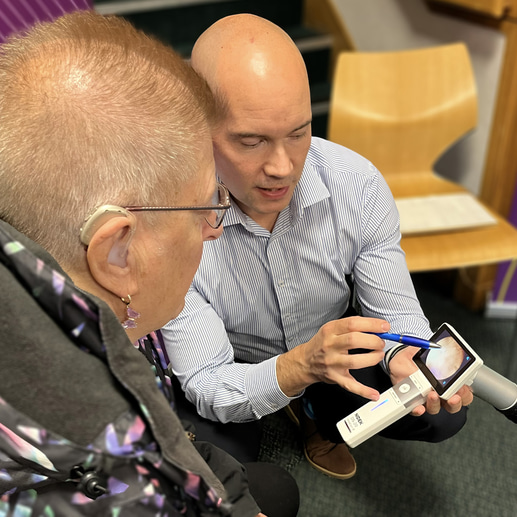
In the lead-up to NEHW, OutsideClinic partnered with Alternative Angels, a charity supporting people who are homeless or vulnerable.
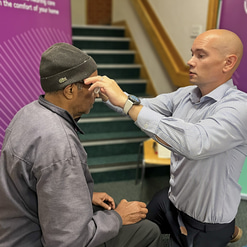
On 16 September, OutsideClinic optometrist, Matt Burford, provided eye health checks at the Pilgrim Centre in Swindon, where Alternative Angels provides meals for people experiencing homelessness.
Burford said: “Access to quality healthcare is a basic right, not a privilege. Eye health is often overlooked, especially in vulnerable communities, and we hope to make a meaningful difference by providing these essential services.”
He described the experience as “incredibly rewarding,” adding: “These checks could identify potential health concerns, and even if we were able to help just one person today, we created a positive change and made a tangible difference in their life.”
Eye health is often overlooked, especially in vulnerable communities, and we hope to make a meaningful difference by providing these essential services
The appointments saw individuals including Joao who, through the screening, was identified to have early signs of cataracts. OutsideClinic was also able to tighten his glasses, which had been slipping. Linda received reassurance about her eye health and learned that she is eligible for a free NHS eye test as a person over 60.
OutsideClinic highlighted the role of NEHW as a reminder of the need for regular eye examinations and preventative care, pointing out that for vulnerable communities, accessing these services can be “lifechanging.”
The Body Doctor on closing the ‘awareness gap’ in menopause and dry eye
The Body Doctor is raising awareness about menopause and dry eye during NEHW and Menopause Awareness Month in October.
The eye care supplier has partnered with menopause campaigner, GenM, and secured the MTick menopause-friendly accreditation for nine of its dry eye products. The MTick signposts menopause-friendly products.
The Eye Doctor products that have been accredited with an MTick include: Antibacterial Dry Eye Compress, Dry Eye Kit, Eye Mist, Advanced Comfort Eyelid Oil, Advanced Triple Action Eye Drops, and Hypocholorous Eyelid Spray, as well as the ReMind supplements.
Sam Wymer, sales and marketing director for The Body Doctor, said: “We’re very excited to partner with GenM and are thrilled to announce that we have secured the MTick accreditation for our leading products. There’s a significant lack of awareness that dry eye is one of the 48 symptoms that women can experience during perimenopause and menopause.”
There’s a significant lack of awareness that dry eye is one of the 48 symptoms that women can experience during perimenopause and menopause
In partnering with the GenM and MTick campaign, The Body Doctor aims to make it easier for customers to find the products, “helping to close that awareness gap and improve their overall wellbeing.”
According to GenM’s Menopause Market Report, more than 15.5 million women in the UK are currently in menopause, but many of these individuals can feel invisible, with brands and retailers overlooking their specific needs.
Research by The Body Doctor found that dry eye affects approximately 61% of women in perimenopause and menopause.
Educating patients and practice team at Urban Optics
Urban Optics in Killarney will be educating patients and the team this NEHW. The practice will be highlighting one condition a day – in practice and online.
Clodagh McGovern, optometrist and director across several Hakim Group independent practices in Ireland, shared that all staff are participating in a short training session each morning on the different conditions.
Living with AMD – advice and support from the Macular Society
Ed Holloway, chief executive of the Macular Society, described NEHW as a “great reminder to prioritise our vision,” sharing: “While macular disease can’t be prevented, we know that lifestyle factors such as a healthy diet, not smoking, and protecting your eyes from UV light can help slow its progression.”
The charity has also highlighted the importance of regular eye tests for early diagnosis of macular disease, “enabling more effective treatment and better management” of the condition.
To mark NEHW, the Macular Society has released a new episode of its My Macular and Me podcast, featuring optometrist Yuan Gao from Imperial College Healthcare Trust.
The podcast is hosted by Vicky Thompson, regional manager at the Macular Society, and provides information, tips and advice on age-related macular degeneration (AMD).
The new episode will aim to raise awareness of the importance of regular sight tests to detect conditions such as AMD, while Gao will also share advice for those living with AMD on managing the condition.
The podcast is available on the Macular Society’s website and major podcast platforms.
Leightons Opticians & Hearing Care spreads the word on eye health
Leightons Opticians & Hearing Care shared that the group will be supporting the awareness week with targeted PR and social content, as well as a bespoke email newsletter.
David Rich, marketing lead for Leightons, said: “At Leightons we are supporting National Eye Health Week 2024, by raising awareness of the importance of regular eye tests.”
He emphasised the role of eye tests in detecting changes in vision, and signs of glaucoma and cataracts, while also screening for underlying health issues.
Newmedica highlights the opportunities of closer working with optometry
Newmedica will release research during the awareness week highlighting attitudes among older people towards eye health and enjoying new activities.
The provider of NHS and private ophthalmology services will be highlighting the role of optometrists in helping to unlock resource in ophthalmology.
Jagdeep Singh, an optometrist and head of clinical proposition at Newmedica, suggested: “It is an opportunity to shine a light on how resource in ophthalmology can be unlocked through closer working with optometry to ensure timely access to care – which is good for patients and eases pressures on the NHS.”
Newmedica is collaborating with primary care colleagues for this aim, Singh said, pointing to the group’s accredited post-operative scheme, as well as the provider’s continuing professional development for optometrists.
He added: “Newmedica backs upskilling of optometrists to deliver enhanced optical services – a theme of the week. We are developing a programme of independent prescribing placements for primary care optometrists.”
Optometrists working in Newmedica have expanded roles into sub-specialities, such as in cataract, wet age-related macular degeneration, and glaucoma services. The provider sponsors its optometrists to undertake higher qualifications.
“Optometrists’ core skills mean they’re well placed to take on such work in partnership with ophthalmology colleagues,” Singh said.
It is an opportunity to shine a light on how resource in ophthalmology can be unlocked through closer working with optometry to ensure timely access to care
Fight for Sight celebrates NEHW with new identity
NEHW 2024 will mark the first for Fight for Sight under its new branding, which was revealed in August and features a new logo, visual identity, and tone of voice.
The charity highlighted that the rebrand forms a part of Fight for Sight’s five-year strategy, with a strong message around the urgent need to better fund scientific research into the understanding, diagnosis, prevention and treatment of eye disease.

Keith Valentine, chief executive of Fight for Sight, said: “When you receive a diagnosis of vision loss, you face two profound questions: Can this be stopped? How will I live my life?
“Our organisation is uniquely placed to answer both positively,” he said, adding that the charity’s new tagline of ‘Save sight. Change lives’ encapsulates that vision.
He added: “We’re particularly excited about National Eye Health Week this year, as this annual event is so crucial in highlighting the vital role eye care practitioners play in keeping us healthy.”
CHEC offers facility tours for community
CHEC will be hosting an eye health fair at its Preston headquarters this NEHW, inviting the local community to take a tour of the facility and speak with surgeons and the hospital manager.
The provider suggests this will support the community to understand the conversations they need to exercise patient choice.
CHEC has more than 30 hospitals around the country, supported by more than 90 community sites.
Dr Moemen Elnawawy, CHEC surgeon, suggested that this approach “improves equity of access to eye care for people living in areas that are typically hard to reach. While this is beneficial for patients, it’s equally so for those who refer them to us.”
Elnawawy continued: “By significantly upscaling our hub-and-spoke operating model over the last 12 months, we can now offer more opticians and ophthalmologists than ever before an efficient solution to which they can refer patients for treatment, and know they’ll be seen in less than four weeks – often much closer to two.”
CHEC encouraged the industry to use NEHW as an opportunity to get to know more about the eye care services available in their community.
SeeAbility highlights importance of routine eye tests
Lisa Donaldson, head of eye care and vision at SeeAbility, explained that the organisation is highlighting a recommendation that everyone with a learning disability should have a routine eye test at least annually.
“Adults with a learning disability are 10 times more likely and children 28 times more likely to have a problem with their eyes but they may not be able to communicate changes in their vision and often signs of poor vision are put down to their disability,” she said.
Donaldson added: “Too often people with a learning disability don’t access the glasses they need, or treatment for eye conditions – yet refractive error, keratoconus, cataract and diabetic eye disease all have a higher prevalence and may happen at a younger age than in the rest of the population.”
RNIB shares top tips
The Royal National Institute of Blind People (RNIB) will be using the opportunity of NEHW to share top tips for looking after the eyes and reminding the public to have regular tests.
A spokesperson for the RNIB said: “This National Eye Health Week is a great opportunity to remind people of the importance of taking care of one of our most vital senses: sight.”
“Bear in mind that several eye conditions have little to no symptoms in their early stages but would be picked up by a regular eye test, for example, dry age-related macular degeneration, cataracts and glaucoma,” they continued.
One in five people will live with sight loss in their lifetime, the RNIB pointed out, urging the public to maintain routine sight tests.

InnoScot Health calls for innovative ideas
InnoScot Health, a partner of NHS Scotland, suggested NEHW could be a catalyst for ophthalmic innovation, after £2m in Scottish Government funding was recently allocated to help reduce waiting times in ophthalmology.
The organisation works to identify, develop, and commercialise healthcare innovations and highlighted the role that innovation could play in helping the health service adapt to heightened pressures.
InnoScot Health has called for innovation, and created a package of support for health and social care staff with advice and guidance in areas of intellectual property protection, regulation, funding, project management, and commercialisation, to a value of £25,000 initially.
Robert Rea, head of innovation at InnoScot Health, said: “National Eye Health Week represents an excellent opportunity to inspire fresh, powerful, innovative thinking across NHS Scotland.”
“Inspired by NEHW’s ‘vision matters’ message and the need to heighten awareness, we believe that the country’s expert ophthalmologists, alongside those in support roles, are best placed to identify unmet medical needs and bottlenecks – and how to solve them,” he said.
“Identifying opportunities for accelerated ophthalmic solutions that can improve both outcomes for NHS Scotland patients and working practices for clinicians is incredibly important,” Rea said. “Fundamentally, targeting heightened efficiency is key during this period of transformation, and it can be achieved in tandem with better eye health across Scotland. The potential is vast.”
InnoScot has supported and worked with innovators on solutions including Peekaboo Vision, an app created by NHS Greater Glasgow and Clyde, and the iGrading platform, a diabetic retinopathy screening tool developed alongside NHS Grampian and the University of Aberdeen.


Comments (0)
You must be logged in to join the discussion. Log in