


05 June 2026
As an optometric advisor at Swansea Bay University Health Board, Raf Islam was perfectly placed to identify an eye care service that was lacking for patients in his area.
Here, Islam explains to OT why bringing eye care to homes in Swansea Bay has proved a valuable decision.
When and why did you decide to become a domiciliary optometrist?
After I qualified, I went into higher education. I had done my independent prescribing (IP) qualification, my medical retina, and my glaucoma certificates, but because of the different roles that I have during the week, it made it challenging to commit full-time to a practice. I felt like mobile optometry could be the answer to this, and could fit better with my schedule.
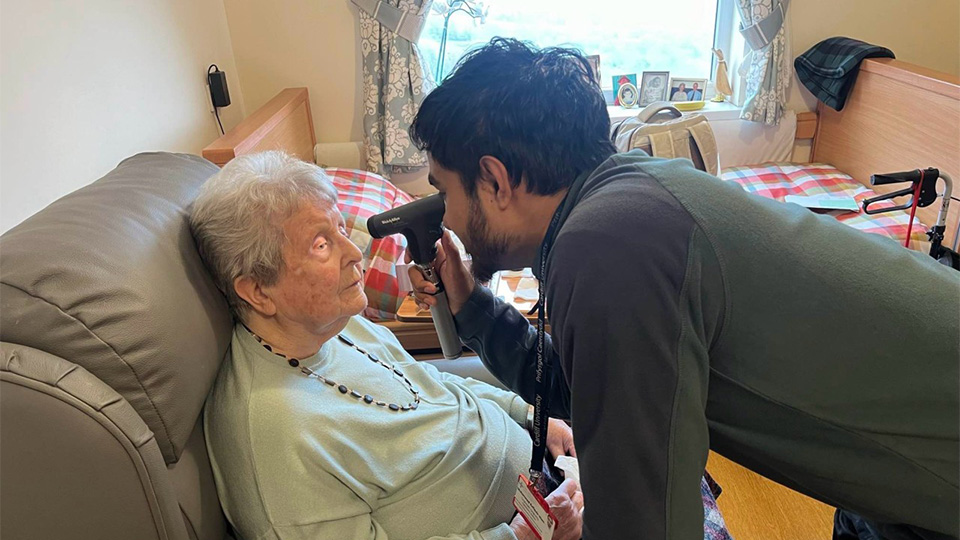
My other role is the optometric adviser to the health board in the local area. We noticed that there was a significant demand for acute emergency eye examinations, especially for those who are house-bound or have difficulty going to a more traditional practice or to the hospital. I asked myself, ‘what are we doing about this?’ and then: ‘Why don’t I start something?’ My whole purpose was to provide enhanced, acute, emergency low vision assessments for that demographic.
I now cover the whole of Swansea Bay, which is a large population. I had never done mobile optometry before and I wasn’t sure how it was going to work, but I gave it a try, and I enjoyed it. Now, it has built up, and I'm one of the main optometrists that care homes and hospitals know that they can send patients to if they have any acute eye care needs.
There’s always a misconception that someone who needs at-home care will not receive the same level of care that they would have in a practice
What do you enjoy most about domiciliary optometry and why?
I enjoy using my skills, using what I learned at university, and applying it in practice. As this is the domiciliary sector, I’m able to focus much more of my time on patients. Some haven’t seen a clinician for many months, and their symptoms could have been present for a long time. They’re grateful for what you do, even if you just listen to them, talk about their concerns, and answer any questions that they may have.
Some of our patients call me a ‘friendly neighbourhood Spider Man.’ It does take a lot of trust, if you’re going to somebody’s house, and they don’t know you. They have to have trust in what you’re prescribing.
In domiciliary, I never have two days that are the same. There’s always a different setting; there’s always a different clinical need. It can be quite challenging. Sometimes, the patient could be bed-bound, and you have to do a corneal assessment, and you think: ‘how can I do this?’
For me, it’s about the variety that it offers, and what you get back. I personally feel rewarded. I feel like I’ve improved somebody’s quality of life, and been there for them at a personal level. I like that we are able to offer tailored and individual care, especially for those with low vision. We know what is going on, and exactly what they are dealing with at home.
What would you change about domiciliary optometry and why?
I would like to change the misconceptions around mobile eye care. When I get referrals, other optometrists often ask me, ‘Can you do this?’
There’s always a misconception that someone who needs mobile eye care will not receive the same level of care that they would have in a practice. I would have agreed with that, before I started domiciliary. But since starting the role, and since investing in the equipment, I’ve noticed that I’m confident in managing at least 90% of what I saw in community optometry practice.
With the enhancements that we have in technology, portable equipment, and artificial intelligence, we’re able to offer enhanced, tailored care. Given in Wales that we are now funded to offer low vision services and independent prescribing, I feel like we can make a massive difference to those in need.
Patients and practitioners shouldn’t feel that domiciliary care is a lower standard of care. It is the same standard of care. In the future, I would like to see the conception of mobile care improved in the profession’s, patients’, and other optometrists’ eyes.
What is your most memorable moment as a domiciliary optometrist?
For me, it’s being there for patients when they most need you. Patients sometimes feel that they don’t have anyone to go to, or because of poor general health, there is no one who will listen to them. They feel lost in the system. I’ve had many cases where patients were so grateful for the care received.
I saw a patient who had a geographic corneal ulcer. This is something that we should refer to the hospital. However, the patient was bed-bound, and declined any hospital referrals.
As an IP, you have to work within your own competencies. We decided to treat it, and we managed to improve his vision from 6/60 to 6/6. I thought that this was a really good outcome. The patient was asymptomatic afterwards. It showed me the level of care that we can offer in a mobile setting.
Without me assessing his eyes, I don’t know if that patient would ever have gone to the hospital. I don’t know if he would have lost his sight. For me, that is a memorable experience. That’s what gets me up and going for the next day.
It is quite hard, travelling around, and the admin side of things. Pressure comes along with that. With my other roles during the week, it can be quite challenging. But being able to improve somebody’s sight and their quality of your life – that’s what makes me enjoy my role.
What is the one piece of advice you would give to those considering domiciliary optometry?
Talking from personal experience, I was quite reluctant to start, because I was scared about not being able to offer the standard of care that I was used to. I was worried about the cases I might see. My advice is to ignore those misconceptions. Give it a try, and put everything into it.
No two patients are the same, and you find your own way of managing different types of patients. You may not be able to solve everything, but if you are able to better that patient’s standard of care, I think that’s an achievement.
If you are interested, try shadowing another mobile or domiciliary optometrist, just to get a feel for it. You might speak to other providers, and see if you can sit in on a couple of tests, so that you can have a taste of it. Give it a go, and remember why you’re doing it.
You may not be able to solve everything, but if you are able to better that patient’s standard of care, I think that’s a good job done
What is the piece of kit you could not live without and why?
In Wales, we can prescribe on a WP10 pad, so we can manage most patients with acute eye care needs that don’t require surgery in the community.
The WP10 pad is my most valuable piece of kit, along with my portable slit lamp. They allow me to offer acute care for those who are in need, and to manage them more effectively. Without these two pieces of kit, I wouldn’t be able to offer as many services as I can, and I would be referring many more of our patients to a practice or to hospital.
For someone who is housebound, it can be challenging to attend the hospital. When I used to work in practice, one of the hardest things was when a patient would say that they physically couldn’t go to the hospital. I’m grateful that I can now offer this service to those patients directly. It also does help with hospital waiting times – even if it is only a little, it still helps. Every impact, no matter how big or small, creates a meaningful difference for the community.
More Decoding domiciliary
-
 “It’s more of an informal conversation with patients when you see them at home”
 -
 Providing domiciliary eye care across England with SightWatcher Mobile Opticians
 -
 “It offers a unique perspective on patient care that you just can’t get in practice”
 -
 “I love going back to see the same patients year after year”
Comments (0)
You must be logged in to join the discussion. Log in