


03 February 2026
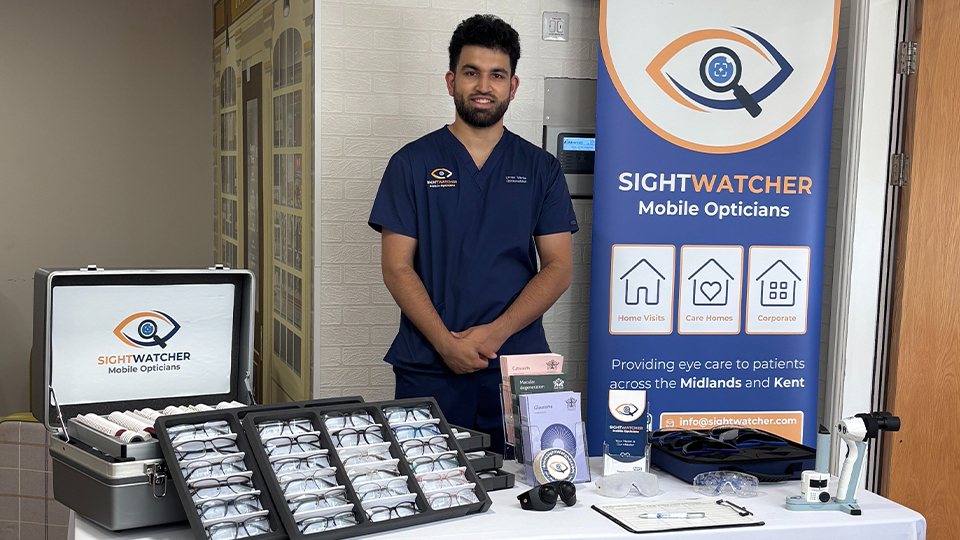
Optometrist Umar Vania achieved a professional goal in the spring of 2025, when his new domiciliary optometry business, SightWatcher Mobile Opticians, was designated as an NHS provider for at-home eye care.
Here, Vania tells OT about his most memorable moments in domiciliary – including helping a patient with Parkinson’s disease better navigate her home.
When and why did you decide to become a domiciliary optometrist?
There were several motivators that drew me towards domiciliary work. As a student at Cardiff University, I remember a lecture on automation within optometry. It planted a seed — the idea of specialising in an area of practice that would be difficult to automate. Domiciliary optometry soon stood out as that niche.
Later, while working as a hospital optometrist running low vision clinics, I saw first-hand the life-changing difference good vision could make for patients with visual impairment. There’s a huge overlap between those patients and the people we see in a domiciliary setting. The potential to meaningfully improve someone’s quality of life became my biggest motivator.
What do you enjoy most about domiciliary optometry and why?
It’s incredibly rewarding to see the improvement in quality of life that better vision brings — whether that’s someone being able to read again or simply recognising a loved one’s face more clearly. In many cases, you’re the last possible intervention for someone whose vision has been declining for years, and a well-judged refraction can be genuinely life-changing.
On a more personal note, I enjoy the autonomy the role offers and the chance to spend time outdoors between visits. Natural daylight, especially during winter months, is an underrated perk that I really enjoy.
In many cases, you’re the last possible intervention for someone whose vision has been declining for years
What would you change about domiciliary optometry and why?
I’d like to see the removal of the pre-visit notification requirement in England, as is already the case in Wales. The current system — which mandates between 48 hours and up to three weeks’ notice before visiting a patient — can unnecessarily delay access to essential eye care, particularly for those with high visual need.
Removing this step would make domiciliary services more accessible and responsive, while also promoting equivalence with patients seen on the High Street, who can access an NHS sight test promptly without prior notification. The principle of timely, need-based care should apply equally, wherever the patient happens to be.
What is the most common misconception you hear about domiciliary optometry and what do you say to demystify it?
There can be an unfair stigma attached to patients seen in a domiciliary setting — a perception that they’re all frail or difficult to manage. In truth, every patient presents their own challenges, whether seen on the High Street, in hospital, or at home.
Our patients are wonderfully diverse, each with their own stories, humour, and warmth. Every visit is an opportunity to make a genuine connection and to help restore something invaluable — sight, confidence, and dignity in daily life.
What is your most memorable moment as a domiciliary optometrist?
Recently, I saw a patient living with Parkinson’s disease, whose vision had become severely limited. After prescribing a new correction, she told me she was able to read again for the first time in months. I also noticed that she was able to navigate her home more confidently, which was particularly important given her mobility limitations and use of a walking aid. Moments like that never lose their impact.
What has been your most challenging moment as a domiciliary optometrist and why?
Navigating best-interest decisions can be particularly challenging. Balancing ethical, clinical, and emotional considerations requires experience, sensitivity, and strong communication skills — both with patients and their next of kin. These conversations can sometimes be difficult, but they’re essential to ensure decisions are made with compassion and in the patient’s true best interests.
What is the one piece of advice you would give to those considering domiciliary optometry?
Give it a genuine try and leave all assumptions at the door. Spend a few days shadowing a domiciliary optometrist – you’ll quickly see how varied, meaningful, and professionally satisfying it can be.
What is the piece of kit you could not live without and why?
I often describe domiciliary work as “pure optometry”, relying on core clinical skills that have been around for decades, reminding us that great outcomes still come from the fundamentals. While technology has progressed enormously, I still couldn’t live without my retinoscope.
As Archimedes said, “Give me a lever long enough and a fulcrum on which to place it, and I shall move the world.” With a retinoscope and a few trial lenses, you can and will move someone’s world.
What is one piece of new technology that you couldn't live without?
The iCare tonometer. It’s compact, quick, and perfectly suited to domiciliary settings. It provides accurate and comfortable intraocular pressure measurements without the need for anaesthetic drops or a slit lamp — an invaluable tool for patient care on the move.


Comments (0)
You must be logged in to join the discussion. Log in