


04 June 2026
From virtual assistants to chatbots and driverless taxis, artificial intelligence (AI) technology is catalysing change across a broad swathe of professions and sectors.
Within eye health specifically, the technology has a diverse range of both clinical and administrative applications.
For practice teams, it can be challenging to know how to harness the opportunities presented by AI while continuing to deliver safe and effective patient care.
OT spoke with AOP clinical and policy director, Dr Peter Hampson, and AOP policy and governance manager, Paul Alexander, about the AOP’s new AI and technology resource hub.

A one-stop AI hub
A new online resource hub developed by the AOP features a range of tools that every member of the practice team can refer to – from a glossary of common AI terminology, to frequently asked questions and guidance on what AI products can be used in healthcare.
Alexander told OT that the aim of developing the hub is to provide accessible information about AI to optical professionals.
“Our new hub offers the profession the tools and insight needed to engage with emerging technologies safely, ethically and in the best interests of patients,” he said.
Alexander noted that practitioners can use the hub when considering what AI technology to implement in practice.
“If there is any doubt about whether the technology is a medical device, the hub has information that can guide practitioners on when to proceed with caution,” he said.
A five-question checklist guides optical professionals through key issues to consider around the use of AI.
Alexander shared that the aim is for the hub to be a contemporaneous resource.
“The intention is to keep it updated,” he said.
Reflecting on his tips for support staff when using AI, Hampson emphasised the importance of fact-checking information that is provided by large language models, such as ChatGPT, even when using them for non-clinical tasks.
He also cautioned practitioners against entering patient information into these tools – for example, if a patient presents to practice wanting to understand what a hospital letter means.
“While the intention is good, you might be uploading sensitive patient data if you enter that into ChatGPT,” Hampson said.
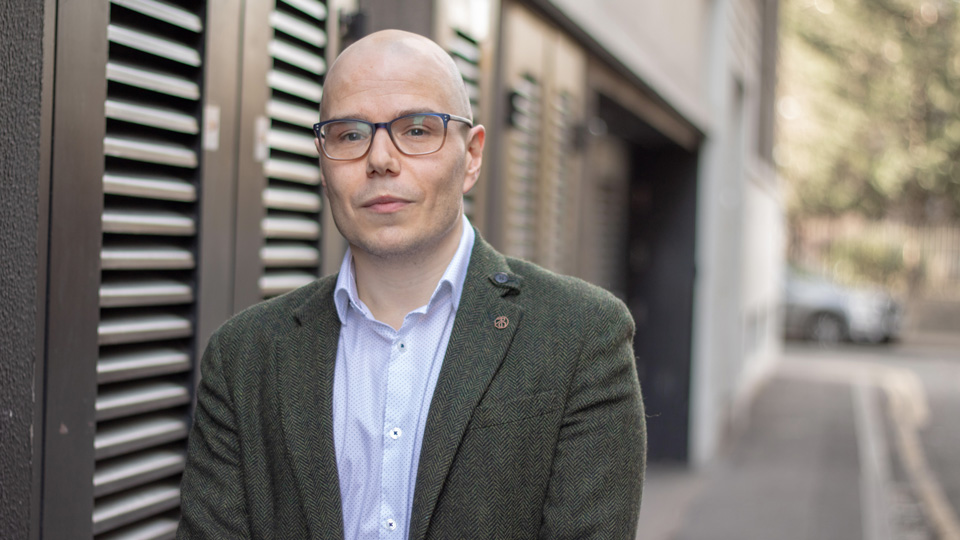
The optometrist believes that in the future AI could help with diary management and streamlining patient appointments.
“AI could take the administrative burden from practices and shrink it down,” Hampson shared.
He added that voice transcription applications could provide a summary of what was discussed and the advice that was given during clinical consultations and dispensing conversations.
“That would be really helpful for optometrists and dispensing opticians in reducing the number of misunderstandings that occur,” Hampson told OT.
Reflecting on how AI could transform optometry, Hampson shared that one day optometrists could be responsible for much of the medical management of eye health, while ophthalmologists focus on surgical management.
“If you need surgery on your eye, then you are sent to an ophthalmologist, but if you need an evaluation and maybe some medication, then that becomes the remit of optometry,” Hampson explained.
He also believes that oculomics – using the eye as a window to systemic health – holds significant potential for optometry.
Hampson shared that many people who present to optometry practice are generally well and may not regularly attend a GP practice.
“If, in the next 10 years, we are able to detect elevated blood pressure or the risk of a heart attack earlier through an optical coherence tomography scan, there is huge value in that,” he said.
“The technology is not quite here at the moment, but it is emerging,” Hampson added.
Our aim is to help mitigate the risks presented without disproportionately stifling innovation
The GOC view on AI
General Optical Council (GOC) head of strategy, policy and standards, Charlotte Urwin, noted that the use of AI within optometry is increasing.
According to the GOC’s annual business registrant survey, 5% of respondents reported using AI in 2024.
By 2025, this proportion had increased to 11% – with a further 28% of respondents intending to use AI within practice over the next two years.
Urwin told OT that the GOC is planning to produce guidance for optometrists and dispensing opticians around the use of AI.
“Our aim is to help mitigate the risks presented without disproportionately stifling innovation,” Urwin said.
She shared AI has broad applicability within eye care – and may be used to assist with diagnosing eye conditions, predicting disease progression, and streamlining referrals to secondary care.
Urwin added that AI also has potential applications in managing appointment bookings, taking notes, powering practice management systems and optimising the accuracy of prescriptions and lens selections.
Urwin noted that there are “well-rehearsed risks” associated with AI – including the risk of bias, skill atrophy, a lack of transparency and data security vulnerabilities.
As healthcare professionals, Urwin shared that GOC registrants have a responsibility to ensure the care and safety of their patients and the public and uphold professional standards.
“They are expected to meet these standards regardless of what tools they use,” Urwin highlighted.
She added that dispensing opticians and optometrists are professionally accountable and personally responsible for their practice – regardless of what guidance they have been given by a colleague or employer.
“This means they must always be able to justify their decisions and actions. This applies to all aspects of professional practice, including when utilising an AI tool,” Urwin advised.



Comments (0)
You must be logged in to join the discussion. Log in