


12 September 2024
How many pairs of spectacles and sunglasses do you own?
I was thinking of counting them but gave up. Let’s just say: a drawer full.
What frame shapes, colours or styles do you usually go for?
I mostly have sporting sunglasses, but I have some pretty cool lifestyle sunglasses that I don’t wear for cycling, just for going into the city.
As a cyclist, or more specifically a mountain biker, I usually go for the large screens because they offer me a lot of protection. They are sturdy when I have a crash. On the road bike, where I don’t have the danger of flying rocks or branches, I still go for the big ones because they protect me from the wind and weather. I also like the appearance.
Can you describe your favourite pair?
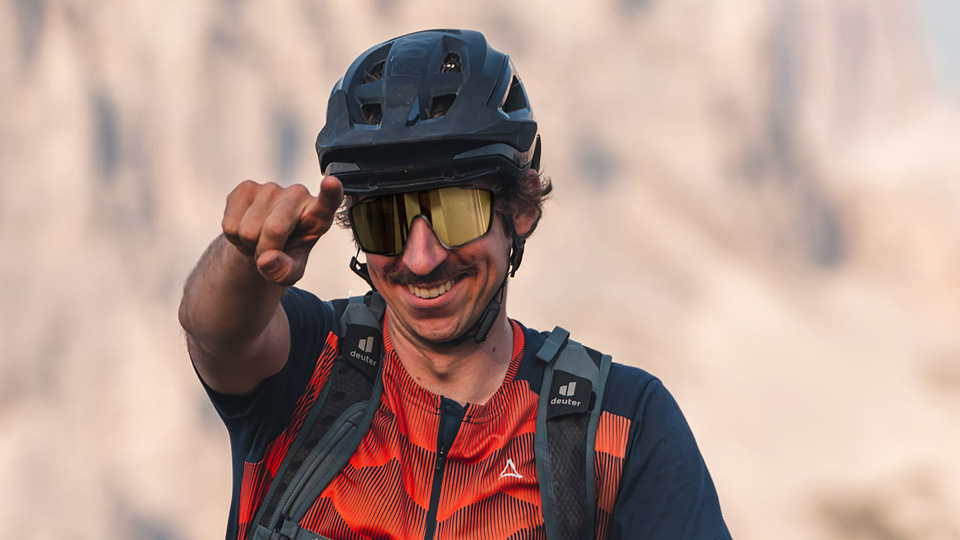
The new ‘Kraft’ from Red Bull SPECT. I love the shape and colours. It’s neutral because of the black and gold colouring, but still sharp-looking. What I really like is on the front it has vents which remind me of a sports car. The ‘Kraft’ also has a wing temple system [this extends out to provide extra security for the frames behind the ear]. These are the last things I would lose if I crashed or rolled down a really bumpy section. I even once went bungee jumping with them – they stay in place. The frame feels like it has the same level of protection and shield as a goggle but without the strange look of wearing a half-helmet and goggles.
Inside the design: ‘Kraft’

In developing these frames, the designers wanted to create a combination of a goggle, which is secure on the face, and sunglasses.
How did you realise that eyewear could benefit you as an athlete?
It’s funny because, when you’re a kid, you don’t think about this. You just ride your bike. Then you get rain and wind in your eyes, and realise ‘Oh, maybe I should put something on.’ Once you go faster and more advanced, you’ve got rocks flying from buddies riding before you, or branches flying towards your eyes, so you realise you need even stronger protection. When you’re at a certain level and speed, you realise glasses can help you by giving really cool contrast, such as in the woods between rocks and roots. It can help you see even better at race speed. The older I got and the faster I got, the more I realised that I needed professional sunglasses.
What does vision and eye health mean to you?
For me, it means the world. The eyes are our portal to the world and to experiencing beautiful nature, friends; everything out there. It's my highest priority to keep them safe. It is one of my highest motivations to wear good protective sunglasses, especially in high-risk sports.
How important is eyewear in reflecting your personality?
When you look into cycling there are several degrees, depending on the discipline, to how important appearance is. For road cyclists how you look is one of the most important things. If you look at free riders, it's not so important. I find myself in the middle. I'm inspired by road cyclists, and I'd love to transfer that style to the mountain bike. Because I think even though sunglasses are a protective item, it's a really cool possibility to express your style. That’s important to me personally.
What are your top three tips for selecting the right pair of frames?
- Define which field of views are needed for which discipline
- Consider in what weather and conditions you use them, because that makes a difference for the colour and filter needed
- Think about what outfits you want to combine the sunglasses with.
Could you tell us about your partnership with Red Bull SPECT?
There are two things I'm really proud of concerning this partnership. The first one is that Red Bull SPECT Eyewear is my longest and oldest partner. I can't even count, but it’s been a lot of years that I have been able to count on them.
The second thing is that they're from Graz, Austria, which is my hometown. I have my biking partners from the US and a unicycle from Canada. It's hard to find good partners near to you, even in your own country, but in your own hometown? It's just so cool. It's nearly too romantic.
Sometimes I get a call from one of the designers and I can pick up the frames and go for a ride to test them out on the same day. Then I can tell him what works and what doesn’t work for me, and we can talk about it.
Where did your love for cycling and unicycle downhill begin?
As far as I can think back, I was drawn to any kind of cycle. When I was two or three years old, I tried to get on the bikes and ride around my yard. I was then starting to become a cross-country racer as a kid.
My parents told me that I could do anything except downhill mountain biking. I had to find a loophole and got to know the unicycle. I was just riding and practising: on grass, in the forest, jumping up and down the curb. I was even watching videos online and saw some people were racing unicycles downhill, and somebody else was jumping onto a ping pong table. I thought: I need to try that. I kept practising and then one day I was jumping on a ping pong table. I started getting into unicycle competitions, which led me to the World Championships.
Besides that, I was always riding any kind of bike – even motorbikes. It's just a love that burns inside me. There's no day I wouldn't look at my bikes. I often joke that I wonder where all of this comes from because I’m the only one in the family drawn to bicycles.
What is your proudest achievement?
I think my personal highlight was stepping on a world champion podium. [Rosenkranz reached third place in the 2014 and 2016 World Championships of Unicycling ‘Unicon’] It gives me goosebumps to think back on it: that's a feeling you will never forget. All the training has paid off, you step up there and know that you’ve done it.
I also brought out a film, Walking the Good Path, that tells the story of Jay Bearhead who found that mountain biking helped him turn his life around. Seeing that message on a screen 20 metres high at the premiere in Munich was also a moment I was quite proud of.
What is next for you?
I'll be tackling 300 kilometres in a gravel race, which is personally a challenge because I'm not an ultra-cyclist. I’ve partnered with a group of cyclists to do that, and our challenge is to combine our personalities to make it something we can achieve together.
Graz
Gerald and Red Bull SPECT Eyewear are both from Austria
300 km
Gerald’s latest challenge is a gravel race
2014 and 2016
third-place podium finishes at the World Championships of Unicycling


Comments (0)
You must be logged in to join the discussion. Log in