


14 March 2026
The process of obtaining higher qualifications in glaucoma was explained by Specsavers head of continuing professional development (CPD) and independent prescribing optometrist, Bhavik Parmar, at 100% Optical (28 February–2 March).
Parmar’s aim was to inspire optometrists to upskill in glaucoma if they had not already done so, he told attendees during his workshop session.
Parmar shared his belief that in 2022 it became clear that the NHS needed optometry, as the pandemic continued and 643,000 patients were waiting for ophthalmology treatment in England.
He noted that, from his perspective, the situation has not massively improved since then.
“We must be part of the answer. We must be seen as the GPs of the eyes,” Parmar told attendees – before noting that, with independent prescribing and the professional certificate in glaucoma being incorporated into optometry degrees in some areas, many practitioners are already viewing themselves this way.
Parmar went on to emphasise the importance of optometrists upskilling in glaucoma, noting that 14% of blindness registrations in the UK are a result of the condition.
It is important for practitioners to be competent in Goldmann tonometry, he said, because in 2017 the National Institute of Clinical Excellence emphasised the importance of repeat testing ahead of a glaucoma referral.
The risk now is that newly referred patients might be prioritised over existing cases, Parmar said.
We must be part of the answer. We must be seen as the GPs of the eyes
Cases from the clinic
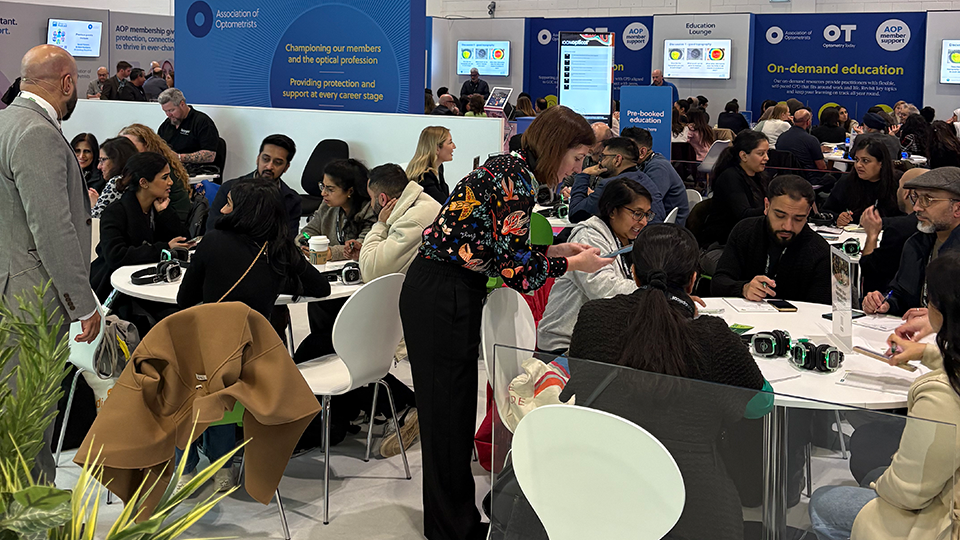
Practitioners broke off into groups to discuss two patient case studies, including establishing what further tests would be useful, identifying a working diagnosis and priorities for management, what local pathways are commissioned in their respective areas, and how their management might change with higher glaucoma qualifications.
The first case study involved a 45-year-old male patient with reduced near vision, and intraocular pressures of 25mmHg and 26.3mmHg in the right and left eye respectively.
The patient was in general good health, practitioners were told.
Disc size is an important factor to note in this case, Parmar said.
In discussing the importance of the slit lamp, he advised attendees to: “Remember the tools that we have in practice.”
He went on to advise that practitioners follow College of Optometrists guidance on whether to refer in such a case, based on corneal thickness.
The second case study involved a myopic 60-year-old female patient, who also had type 2 diabetes.
The patient was a varifocal wearer and presented with deteriorating near vision, practitioners heard.
The patient also struggled on the visual acuity test. Family history was unknown.
Practitioners heard that intraocular pressure was 12mmHg in the right eye and 14mmHg in the left eye.
There were glaucoma risk factors in this case including cupping, Parmar noted, adding that practitioners should consider anterior eye angle tests and repeating the visual fields test.
A full threshold rather than a supra visual fields test would be most appropriate in this case, Parmar said.
He advised that practitioners again refer to the College of Optometrists’ guidelines, but noted that this patient is likely to be suitable for a glaucoma enhanced referral service appointment.
Paths into glaucoma higher qualifications
Parmar noted that the WOPEC level 2 training in glaucoma is the first step and minimum standard that is required for glaucoma management, whilst the professional certificate in glaucoma is the first step in a practitioner’s glaucoma upskilling journey.
The WOPEC level 2 assessment includes an objective structured clinical examination (OSCE) with five stations, Parmar explained.
These stations cover Goldmann applanation tonometry calibration, a Van Herick assessment, use of the volk lens, an optic disc assessment, and a case-based scenario.
Many future optometrists will graduate with a level glaucoma accreditation already, as it is now embedded in some optometry degree courses, Parmar noted.
He emphasised that upskilling in this area is important, to avoid those with years of experience falling behind newly-qualified optometrists who have recently gained their accreditation.
Nine UK universities – Bradford, Cardiff, Manchester, Ulster, Plymouth, Hertfordshire, Aston and City, St George’s, plus the University College London (UCL) Institute of Ophthalmology, in partnership with Moorfields Eye Hospital – offer the professional certificate in glaucoma.
Parmar shared that his own glaucoma qualification involved two practical teaching days, plus an OSCE, and was highly flexible.
The course should take between three and six months to complete, he said.
He also noted that many employers or local optical committees may be willing to fund their optometrists to complete the course.
The higher certificate and the professional diploma in glaucoma: a step up
The higher certificate in glaucoma allows for management of the condition in both the hospital and the community, Parmar told attendees.
He explained that completion of the higher certificate is likely to take between six and nine months, and students will see 150 cases during this period.
Students will be able to identify changes in clinical status by the end of the course, Parmar said.
Four providers offer the higher certificate: the University of Bradford, Cardiff University, the University of Plymouth, and the UCL Institute of Ophthalmology.
The course takes between four and 12 months and should further develop a practitioner’s ability to detect changes in clinical status and subsequent decision making, as well as their overall management of patients with glaucoma.
The placement requires 150 cases to be seen, Parmar’s presentation said.
The professional diploma in glaucoma requires seeing 250 patient cases over six to 12 months and is offered by Cardiff University and UCL Institute of Ophthalmology, again in partnership with Moorfields Eye Hospital.
The more qualified you are, the more you are going to be able to do with glaucoma patients
Reasons for upskilling in glaucoma
Parmar identified confidence, especially in appropriate recalls and communication with patients, as a key reason for upskilling in glaucoma.
He also recommended that practitioners incorporate glaucoma upskilling into their CPD professional development plan.
“The more qualified you are, the more you are going to be able to do with glaucoma patients,” Parmar emphasised.
For practices, he noted an enhanced reputation, better competitive advantage, database growth through referrals from other practices, and a greater retention of patients who are being seen closer to home.
Better referrals also mean a better overall relationship with secondary care, Parmar said.
For patients, he emphasised improved care, better access to glaucoma experts closer to their homes, a reduction in false positives for the condition, and an overall reduction in avoidable sight loss.


Comments (1)
You must be logged in to join the discussion. Log in
Anonymous14 March 2026
I assume with the upskilling by obtaining further qualifications there is a quite substantial increase in salary? Can someone from Specsavers confirm the details of salary increases that the additional qualifications rightfully deserve ?
ReportLike6