


Approaching the final year of his medical degree, optometrist, James Brawn, was faced with a choice.
He could continue down a path that led to him becoming a qualified doctor, or he could return to his career as an optometrist.
Should he continue his pursuit of a longstanding professional ambition – one that he had already made many sacrifices to obtain?
Or should he return to a familiar and comfortable career that would enable him to spend more time with his young daughters?
He thought about the weeks where he would go for days without seeing his own children despite living in the same house. He thought about the moments where he was physically present with his family but mentally absent – with the pressure of study and work taking a toll.
“In the end it became a straight up choice. Am I going to choose my medical career or am I going to choose to be a father?” Brawn shared.
Brawn chose to return to optometry and has not looked back – although he gained many valuable experiences through studying medicine.
“I genuinely had some moments I'll never forget, and will definitely treasure,” he said.
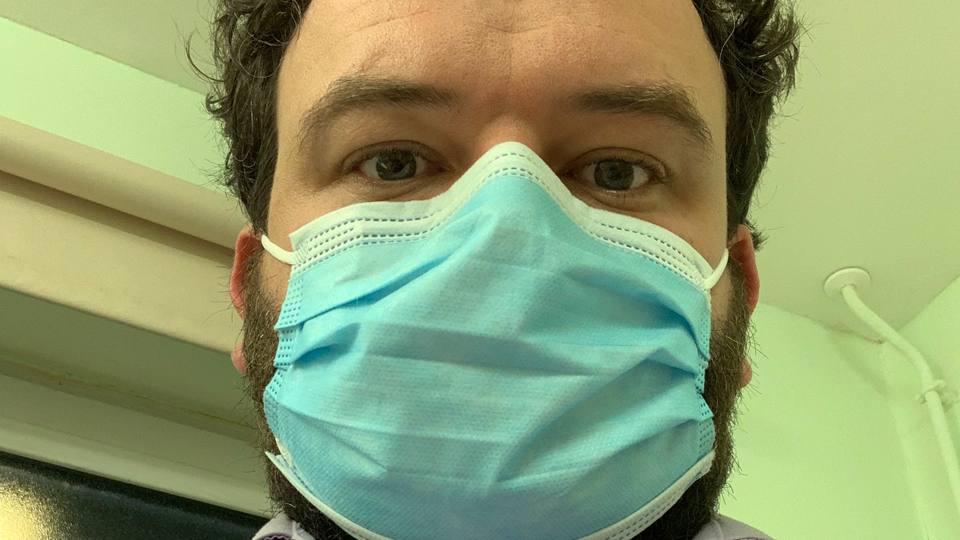
After leaving his medical degree in 2025, Brawn now works as a locum optometrist in South Wales and as a Welsh clinical leadership training fellow for Health Education and Improvement Wales.
While Brawn grew as a clinician during his medical training between 2021 and 2025, the optometry profession also evolved.
“When I started medical school, in Wales we had a traditional General Ophthalmic Services contract – similar to how optometry works in England at present,” he highlighted.
“Now that I’ve come back to optometry, we have the WGOS service, which puts shared care right at the centre of the profession. It is becoming much more common for optometrists to work with ophthalmology,” Brawn observed.
His time studying medicine has helped him to take a more holistic approach to patient care now he has returned to optometry.
“You have a patient in your chair, and you don’t know what is going on in their life,” he said.
“I’m not saying you need to spend time finding out everything, but unless you get to know someone, you can’t really act in their best interests,” Brawn observed.
Now when Brawn is taking a patient history, he will consider three questions that he picked up as part of his medical training.
“It’s called ICE – which stands for ideas, concerns and expectations,” he explained.
“If somebody has come in with a problem, you can ask, ‘Do you have any idea what this could be?’ ‘Do you have any concerns about this?’ And ‘what are your expectations?’,” Brawn highlighted.
I genuinely had some moments I'll never forget, and will definitely treasure
The decision to study medicine
Growing up with a sibling who required many hospital appointments as the result of a genetic condition, Brawn was exposed to the idea of medicine as a career from a young age.
However, when he was deciding on his future career, the level of responsibility that medicine entails was a daunting prospect for Brawn.
“I didn’t like the idea of having someone’s life in my hands,” he said.
After studying to be an optometrist at Cardiff University and completing his pre-registration year in 2014, Brawn built a varied optometry career across primary care, hospital, teaching and research.
“I always had this little niggle at the back of my head saying, ‘You should have done medicine’,” the optometrist reflected.
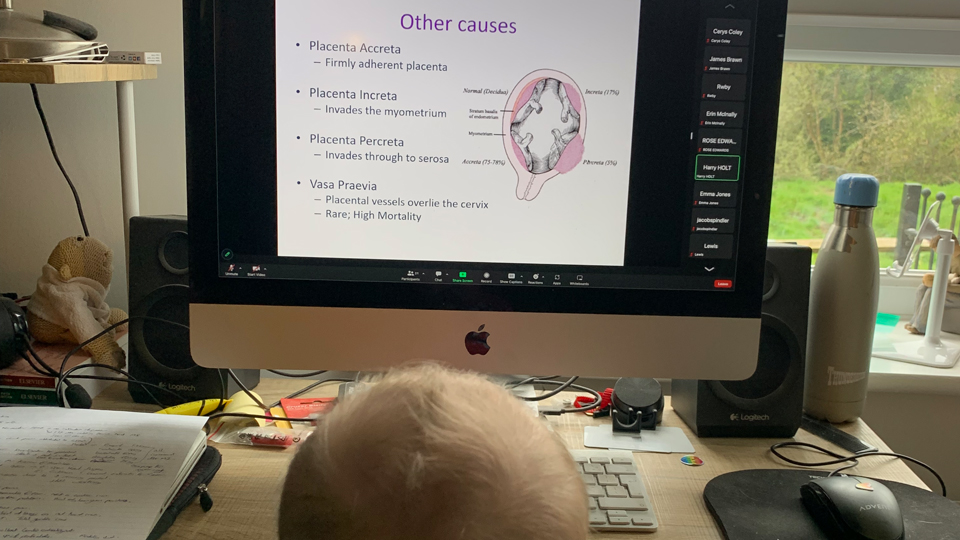
Brawn applied for a graduate medicine programme at Swansea University in 2019, taking up his place in 2021 following disruption caused by the pandemic.
Brawn shared that the experience of studying medicine was intense.
“By most reasonable measures, if you ask people what is the hardest degree, they would probably have a medical degree right up there, so doing an accelerated version where they condense the degree down was a big shock to the system,” he said.
There were moments where Brawn’s prior experience as an optometrist proved useful – for example, when he taught an emergency department consultant how to use a slit lamp.
There were other moments where Brawn realised the extent of knowledge he needed to gain, even within the field he had qualified in.
“In our second week, they presented a clinical sign that is present on the front of the eye, and I didn’t know what it was. That caused a bit of a crisis of confidence,” Brawn said.
The clinical sign was Kayser-Fleischer rings – where copper deposits form darkened rings around the peripheral cornea.

No regrets
Brawn continued to work as an optometrist on weekends and through study breaks alongside his medical training.
He told OT that as a graduate student this was a financial necessity.
“The funding model for medical students, as with any type of undergraduate degree, is based on the assumption you're 18 years old with no significant financial responsibilities,” Brawn highlighted.
“When I started medical school, I had a mortgage, I had bills to pay, I had a young daughter who was only nine months old at the time. I knew that realistically I was going to have to supplement my student loans and grants through doing locum work,” he said.
Study, work and family commitments left little time for Brawn to prioritise his own wellbeing.
When he talked with foundation doctors about their work-life balance, Brawn was told that he should not expect his workload to change much until he was a consultant.
That meant it could be up to a decade before Brawn was able to devote more time to his family.
“My daughters would be teenagers and preparing to leave home themselves,” Brawn said.
Now that he is working as an optometrist, Brawn has enjoyed more quality family time. He feels happier and healthier.
“I don’t regret my decision whatsoever. I’ve had the most wonderful experience. I’ve actually been a father: it’s not the big moments. It’s all the little moments that add up,” Brawn concluded.


Comments (0)
You must be logged in to join the discussion. Log in