


22 January 2025
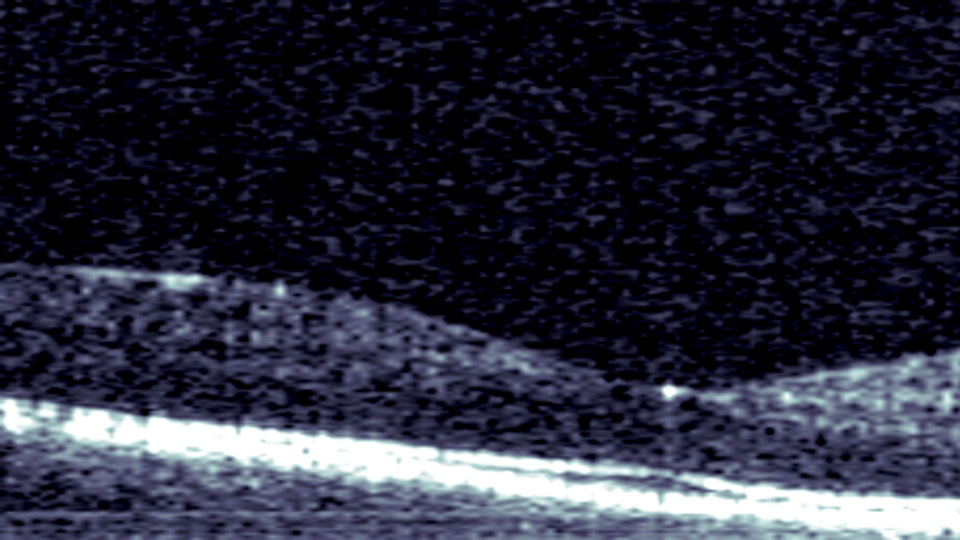
To outside observers, the picture may seem nothing special – a moonlit landscape, the bright lights of a township nestled below hills.
But to Dr Alasdair Price, the image was extraordinary. This was not, in fact, a nighttime countryside scene, but an image of the human retina captured using components with a footprint smaller than a £1 coin.
“I couldn’t believe we had actually done it,” Price told OT.
In October last year, Price’s company, Siloton, became the first commercial organisation to capture an optical coherence tomography (OCT) image of a live human eye using photonic chip technology.
In doing so, the Bristol-based start-up made a notable step towards transforming the way OCT scans can be delivered.
For desktop OCT devices, the technology could one day help to lower the cost while delivering a higher level of functionality within the same footprint.
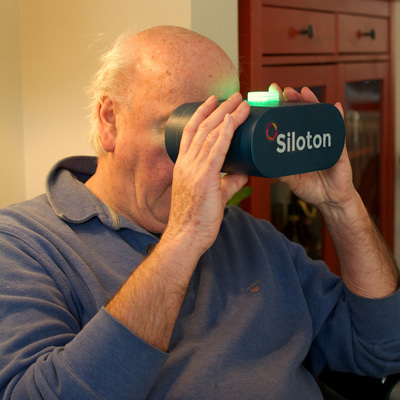
In a development that domiciliary optometrists will welcome, the grainy image also represents progress towards a portable OCT device that could be used in home settings.
While the chip that captured the image is a starting point rather than a finished product, Siloton is aiming to have regulatory approval for a portable OCT device within three years.
A quantum leap
Before establishing Siloton, Price worked within quantum technology, which he describes as “exploiting physics at the smallest, most fundamental level.”
His experience focusing on the way that single particles of light behave has helped to inform his approach to developing OCT technology.
“In terms of the eye, for every billion photons you put into the eye, you get about one back out,” Price shared.
“When working on component design for the chip, we can use learnings that we have from quantum technologies,” he said.
Price told OT that while others have tried to develop photonic chips for OCT within an academic setting, Siloton is the first commercial company to reach the level of imaging real people.
Siloton is comprised of scientists with backgrounds in physics and engineering. Across the team, they have experience developing more than 25 photonic chips for a range of applications.
Asked how he came to focus on OCT, Price told OT that during his PhD he became interested in establishing a company.
“I could see that the way to achieve real positive benefits for society was through doing that, because you can work at a much faster pace than you can in larger organisations – that's both universities and also big companies,” he said.
We've shown that it is capable of imaging human eyes, which is phenomenal
He was motivated to focus on developing a medical device in order to use his skills to create technology that helps people and cannot be misused.
Price secured a 12-month Enterprise Fellowship – a programme run by the Quantum Technologies Enterprise Centre, that supports researchers and graduates to make the transition from academia to entrepreneurship.
Through the fellowship, Price talked to many professionals about the challenges they had in their roles, including Dr Denize Atan from Bristol Eye Hospital.
Price’s hunch about the potential benefits of using photonic chips for medical imaging were confirmed when Atan outlined the common issues she experienced with OCT images.
“I knew straightaway that we could tackle that with photonic chips,” Price highlighted.
From this initial idea to developing a photonic chip for OCT, the path has not been straightforward. Siloton was incorporated only a few weeks after the first UK lockdown.
A challenging fundraising environment meant that Price and his colleagues approached friends within the industry to ask for free or discounted components.
The first OCT system was built on the chief technology officer’s dining room table, navigating the challenges of dust and creaky Victorian floorboards.
“Normally, you need a really stable optics lab,” Price recalled.
“We broke every rule of building optics. Every time Euan moved, he changed the set up,” he said.
Price explained that developing photonic chips is about balancing two aims that can work in opposition to each other.
“The dark art of chip design is managing to put something on there that is definitely going to work, but that is also good enough quality to be useful,” he said.
“You need to take some risks to ensure the quality of the image, but those risks also reduce the chance of it working,” he highlighted.
Siloton secured around £485,000 of investment in March 2022, enabling the company to develop its first OCT device and first-generation chip.
Price told OT that he had expected that the initial photonic chip would only be used to image artificial eyes.
“We've shown that it is capable of imaging human eyes, which is phenomenal,” Price shared.
A further investment round has brought Siloton’s total funding to over £1.6 million, with the company planning to develop a second-generation chip this year.
“If we absolutely knock that out of the park, then we will move on to the third generation, which will focus on fine tuning and design for manufacture,” Price said.
A simple solution
Alongside developing a portable OCT device, Siloton aims to provide established OCT manufacturers with photonic chips.
“Our goal as a company is that if there is an eye scan being done, we want a Siloton chip to be behind it,” Price said.
He explained that using a photonic chip has the potential to simplify the supply chain for OCT manufacturers, while also freeing up space for additional functionality within the device.
“Not absolutely everything is on the chip, but about 70% of the system is,” Price highlighted.
“If you're sourcing multiple components from multiple suppliers, then that alone is a complex supply chain that increases costs,” he said.
Price envisions that, in the near term, a Siloton photonic chip will be able to produce an image of the same quality as that produced by existing low to mid-range OCT devices.
He added that increasing the affordability of OCT devices could enhance access to eye care in developing countries, as well as enhancing disease monitoring.
Price shared that at present only around 13,000 OCT devices are sold globally each year.
A portable OCT device could enhance home monitoring of eye diseases and enable personalised care by tracking biomarkers over time.
“There is a huge potential to develop a better understanding of the diseases that affect us better, and to therefore find new treatments,” Price said.
He emphasised that within the UK, portable OCT devices could enable domiciliary optometrists to use the same technology that is offered on the High Street, while also enhancing the level of care that can be delivered outside a hospital setting.
In terms of cost, Siloton aims to develop a portable OCT device that would be significantly cheaper than existing desktop devices.
“We'd be looking at around a 10 times reduction in price compared to the equivalent desktop system,” Price said.
A key focus of the company has been on developing a device that is easy to use, Price shared.
He observed that reducing the time taken to capture an image means that clinicians can instead focus on what they do with the data.
“It's allowing optometrists and ophthalmologists to focus on helping people, rather than sitting there trying to get an OCT to work,” he said.


Comments (0)
You must be logged in to join the discussion. Log in