


05 December 2025
Photochromic lenses offer a practical, and increasingly colourful, option for many patients with fast-paced lifestyles and manufacturers have sought out ways to meet the differing needs of these on-the-go wearers, while broadening the appeal of the category.
Anne Catherine Scherlen, vision care products and services at Transitions Optical, explained that the launch of the company’s latest lens, Transitions Gen S, followed five years of development and more than 100,000 prototypes.
The lenses reach category one in two seconds, achieving full darkness in 25 seconds, returning to clarity in less than two minutes, with 45 seconds to fade-back to category one.
“The development of Transitions Gen S was driven by strong scientific and clinical evidence to better understand how light impacts vision and how to modulate it effectively – not only to reduce glare, but also to actively support visual quality,” Scherlen said, adding that effective light modulation requires “highly responsive technology synchronised with physiological needs.”
By reducing glare and adapting to brightness, the lenses help wearers maintain sharper and more comfortable vision. Scherlen said: “In practice, this means patients not only recover their vision faster but also enjoy a smoother, less fatiguing visual experience overall.”
Clinical studies have found that the lenses deliver stable vision in 90% of real-world conditions, two-and-a-half times faster contrast sensitivity recovery time when moving from bright to dim conditions compared to clear lenses, and reduce squinting by 50% compared to clear lenses.
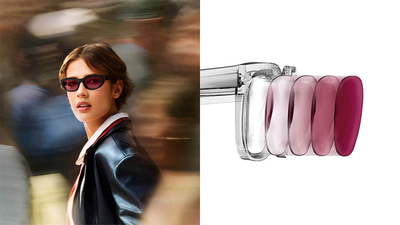
The lens is available in eight colours, with this choice of colours making the lens more attractive to 81% of wearers, the company found.
“For many years there was a hesitation in some practices to recommend Transitions lenses universally, as they were often perceived as a solution mainly for older patients. That stigma created a barrier, with photochromics seen as practical but lacking the style and modernity that younger wearers expect. Transitions Gen S changes this conversation completely,” she said.
The Transitions Color Match tool allows patients to scan a QR code in the practice and preview how the Gen S colours would look in a frame of their choice.
The company is also introducing Transitions Color Touch, which will present a subtle tint of colour when not activated.
Scherlen described how the newest ranges are appealing to younger wearers “who value style, tech-driven performance, and comfort.”
Halo effect
Hoya’s Sensity family of photochromics includes five distinct products tailored to specific patient needs.
These include Sensity 2, recommended for everyday use, Sensity Dark, which reacts to visible light and UV for photochromic performance even through a windscreen, and Sensity Shine, which combines Sensity Dark with light mirror coatings.
Sensity Fast activates close to category three absorption and achieves a 70% transmission in under 80 seconds at 23 degrees, while Sensity Colours provides the performance of Sensity Fast with six tint options, including graduated and solid.
Andy Sanders, professional services director at Hoya, explained that the lenses preserve natural colour perception, avoiding distortion that is common with tinted lenses, to ensure accurate and comfortable vision.
The lenses can also reduce glare and enhance contrast, supporting visual comfort and detail recognition, he said.
In March, Hoya introduced Sensity Colours to the UK market, with tints including Dynamic Yellow and Energising Orange.
Sanders said the launch was driven by a desire to “merge advanced photochromic technology with modern style.”
He added that since the launch, the range has prompted “huge interest” amongst eye care professionals: “As well as widening the appeal of photochromics to a new, younger demographic, Sensity Colours has helped to support a halo effect across the whole Sensity family.”
“The Sensity family attracts a wider audience, including younger, fashion-conscious individuals who may not have considered photochromic lenses previously,” Sanders said.
The yellow and orange options particularly appeal to active wearers, offering improved contrast.
Sanders encouraged practitioners not to make assumptions based on age or past lens choices, noting that patients may not be aware the option of photochromics is suitable for them, or realise how much the technology has evolved.
Dynamic approach
Jason Halsey, product and training manager at Rodenstock UK, shared: “Light sensitivity is a common experience in modern society. Photochromic lenses are great for everyday life.”
With photochromic lenses providing the ideal level of tint for every lighting situation, Halsey said: “Life gets more comfortable and convenient, because you don’t have to switch as often anymore between sunglasses and your clear pair, therefore squinting and eye fatigue is reduced dramatically.”
Rodenstock offers the ColorMatic Three, ColorMatic X and ColorMatic Sun in its current range of photochromic solutions.
ColorMaticX is the fastest of the three options, changing from maximum absorption to full clarity 54% faster than the previous generations of the lenses, reaching clarity of 95%. The material also provides a darkening of up to 88%.
Halsey told OT that this fade-back speed is important for the “seamless experience” of the wearer.
The company noted that everyday life has becoming increasingly dynamic, with changing and challenging light scenarios and experiences indoors and outdoors.
Rodenstock describe these lenses, with the combination of speed and clarity, as ideal for everyday use, whether commuting, working in an office, or shopping on the High Street.
“ColorMaticX ensures visual comfort, convenience, and protection,” Rodenstock shared.
The lenses have been designed with both a high index base material and a photochromic double matrix, which emphasises the darkening of the lens.
The range is available in a variety of timeless and fashionable colours, including chestnut brown, smokey grey, pilot green, and steel blue.
With an in-house photochromic dye department that has developed more than 1900 dyes, Rodenstock was able to tailor an environment for the dyes to be designed for speed and emphasising the darkening of the lens.
ColorMatic Sun also includes a fashion contrast option that starts as an orange and turns into a brown in full sunlight.
Halsey noted: “photochromic lenses don’t replace sunglasses one:one in every situation, due to variances in the dyes based on temperature and exposure.”
This means sunglasses are still recommended at the beach, in very hot climates, or hiking in a mountainous environment, he said.
Halsey told OT that more is to come from Rodenstock in the photochromic space, sharing that the company will be showcasing a “new approach” in 2026.
“We’re hoping to make it so that more people can actively benefit from ColorMatic,” he said.


Comments (0)
You must be logged in to join the discussion. Log in