


19 November 2026
The safety and effectiveness of optometrist-delivered YAG laser and paediatric scleral contact lens fitting were among topics discussed at the Hospital and Specialty Optometrists Conference (14–15 November, London).
Alongside keynote lectures, peer reviews and clinical workshops, a series of short paper presentations provided delegates with insight into the latest research within hospital optometry. Here, OT presents a summary of what was discussed.

1 A community-based glaucoma service in Croydon
Moorfields Eye Hospital optometrist, Hussain Khambati, provided HSOC delegates with insight on low-risk glaucoma monitoring within primary care optometry practices during his HSOC presentation.
Moorfields Eye Hospital established the Croydon service in 2021 in partnership with Primary Eyecare Services.
“In addition to the suite of services we had already decided that we wanted to commission, we wondered whether we could mobilise a stable glaucoma service delivered by primary care optometrists to be run in parallel to our asynchronous review pathways,” Khambati explained.
He presented an audit of 276 appointments within the low-risk glaucoma monitoring service that took place between December 2021 and January 2023.
The appointments were delivered by three optometrists with specialist qualifications in glaucoma at three different practices in Croydon.
Khambati shared that 66% of patients remained within the monitoring service – while 20% were discharged back to the care of their GP.
Only 12% were referred back to the hospital eye service with suspected disease progression or unsatisfactory intraocular pressure control.
To assess the decision making of the optometrists involved in the service, Khambati explained that the researchers took a random sample of 55 patient episodes seen by the three different primary care optometrists involved in the service.
Two senior hospital optometrists and a consultant ophthalmologist were asked if they agreed with the optometrist’s management in each case.
Khambati highlighted that this audit found moderate-to-substantial agreement between the primary care optometrists and hospital clinicians.
He added that survey responses from 119 patients who accessed the community glaucoma service revealed a 98% satisfaction rate.
“We think this data broadly supports the notion that synchronous primary care-based glaucoma monitoring delivered by community optometrists who are appropriately trained represents a good alternative to the virtual review model,” Khambati shared.
2 An audit of selective laser trabeculoplasty at Warrington Hospital
Warrington and Halton Teaching Hospital optometrist, Natalie Warrilow, presented an audit of patients who underwent selective laser trabeculoplasty (SLT) during her HSOC presentation.
Warrilow shared with delegates that the Laser in Glaucoma and Ocular Hypertension (LiGHT) trial in 2019 resulted in a recommendation that patients should be offered SLT as an initial treatment in patients with open angle glaucoma and ocular hypertension.
She added that National Institute for Health and Care Excellence guidelines were updated in 2022 to reflect this research.
Warrilow noted that as well as being offered as a first line treatment, SLT could be used to treat existing glaucoma patients.
“It’s very handy if people are not tolerating their eye drops,” she said.
“It was fantastic news. We had another tool in our armory for controlling patients’ pressures,” Warrilow highlighted.
She observed that from a patient point of view, SLT is quick, easy and painless.
“From a performer point of view you need someone who is experienced in gonioscopy and assessing the angle, with previous glaucoma experience,” Warrilow said.
An SLT clinic was established at Warrington Hospital in 2021. Warrilow noted that the procedure was initially delivered by glaucoma consultants before she began performing SLT.
In order to examine the effectiveness of the service, Warrilow followed the three-year outcomes of every patient who received SLT at Warrington in 2021, and compared these results to those achieved in the LiGHT trial.
Warrilow noted that in the LiGHT trial, 74% of patients were drop-free at three years after SLT – compared to 30% within the cohort of 115 patients at Warrington Hospital.
However, Warrilow explained that there were a higher proportion of patients who were already receiving treatment within the audit sample compared to the LiGHT trial.
“We weren’t expecting the same results as LiGHT because of medication use. The other difference is the level of glaucoma – we had more advanced disease than was included in the LiGHT study,” Warrilow shared.
When controlling for these factors, 67% of patients within the Warrington Hospital audit were drop-free at three years.
She observed that the audit found that SLT was less likely to be effective if a patient had received prior treatment, or had a more advanced stage of disease.
“In conclusion, SLT is effective and safe, but you do need to counsel your patients on who the treatment is less likely to be effective in,” she said.
3 Exploring the effectiveness of a virtual contact lens assessment service
Moorfields Eye Hospital consultant optometrist, Yetunde Obadeyi, provided insight on a virtual contact lens assessment service at HSOC.
Explaining the context to the development of the service, Obadeyi shared that an audit of referrals into the Moorfields Eye Hospital contact lens service in 2024 found that while 61% of patients were fitted with contact lenses, 39% were not.
She noted that there were two main reasons that patients were not fitted with contact lenses.
“About a quarter did not want to be fitted with contact lenses in the first place, and about a quarter had already achieved good visual acuity in glasses,” Obadeyi highlighted.
As a result of this audit, Obadeyi and her colleagues decided to establish a virtual clinic to determine the motivation for contact lens wear before patients come into the hospital.
The optometrist observed that the aim of the initiative was to reduce the waiting time from referral to treatment.
“We wanted to ensure that those who needed medical contact lenses were seen sooner, while those who didn’t need contact lenses were reviewed virtually,” Obadeyi said.
The virtual clinic involved a digital pre-assessment questionnaire being sent to a patient’s smartphone.
Between November 2025 and August 2026, Obadeyi shared that 114 patients have been seen through the virtual clinic.
“The discharge rate from the clinic is 36%. This is similar to the initial 39% that were not fitted in contact lenses from the initial audit,” she highlighted.
Obadeyi observed that the virtual clinic has increased the ability to see new medical contact lens patients three-fold.
Patients were seen by the virtual clinic within 9.5 weeks on average, compared to 18 weeks for a face-to-face appointment.
The number of patients waiting for their first appointment reduced from 381 in November 2025, to 200 in August 2026.

4 Patient non-attendance within a digital medical retina service
Moorfields Eye Hospital research optometrist, Tasnia Begum Ali, outlined research exploring reasons for non-attendance among a large-scale digital medical retina service at HSOC.
The questionnaire-based study was conducted across four asynchronous digital medical retina Moorfields Eye Hospital clinics between December 2024 and June 2025.
Among the 1759 survey respondents, 18.6% of respondents reported that they had previously not attended a digital medical retina appointment.
“That’s almost three times the NHS ophthalmology Did Not Attend (DNA) rate of around 7%,” Ali highlighted.
71%
of patients would like digital medical retina appointments to be delivered at their local optometry practice
Ali observed that there was an uneven distribution of self-reported DNA rates among different demographics.
Patients under the age of 45 had a DNA rate of 23% compared to a rate of 12% among patients older than 75.
Patients living in the most deprived areas had a DNA rate of 25% compared to 13.2% in the least deprived areas.
Ali shared that the survey found a high level of patient satisfaction in the digital medical retina service – regardless of whether a patient had reported not attending a previous appointment.
“When someone attends, they rate it just as highly as anyone else. The challenge is in access and not acceptability,” she said.
When asked what factors might make them more likely to attend a digital medical retina clinic appointment, 93% wanted the clinic to be under an hour, 90% wanted the clinic to be close to transport links, and 80% wanted correspondence in their preferred language.
“Interestingly, 71% of patients wanted the clinic to be hosted at their local optometry practice,” Ali said.

5 A 15-year audit of paediatric scleral contact lens fitting at Moorfields Eye Hospital
Moorfields Eye Hospital consultant optometrist, Shreeti Lakhani, provided insight on paediatric scleral contact lens fitting during her HSOC presentation.
She outlined the results of an audit of paediatric patients fitted with scleral or mini scleral contact lenses at Moorfields Eye Hospital between 2010 and 2015.
Lakhani noted that among the 30 patients who were fitted with scleral contact lenses over the period, the average age was 13.
There was a gap in patients being fitted with scleral contact lenses between the ages of three and five.
“Those of you who fit contact lenses in babies or pediatric contact lenses know that this age, between about three and five, is so difficult to fit. We fit them when they’re babies, and then we stop for a little bit, and then restart again,” Lakhani said.
“The same is true for other contact lens types and not just soft contact lens fittings,” she added.
The main reason for fitting paediatric patients with scleral contact lenses was to improve vision (69%) followed by therapeutic indications (20%).
“The main ocular conditions were corneal ectasia, followed by neurotrophic keratitis. We also identified some rarer conditions such as brittle cornea syndrome, Stevens-Johnson syndrome and neurofibromatosis,” Lakhani said.
Lakhani noted that 58% of patients were still wearing their scleral contact lenses at the end of the audit period and most patients were wearing their lenses for more than eight hours each day.
Reflecting on the findings of the audit, Lakhani told delegates that it can be helpful to start with a smaller lens diameter in paediatric patients to help patients get used to it before increasing the diameter.
“For therapeutic cases, the lens may only be required for a short period of time. Lens wear should be reviewed because it may not be clearly indicated anymore or the patient may be managing without the lens,” she said.
6 A closer look at an optometrist-led external disease clinic
Moorfields Eye Hospital specialist optometrist, Phoebe Withrington, provided HSOC delegates with insight on an audit of an optometrist-led external disease (OL-EX) clinic at Moorfields St George’s.
She explained that the clinic was set up in June 2021 and is staffed by three independent prescribing optometrists.
Explaining the reasoning behind setting up the clinic, Withrington shared: “Waiting times for external disease review with consultants are often long. A clinic like this creates capacity.”
An audit of cases seen by the clinic was performed between January and May 2024.
The audit found that among the 200 patients seen, the most common condition was dry eye disease (24%) followed by stable corneal graft patients (14%) and keratoconus (13%).
Withrington shared that one in three patients was determined to be unsuitable for the OL-EX clinic under the current referral protocol.
“This prompts a reflection on both the appropriateness of referrals and triage to the service,” she said.
The audit found that two in three suitable patients who presented to the OL-EX clinic were appropriately managed.
In cases where patients were deemed to have been inappropriately managed, this was largely due to either a patient being discharged without a consultant review or a discrepancy in the follow-up interval when compared to protocol.
“Where do we go from here? One possibility is to explore whether the protocol could be safely expanded,” Withrington said.
She added that changes to the protocol could include an expansion of conditions that can be safely managed within OL-EX, as well as amendments to follow up and discharge protocols.

7 Improving record keeping in patients with diabetic eye disease
Manchester Royal Eye Hospital principal optometrist, Caroline Severs, outlined how text prompts within electronic patient records have improved the care of patients with diabetic eye disease during her HSOC presentation.
Severs shared that in 2024 the National Institute for Health and Care Excellence published guidance on the management and monitoring of diabetic retinopathy.
“It includes direct reference to systemic factors that we need to consider,” she said.
“For those of us working in ophthalmology clinics, we should have access to a person’s HbA1c and blood pressure results. We should be discussing with them how these factors can affect their eyes and their vision,” Severs highlighted.
She explained that the guidelines require clinicians to take into account a patient’s stage of diabetic retinopathy alongside their HbA1c level, their renal function, and their blood pressure when making decisions about treatment and follow up intervals.
“We found that in our ophthalmology clinics, whilst ocular history was routinely documented, systemic history was not being consistently recorded,” Severs said.
In response, Severs and her colleagues developed templates with a series of text cues prompting clinicians to record relevant ocular and systemic factors.
“Having these risk factors visible on the patient record meant that they were more readily considered, and it aided in the standardisation of notes across clinics and clinicians,” she shared.
Severs presented three case studies illustrating the importance of considering systemic factors when seeing patients with diabetic retinopathy.
“Without considering a patient’s current systemic and ocular status, management plans may be suboptimal,” she said.

8 Effectiveness and safety of optometrists delivering YAG laser at Moorfields Eye Hospital
Moorfields Eye Hospital specialist optometrist, Naomi O’Brart, discussed an audit of YAG laser capsulotomy procedures performed by optometrists at Moorfields Eye Hospital during her HSOC presentation.
The audit involved 200 patients who were assessed for treatment between August 2023 and February 2025.
“To give a little background, posterior capsule opacification is a common complication after cataract surgery. It can affect visual quality and patient satisfaction, causing symptoms of blurred vision, increased glare, and reduced contrast sensitivity,” O’Brart shared.
“YAG laser capsulotomy is an established treatment,” she said.
O’Brart noted that cataract surgery activity is increasing.
“We therefore need service models that can maintain access and provide timely treatment without placing all activity on an already stretched workforce,” she said.
The specialist optometrist shared that Moorfields Eye Hospital introduced optometrist-led YAG laser capsulotomy clinics in June 2023.
In order to assess the safety and effectiveness of this service, O’Brart and colleagues conducted an audit of YAG laser procedures performed by optometrists between August 2023 and February 2025.
O’Brart shared that the audit found that 3% of the 150 patients who received a YAG laser capsulotomy experienced a complication as part of the procedure. In all of these cases, the complication was a non-central lens pit.
At follow up, 70% of patients experienced an improvement in visual acuity of at least one line compared to before the procedure.
“The findings suggest that optometrist-delivered YAG capsulotomy was safe and effective in this cohort,” she said.
Woodward Memorial Medal and Ditipriya Mukhopadhyay Prize
Professor Jonathan Jackson delivered the 2026 Woodward Memorial Medal Lecture exploring the topic of keratoconus in a presentation titled ‘In the presence of greatness – looking over the hill.’
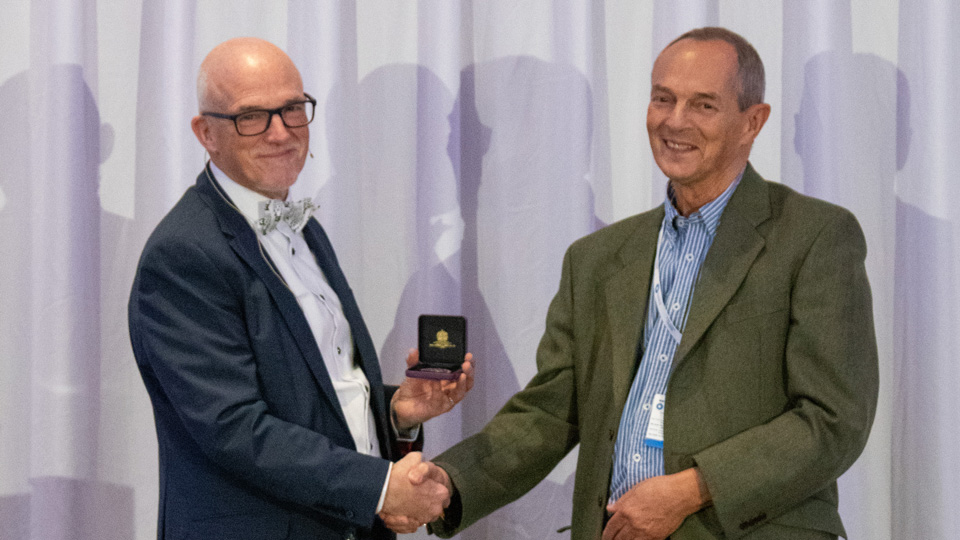
Emily Mailman and Maria Del Rosario Gill received the Ditipriya Mukhopadhyay Prize for their poster ‘Uniocular contact lens fitting – does it work?’


Comments (0)
You must be logged in to join the discussion. Log in