


28 October 2026
The AOP’s second locum clinical skills conference 2026 saw 60 locum optometrists gather in central London for a day filled with learning, networking, and peer discussion.
Delegates attended lecturers by Matthew Chan, optometrist at Bristol Eye Hospital and senior lecturer at Cardiff University; Roshni Kanabar, AOP clinical and regulatory adviser and optometrist at Stoneygate Eye Hospital in Leicester, and Birmingham Midland eye Centre’s head of optometry services, Dr Waheeda Illahi.
The day was delivered in partnership by Johnson & Johnson Vision Care. A peer review for practitioners was presented by Johnson & Johnson Vision Care in the afternoon.
Macular neovascularisation in AMD patients
Chan hosted a presentation focused on macular neovascularisation (MNV), including how the condition develops in patients with age-related macular degeneration (AMD).
The ageing of the retinal pigment epithelium can lead to thickening of the Bruch’s membrane, which in turn can lead to drusen, Chan explained.
Vascular endothelial growth can “block the pathway” and lead to MNV, Chan told attendees.
There are three types of MVN, he explained: sub-RPE, subretinal, and intraretinal.
Chan went on to speak about how he would approach looking at an optical coherence tomography (OCT) scan, focusing on which part of the eye appears to be affected.
A white or green line on an OCT scan is usually impacted in AMD cases, Chan told attendees.
OCT-angiography (OCTA), which can provide “lots of OCT scans in quick succession,” is becoming more common in practice, Chan noted.
OCTA scans are non-invasive and can show vessels directly, he said.
Chan than shared his tips for reading OCTA scans with practitioners, before presenting a series of case studies.
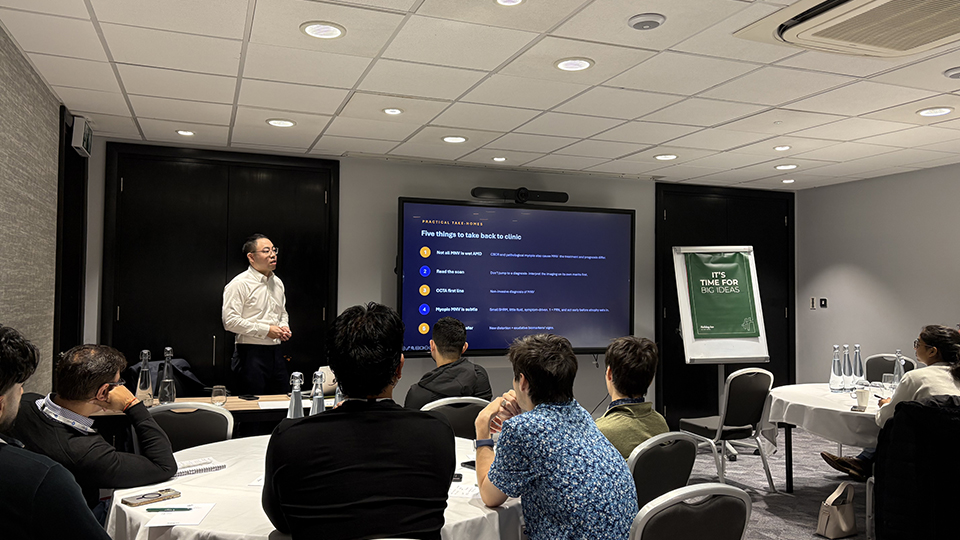
The first case centred on a patient with a history of central serous retinopathy, who had been experiencing deteriorating vision in their right eye over a period of two months.
Chan shared OCT scans of both of the patient’s eyes, before emphasising the importance of considering the thickness maps.
A second case study focused on a 40-year-old female patient with a history of high myopia.
Chan shared fundus images of the patient’s left eye, and encouraged practitioners to discuss differential diagnoses.
Attendees considered how AMD would be an unlikely diagnosis in this case due to the patient’s age, but that inflammation or uveitis could be considered.
The patient was eventually diagnosed with myopic MVN and was treated with injections, Chan revealed.
Chan also shared the five things that he hoped practitioners would take back to clinic: that not all MNV is wet AMD, as pathological myopia and central serous chorioretinopathy can lead to this condition too; to read the scan before jumping to a diagnosis; that the first line of an OCTA can lead to a non-invasive diagnosis of MNV; that myopic MNV is often subtle, and that practitioners to know when they should refer – for example, when there is new distortion or exudative biomarkers.
Referring into the hospital eye service as a locum
Illahi’s presentation focused on the challenges that locum optometrists might find when referring into the hospital eye service.
A good referral includes “trust between community and hospital,” Illahi said.
She noted that community optometrists have “a big say in where the profession is going” and are “ambassadors for the profession” in their local areas.
The main focus of her session was on whether certain referrals were appropriate and what could be done to improve them, Illahi told attendees.
She noted that challenges for locums in practice include volume and time pressures, variable support from resident staff, and uncertainty about who might be responsible for a referral if the locum is not returning to the practice.
Illahi emphasised that a referral should not be seen as an administrative task, but as a formal transfer of clinical responsibility and one of the most important parts of an optometrist’s job.
A good referral includes clear evidence, consideration of who it is being directed to, and specifics on why the referring practitioner is concerned, Illahi told attendees.
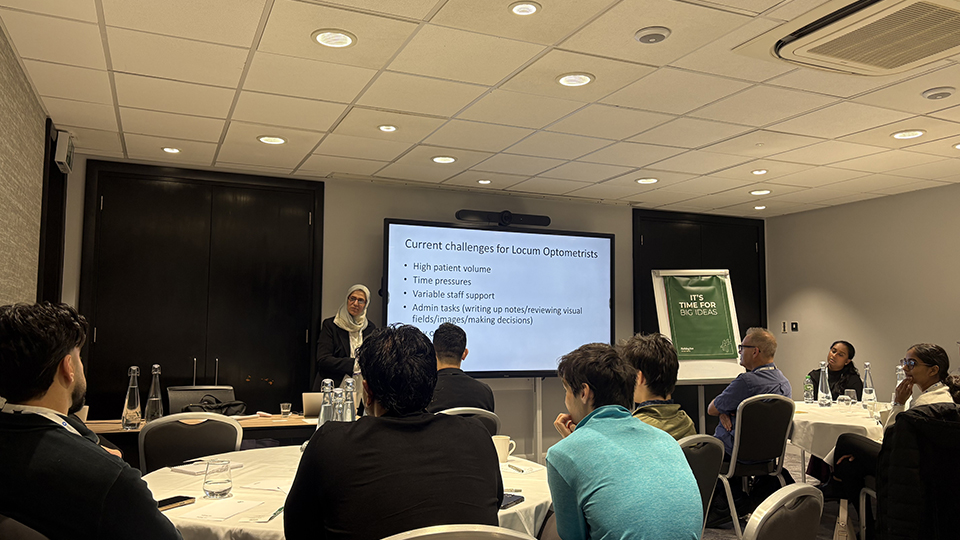
The first case study presented concerned a corneal referral for a 25-year-old patient.
It is important for the hospital eye service to know about the patient’s refractive history in cases such as this, Illahi noted.
Illahi explained that, in the corneal clinic, the patient was diagnosed with keratoconus in her left eye.
She also emphasised the importance of fully explaining the condition to the patient.
It is important to keep on top of core skills as an optometrist, Illahi told attendees, emphasising that skills such as retinopathy are “things you can do that no one else can do.”
The second case study discussed a same day urgent referral for a 23-year-old male patient with blurred vision, who had last had an eye examination seven years previously.
In this case a referral was made for a possible macula hole, Illahi said.
She noted that the patient spent four hours in the urgent care clinic, when in fact he could have attended the corneal clinic and experienced a much shorter wait.
The patient’s age and history did not fit the criteria for a macula hole and the optometrist could have better considered the roles of age, trauma and posterior vitreous detachment in this case, Illahi suggested.
“Even if it was a macula hole, would you refer it to eye casualty?” Illahi asked attendees.
Signs that might lead to a consideration of keratoconus could include allergies, hayfever, family history, reduced or changing vision, diplopia, glare, or the patient being in their teens to mid-20s, she noted.
She emphasised that in all referrals: “This is about your GOC number – this is about you acting safely.”
The third case considered a low vision clinic referral for an 88-year-old male patient, who had received a diagnosis of dry macular degeneration in his left eye upon examination in community optometry.
The patient was triaged as a low vision referral and was accepted onto the hospital’s low vision pathway, Illahi explained.
Illahi emphasised the importance that eye clinic liaison officers have in this case.
Suggested questions that optometrists could ask ahead of referring include whether the patient lives in a house or a bungalow, whether they are finding any trouble cooking their meals, and whether they have stickers on their microwave to denote certain buttons, Illahi said.
In terms of the referral, it is important to be clear on what is being referred – for example, does the issue affect the back of the eye? – Illahi told attendees.
This is important because of the number of potential specialty clinics that the patient could be seen by, Illahi said.
“It is important to say where you want the patient to be seen,” she emphasised.
The fourth case involved a same day casualty referral for an 82-year-old male patient, who subsequently spent four and a half hours waiting to be seen.
Considering the age of the patient and their needs is important here, Illahi emphasised.
She urged practitioners to “take into consideration their day” – including whether the patient might need to eat before travelling to the hospital, or whether they might need to go home first to change into more comfortable shoes.
Optometrists could build on the care that they are providing by offering a patient a cup of tea before they leave the practice, Illahi suggested.
In this case, Illahi revealed that the clinic found that the patient had dry AMD, and he was discharged from the hospital.
The referral to casualty was not appropriate in this case and optometrists should ensure that they know about available referral pathways in the areas that they are working in, Illahi emphasised.
Illahi’s final case study considered a self-referral of a 13-year-old-patient by a parent, one week after a visit to a community optometry practice.
The patient had an itchy right eye, but had good vision and reported no allergies and their blood work returned normal, Illahi said.
She noted that the patient had a history of itchy eyes caused by hayfever, and was already on various medications to combat this.
The patient was sent to urgent care and the notes were shared with the paediatric ophthalmology department, Illahi told attendees.
At the hospital, the child was diagnosed with an episode of resolved uveitis, Illahi told attendees.
She noted that extra caution should be taken with paediatric patients, as was done in this case.
The symptoms in this scenario could have led to a diagnosis of red eye or inflammation, Illahi noted.
She also emphasised the important of following the College of Optometrists’ Clinical Management Guidelines.
It is “important to put the pieces together,” Illahi said.
She concluded: “The real focus is on patients being seen at the right place, at the right time.”
Regulatory issues for locums in practice
AOP clinical and regulatory adviser, Kanabar, presented a session focused on scenarios that locum optometrists might encounter in practice.
In each scenario, practitioners were encouraged to consider what course of action they would take.
In the first scenario, a 74-year-old patient with suspicious discs and was left with the practice’s optical assistant for a visual fields test, but left before the test could be performed.
Delegates discussed phoning the patient to ensure that he understood the importance of the visual fields test being performed. Practitioners considered writing a letter if making a phone call was not successful, outlining how the test could rule out certain conditions, what would be involved, and what any potential treatment would look like.
It was noted that clarity over these aspects might reassure a patient if they were nervous.
Delegates also considered writing the patient a referral letter than they could then take to their GP, and whether this would be appropriate if the practice already had the GP’s details.
Kanabar acknowledged that contacting the GP without a patient’s explicit permission is likely to be a legal grey area, but emphasised that this course of action should not be taken if the patient has said they do not want it to happen.
The second case considered duty of candour, after it was discovered that a six-year-old patient had reduced vision after wearing the wrong prescription for a year.
The wrong prescription was issued after a transposition error by a practice colleague, Kanabar noted.
The discussion centred on the process of reporting colleagues, and on whether the situation should be discussed with the colleague themselves.
It was noted that a locum optometrist who was not returning to the practice might choose to report to a concern to the practice manager, rather than directly to the General Optical Council.
“As a healthcare professional, you have a duty of candour,” Kanabar emphasised.
Delegates noted that optometrists should always report a colleague if they notice a pattern of mistakes in practice.
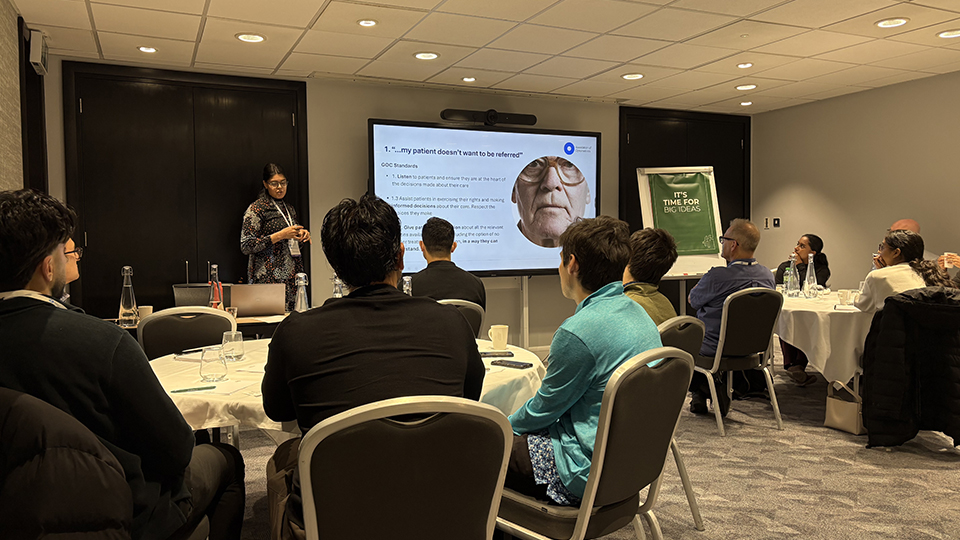
The third scenario considered a safeguarding situation, where a four-year-old patient had missed two cycloplegic refraction appointments.
The discussion centred on what the optometrist might be particularly worried about, what should be included if writing to the patient’s parents, and whether the optometrist could refer the child without the parent’s permission.
Delegates noted that a possible diagnosis could be amblyopia, and the importance of reiterating the importance of the test in reaching this diagnosis.
Kanabar emphasised the importance of following up with the parents in writing, expressing the consequences of not performing the cycloplegic refraction and including a leaflet on children’s eyesight.
“Parents sometimes don’t realise that children’s eyes are not the same as adults’,” Kananbar told delegates.
Audience members noted that they would consider referring the child without the parent’s permission, even if this risked the parent making a complaint to the practice.
Kanabar explained that due to the child’s age, they might not have reported any symptoms to their parents – so the request for further tests might have come as a surprise.
Sometimes parents need time to absorb recommendations or discuss them with family members before taking action, she added.
Kananbar noted that small practices might not have a standard operating procedure around safeguarding – but that the safeguarding contact for a local area should be relatively easy to find.
The audience also noted that lack of further investigation could lead to the child developing a lazy eye later – which could lead to a future complaint levelled at the practice.
Kananbar’s penultimate case considered what a locum optometrist would do if they arrived in practice to find that the slit lamp was not working.
The conversation centred around whether practitioners would refuse to work in this scenario, or how they would manage patients who needed a slit lamp examination if they were to proceed with the clinic.
Attendees said that refusal to run the clinic would depend on the kind of clinic that it was and that contact lens patients, for example, would need to be rebooked.
Delegates noted that they might see patients for minor eye conditions service appointments, but that they would send the patients to another practice or refer them if they were at all unsure.
Kanabar noted that patients might be frustrated if their appointment was unable to go ahead, but that “there is no right answer here.”
“As a locum, you want to retain a relationship with the practice,” Kanabar said.
She acknowledged: “Cancelling a clinic might not go down too well.”
Audience members noted that they might choose to make an internal referral in this case, formally passing on the responsibility for care to a colleague who did have fully operational equipment.
Kananbar also pointed out that practitioners should not issue prescriptions or provide patients with NHS vouchers in scenarios where they have not been able to perform all the tests that they feel are required.
In the final case study, a patient with recent onset floaters reported that they did not have time for a dilation during the appointment, and that they would need to return on another day – but that they did plan to drive directly after leaving the practice.
Practitioners considered issues around dilating just one eye, whilst booking an appointment for dilation of the second eye with another practitioner or a different day.
Questions were raised around who would take on responsibility for the patient’s care, and where liability could fall.
Practitioners weighed up the risk of not detecting a detachment in the initial appointment, versus the patient returning on a different day.
Kanabar acknowledged that this is not a black and white situation.
She noted that, if the locum decided to book the patient in on another day with a different practitioner, an internal referral should be made to transfer the responsibility for care.
It was also noted that practitioners could keep a copy of the internal referral themselves, as evidence that the care had been transferred.
There is unlikely to be identifiable patient information on the referral so the locum should not have to worry about holding data in this case, Kanabar noted.
A practitioner could even take a photo of the internal referral on their phone, she suggested.
She added: “If you have made an internal referral, it is then very clear that you have transferred that responsibility onto another practitioner who would then manage that patient.”
Developing clinical skills
Rachel Hiscox, professional education and development lead, UK and Ireland, at Johnson & Johnson Vision Care, told OT: “Locum optometrists play an important role in delivering eye care across the UK, and it is important that they have access to high-quality education that is relevant to the patients and clinical situations they encounter in practice.
“Through our support of the AOP locum clinical skills conference, Johnson & Johnson was able to contribute practical, patient-centred education focused on presbyopia and astigmatism.”
Hiscox added: “Our Sliding doors and Through their eyes sessions encouraged practitioners to consider how the clinical decisions they make, alongside the conversations they have with patients, can shape the contact lens experience.
“Exploring pivotal moments in the presbyopic contact lens journey and hearing directly about the experiences of patients with astigmatism encouraged delegates to reflect on how their recommendations, communication and understanding of individual patient needs can influence satisfaction with contact lenses.”
She noted: “This patient-centred approach provided learning that could be readily translated into day-to-day practice, helping to create better experiences for the patients they care for.”
Erika Moss, the AOP’s events coordinator for the locum clinical skills conference, told OT that “it was a pleasure to plan and be involved in delivering such a valuable day.”
“The event provided locums with an opportunity to develop their clinical skills, build confidence and learn in a supportive, hands-on environment. It was great to see everyone getting involved and making the most of the sessions,” Moss said.
She added: “Overall, the day was a success, and it was rewarding to see all the planning come together to create an experience that supports locums in their clinical development.”

Locum optometrist guide
From communication tips to seamless patient journeys, how you can succeed as a locum in 2026 and beyond


Comments (0)
You must be logged in to join the discussion. Log in