


06 May 2026
Correcting the vision of garment workers globally would add $27 billion a year to the sector’s economy and would significantly boost the economies of low-income countries where textiles are produced, a study by VisionSpring has found.
The PROSPER II study found that an intervention to provide spectacles to 344 sewing machine workers at Shahi Exports in India gave a 337% net return on investment over a three-month trial period.
The trial cost less than USD $10 per worker to facilitate, VisionSpring said. If sustained over a 12-month period, it would have a projected 1647% return on investment.
Many of the workers who took part in the trial were living with uncorrected presbyopia.
Shahi Exports is India’s largest apparel manufacturer. As a result of the trial, the company has now committed to providing a vision correction programme for 100,000 workers across all its factories.
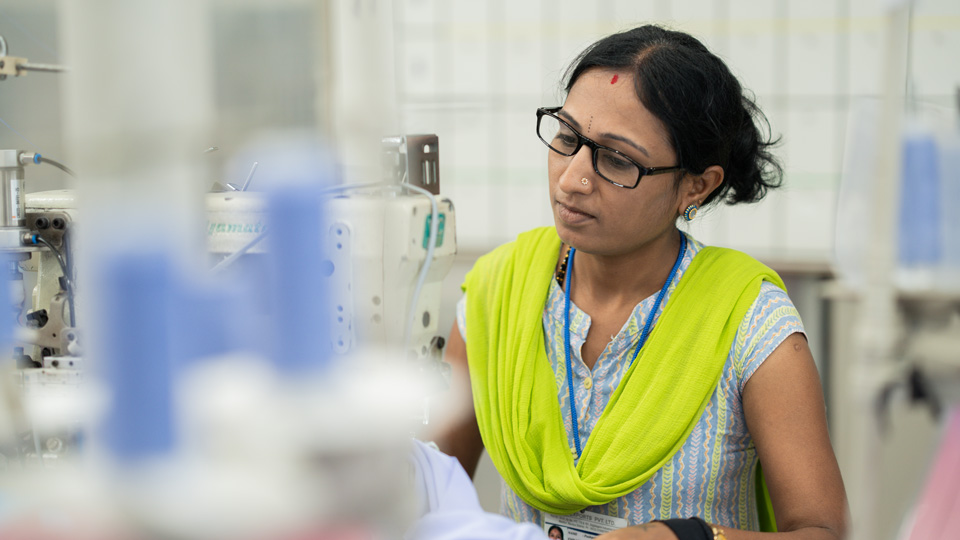
PROSPER II was the first randomised controlled trial to test the impact of vision correction in a factory setting. PROSPER I, carried out over three months in 2017, found productivity gains of 22% in an agricultural setting.
As with agriculture, factories are viewed as effective sites for vision correction interventions as they are located in a single place, allowing for efficient large-scale screening.
The productivity of garment workers in India was increased by 6% when they were provided with spectacles, the study found.
The randomised controlled trial found that 27% of sewing machine operators globally are living with uncorrected vision impairment and do not own spectacles.
Workers were able to make fewer mistakes and to complete more garments when they were provided with spectacles, the study said.
Providing spectacles to the garment sector globally could see an additional 3.8 billion items created per year.
The study was carried out by VisionSpring and the Good Business Lab, with assistance from Queen’s University Belfast, the University of Michigan, and the University of California San Diego.
The results were published in the British Journal of Ophthalmology.
The study outlined the impact that a vision correction intervention could have if it was rolled out to the estimated 53 million garment workers currently employed in India, Bangladesh, Vietnam and Cambodia.
In India, the garment industry accounts for more than 12% of exports, and directly employs more than 45 million people.
In Bangladesh, the industry contributes 11% to the country’s GDP, whilst in Vietnam, the contribution is 16%.
Companies including Primark are already working with VisionSpring and US eyewear and contact lens retailer Warby Parker to correct the vision of workers in their supply chains.
James Chen, global ambassador of the International Agency for the Prevention of Blindness and chair of The Chen Yet-Sen Family Foundation, which funded the PROSPER II trial, said: “In an age defined by advancements in robotics, automation, and AI, we are constantly searching for innovative ways to boost productivity. Yet one of the most instrumental and cost-effective solutions for correctable poor vision is a 700-year-old invention: eyeglasses.
“This study underscores a critical truth: investing in something as fundamental as eye care is not just about public health, but a global economic imperative. It is time for governments and companies around the world to invest in eye care to help transform lives and create significant social and economic progress.”
More News
-
 New eye clinic liaison officer suite opens at Sunderland Specialist Eye Hospital
 -
 Eye care leaders call on sector to unite behind global compact
 -
 Half of people experiencing homelessness have worsening eyesight or hearing, Specsavers says
 -
 Specsavers practice partners join Thames Path Ultra Challenge in memory of colleague
Comments (1)
You must be logged in to join the discussion. Log in
Anonymous07 May 2026
Wow - just imagine if they did the same for UK Diabetic Retinopathy screeners...
ReportLike0