


30 April 2026
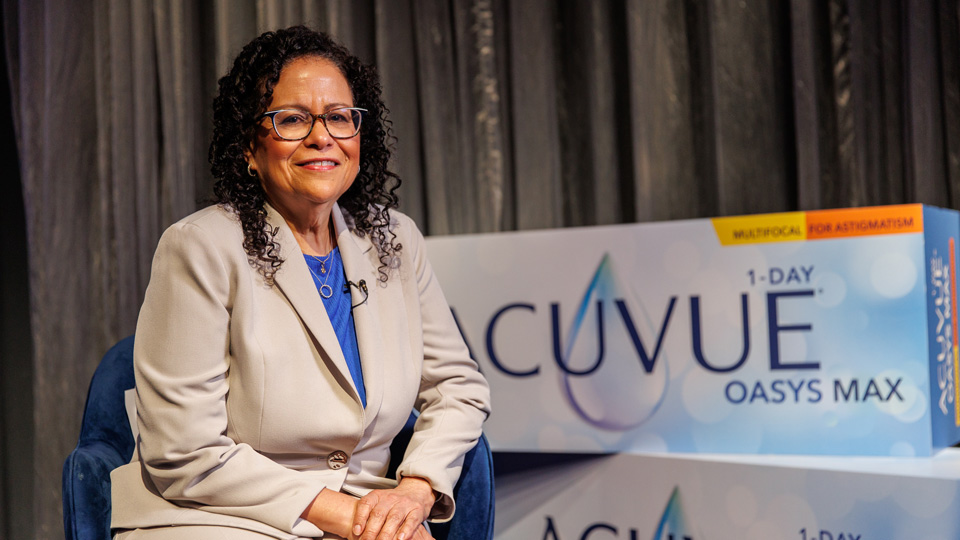
Johnson & Johnson explored the experiences and needs of modern presbyopic patients with astigmatism at an event celebrating the Acuvue Oasys Max 1-Day Multifocal for Astigmatism.
The contact lens has been described as the first and only disposable multifocal toric contact lens for astigmatic presbyopes.
Carolyn Paul, EMEA chair of health at Edelman, led a panel in exploring the requirements of presbyopic patients for vision solutions that fit into and enable their, often busy, lifestyles.
The panel featured Dr Giovanna Olivares, research and development astigmatism lead at Johnson & Johnson Vision, Anand Gosrani, independent optometrist at Crystal Eye Centre, and British Olympian and wellness advocate, Sally Gunnell.
The panel discussed what is meant today by ‘midlife,’ suggesting that in the past the term was associated with a ‘slowing down,’ but that doesn’t reflect the reality or the perception that people in midlife have for themselves.
Gosrani highlighted that ‘midlife’ has been the busiest time of his life, between work and raising young children: “It’s one hundred things at once, at one hundred miles an hour.”
Gunnell described the impact of changing vision on her life, from struggling to read the labels when shopping, to accessing her fitness app in the gym.
“So many little things,” she explained. “As an athlete, to perform at the top there are loads of little things and it is those one percents that make the difference. It wasn’t always about training hard and putting the hours in, it could be about the pillow you took to that Olympic final that could make the difference.”
She added: “That is how I see vision – looking at those little one percents of – how can it impact my life and improve?”
Gunnell emphasised: “I don’t want to settle.”
Discussing the requirements of presbyopes, Gosrani said: “We see patients in their 40s and 50s aspiring to do better, do more, and take on new roles and challenges in life.”
Panellists spoke about compromising in contact lenses, and the risks that this could lead to dropping out of the category entirely.
Gosrani explained that, previously, there was not a multifocal toric contact lens in a daily form.
He shared a case study from practice of a highly myopic patient with astigmatism who had previously been a happy daily disposable toric contact lens wearer.
Presbyopia presented a new challenge however and they tried various lenses including monthly toric contact lenses before settling for monovision correction.
After trying the Acuvue Oasys Max 1-Day Multifocal for Astigmatism, the patient was surprised at how comfortable the contact lenses were and the quality of vision between each eye individually.
“She felt it was a natural evolution in her vision and has regained the ability to multitask with ease,” Gosrani said.
Olivares explained that the mindset in designing for presbyopic and astigmatic patients has changed “tremendously” in the past 20 years.
Now, engineers want to deliver more than visual acuity. Olivares said: “There are a lot of Sallys in the world who still want to live their lives the way they live their lives. They want to go to the gym, do yoga, run, read on screens, and [read] the words on a medicine bottle. So many life activities that happen on a daily basis beyond Snellen acuity.”
The research and development team began by looking at the market research of what patients are doing, how they are moving, and understanding what problems need to be solved beyond providing clear vision.
Alongside this, they also looked at how the eye is changing in presbyopia and whether anything could be done about it – for example, increasing light scatter as the crystalline lens changes, and a decrease in tear film break up time.
These have been addressed in the Acuvue Oasys Max 1-Day Multifocal for Astigmatism with the OptiBlue Light Filter and TearStable technologies, in addition to the Pupil Optimised Design.
“We start to look at problems and solutions in a more holistic way for the patient – it's not just about delivering a clear visual acuity, but a functional acuity,” Olivares said.
Inside research and development
OT spoke with Dr Giovanna Olivares during the event about the development of the Acuvue Oasys Max 1-Day Multifocal for Astigmatism.
Just correcting astigmatism in itself is an engineering feat, Olivares explained, let alone adding the needs of a presbyope in providing vision at distance, intermediate and near.
“Those two are complex enough, to combine the two and still maintain crisp and stable vision at all distances – it's challenging, but it’s a challenge we took on,” she said.
Fortunately, the Pupil Optimised Design of the multifocal contact lens provided a base to deliver on the patient requirements.
“In developing the Max family of lenses, what we found was that people are spending more than 13 hours on their computer or digital device,” Olivares said, adding that with this comes less blinking and the effect on the tear film.
With that, the team developed the TearStable Technology. Lab testing revealed two times less evaporation of tears compared to leading competitors, Olivares told OT.
The team also looked at blue violet light scatter, “the most bothersome light,” and whether something could be done to provider a sharper, clearer image to the retina.
The team introduced the OptiBlue Light Filter to address this issue for patients.
“It’s exciting [that] we were able to combine four technologies into one. But the most important thing is: what does Sally say? Did we actually help? It warms my heart when I hear the product is working because you work all these years but it’s all about the patient.”
Highlighting the benefits of designing for presbyopic astigmatic patients, Olivares noted that many current contact lens wearers will be entering midlife.
“Think about it: I am glasses-free for most of my young life and now there may not be a solution for me. There are a lot of dropouts that occur in midlife,” she said.
Olivares added: “It became clear that the presbyopic patient has very unique needs and they should not be ignored.”
The contact lens has received positive reactions so far from optometrists and patients. While the team were prepared for comments on the improved comfort, Olivares explained: “We weren’t prepared for the ‘Wow.’”


Comments (0)
You must be logged in to join the discussion. Log in