


22 January 2026
A bill that aims to embed glaucoma detection, treatment and monitoring in primary care optometry has passed its first hurdle in the House of Commons.
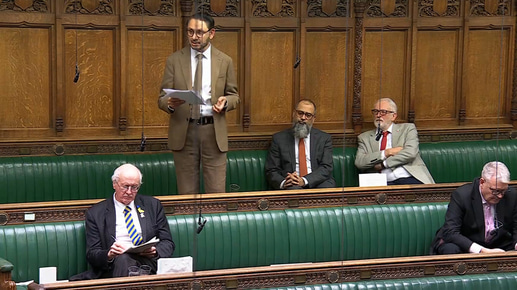
Shockat Adam MP presented his 10-Minute Rule Bill, entitled Glaucoma Care: England, to Parliament on Tuesday 20 January.
Adam, the MP for Leicester South and an optometrist and practice owner, explained to MPs that as many as half of the estimated 700,000 patients who have glaucoma do not realise they have it, because of its effect on their peripheral vision.
Eye conditions including glaucoma can be picked up during routine eye examinations, Adam reminded MPs.
He asked MPs to cover their eyes from the periphery to better understand what having glaucoma might feel like.
He also offered two examples of glaucoma cases that he had witnessed whilst working as a community optometrist.
One case involved a patient whose car was hit twice from the side because she had not realised that she was losing her peripheral vision.
The second involved a woman who attended Adam’s practice with a handbag filled with cash, saying that she would pay anything in order to have her sight restored.
Unfortunately, Adam explained to MPs, by this stage “damage is usually permanent and the loss has far-reaching consequences.”
He also highlighted the example of former Liberal Democrat MP, Paul Tyler, who has been living with glaucoma for 25 years but due to early diagnosis and management has experienced minimal side effects.
The ageing population means that instances of glaucoma are expected to increase by 44% over the coming decade, Adam emphasised.
He also impressed on MPs that glaucoma follow-up appointments in hospital are often delayed or cancelled, leaving patients’ conditions to worsen.
“Patients are losing their sight not because care does not exist, but because the pathway is broken and the follow-up is delayed,” Adam said.
“We need published data on follow-up waiting times, because that’s where sight is lost,” he added.

1.1 million people in the UK estimated to have glaucoma
New research published in the British Journal of Ophthalmology has predicted glaucoma will rise to 1.6 million by 2060
Glaucoma care in community optometry: supporting the 10-Year Health Plan
Minister of state for care, Stephen Kinnock MP, was in attendance in the chamber to hear Adam present the bill.
Adam emphasised that glaucoma care in community optometry would directly support the Government’s proposed moves from hospital to community and from treatment to prevention, as outlined in last year’s 10-Year Health Plan.
Community optometrists are already qualified and utilising them in this way could release up to 300,000 hospital appointments per year, he said.
“Full use of the skills and capacity” already available in primary care optometry should be initiated, Adam added.
He also noted that, whilst a national approach to glaucoma testing using qualified High Street optical practices would work to take the pressure off hospital ophthalmology departments, it could also save England’s NHS an estimated £12 million annually.
This approach is already used in Wales and Scotland, he said.
The current system in England, where glaucoma care is patchy, with patients in some areas relying on over-stretched hospital services, “punishes the vulnerable,” Adam said.
England’s hospital-led approach also risks undermining the Government’s ambition to shift care from hospitals to the community, he added.
However, Adam noted, integrated care boards (ICBs) nationally will be unable to commission glaucoma detection and monitoring services without direction to do so from the Government.
“Fundamentally, I am asking for a national direction from the Department of Health and Social Care to ICBs that they should commission a uniform primary care glaucoma service that utilises qualified High Street optician practices,” Adam said, adding: “Only by doing so will we end the postcode lottery in glaucoma care.”
Shockat Adam MP presents his Glaucoma Care: England Bill to Parliament

Glaucoma Care: England Bill progresses to second reading
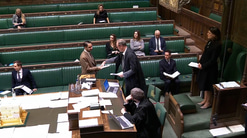
The bill received enough support from MPs to progress to its second reading, which will take place on Friday 13 March.
Adam later said: “I was delighted to present my bill to the House of Commons. I was even more delighted to see it passed its first reading unanimously.”
He told OT: “As I feared, the prevalence of glaucoma is higher than we previously thought. This bill provides a timely opportunity to begin to tackle the glaucoma challenge and save the sight of thousands of patients.”
Adam added: “We must end the postcode lottery in glaucoma care and introduce a community led approach for testing and diagnosis that would help boost the numbers getting their eyes tested and lead to earlier treatments that would save people’s sight – this bill will achieve that.
“With an ageing population and the number of glaucoma cases expected to rise by more than 40% over the next 20 years, tackling it early is the best way to save people’s sight as well as save the NHS money.”
Adam’s full speech presenting the Glaucoma Care: England Bill can be read on Hansard.


Comments (0)
You must be logged in to join the discussion. Log in