


18 December 2025
MPs and eye health professionals gathered at the Houses of Parliament to launch a report outlining how optometry can assist in NHS reform earlier this month (1 December).
The report, created by eye health lobbying group The Eyes Have It, is entitled Transforming eye care for tomorrow’s NHS: from vision to action.
It outlines how the eye health profession can assist in the implementation of the Government’s 10-Year Health Plan.
Recommendations include the commissioning of enhanced primary eye care services consistently across all regions of England, an increase in the use of diagnostic and management centres in community settings, improved uptake of regular sight testing and early intervention services, particularly for at risk groups, the standardisation of electronic health records, and wider adoption of NHS.net Connect (previously known as NHSmail) in order to improve connectivity between primary and secondary care.
The report also recommends the establishment of a dedicated eye care policy team within the Department of Health and Social Care, which The Eyes Have It believes would “ensure sustained focus on eye health, helping the system meet rising demand from an ageing population.”
Proven benefits of investing in a single point of access
The report was launched at The Eyes Have It’s annual Westminster Eye Health Day event.
The evening reception was hosted by Marsha de Cordova, the MP for Battersea and chair of All-Party Parliamentary Group on Eye Health and Visual Impairment.
The AOP is a member of The Eyes Have It partnership, alongside the Royal College of Ophthalmologists, the Royal National Institute of Blind People, Fight for Sight, the Macular Society, and Roche. The group’s activities are funded by Roche.
De Cordova told attendees that the eye health sector is ready to deliver on the three shifts – hospital to community, treatment to prevention, and analogue to digital – that the Government set out in its 10-Year Health Plan.
The report offers practical recommendations that would help to create a more equitable eye health system, de Cordova said.
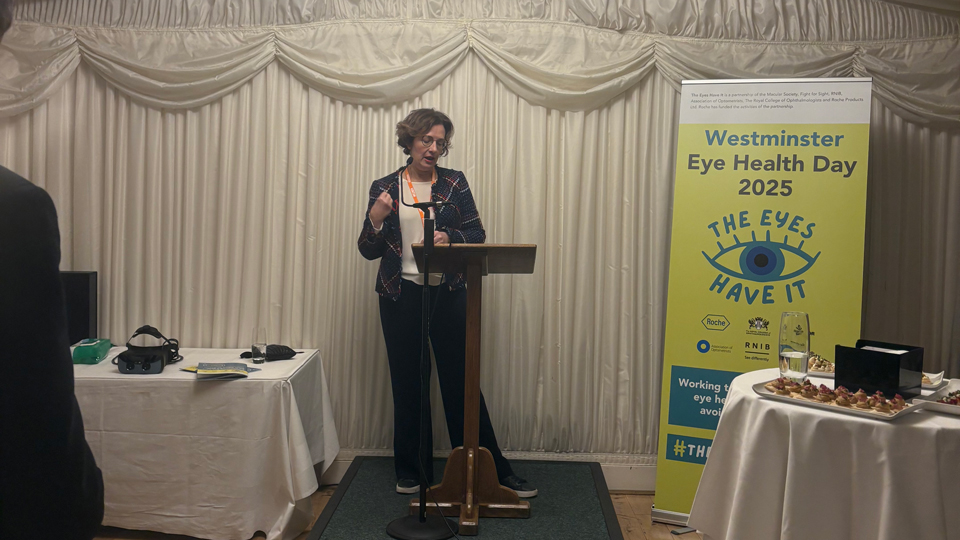
Louisa Wickham, the national clinical director for eye care and a consultant ophthalmologist at Moorfields Eye Hospital, also spoke at the event.
The 10-Year Health Plan “challenges us as a sector to improve eye care health and also to reduce avoidable sight loss,” she said.
Wickham emphasised that accelerator work conducted by NHS England over the past 18 months showed the “amazing potential benefits” that would be seen in both primary and secondary care if a single point of access and digital information moving seamlessly between the community optometry and the hospital eye service could be more widely adopted.
The accelerator work highlighted benefits including a reduction in triage and treatment times from 10 days to 24 hours and a £1.4 million productivity saving per integrated care board, Wickham said.
However, despite telling a “compelling story,” these changes cannot be implemented due to a lack of funding, Wickham told attendees.
The eye health profession is already “on a journey of digital enablement” but optometry needs to work better with the resources that it already has, she emphasised.
“We are absolutely the analogue to digital. We are absolutely the hospital to community, and we are absolutely the treatment to prevention,” Wickham believes.
The profession is “an embodiment of the left shift,” she added.
The ‘left shift’ is used to describe the three healthcare changes that the Government committed to in its 10-Year Health Plan, and is defined by the NHS Confederation as “the shift of activity out of hospitals to those delivered closer to home – largely provided by primary or community services and wider system partners.”
Wickham also expressed that the Department of Health and Social Care segments patient pathways, but that patients themselves would prefer their journey to be more integrated.
“We, as a community, need to try and work harder to work together,” she said.
She added: “We need to bring all of our various skills, our attributes, our views of how an eye care pathway should look, and work together – whether that be in hospital services, with community stakeholders, or the third care sector.”
An eye care board would assist in this and help to leverage the opportunities presented in the 10-Year Plan, Wickham believes.
Demonstrating the value of optometry in the wider health agenda
Also in attendance was optometrist Shockat Adam, MP for Leicester South, and pharmacist Taiwo Owatemi, MP for Coventry North West.
Adam told OT that Westminster Eye Health Day is important because it allows different organisations to come together with a common purpose.
“It is really important that we work in a coordinated manner to achieve our goal,” he said.
Optometrists have a role to play in the prevention agenda because people are often not unwell when they present in community practice and this provides an opportunity for early detection, Adam told OT.
He added: “As optometrists, we’ve got a huge role to play. We should be, as a profession, a lot louder with the proficiency of the work that we do. I think we do such an efficient job that sometimes, the government leaves us alone because [they think] we don’t need any assistance.”
Optometrists can use involvement with their local optical committees to push the Government into further recognising the value of the profession, Adam believes.
“We have to show that we can achieve a lot more,” he said, adding: “All optometrists should get involved with their local optical committees and ensure that we demand more from the Government.”
Adam emphasised: “We can provide a lot more, working with our ophthalmology colleagues, in order to achieve the aims of this report.”
Removing barriers for those with disabilities
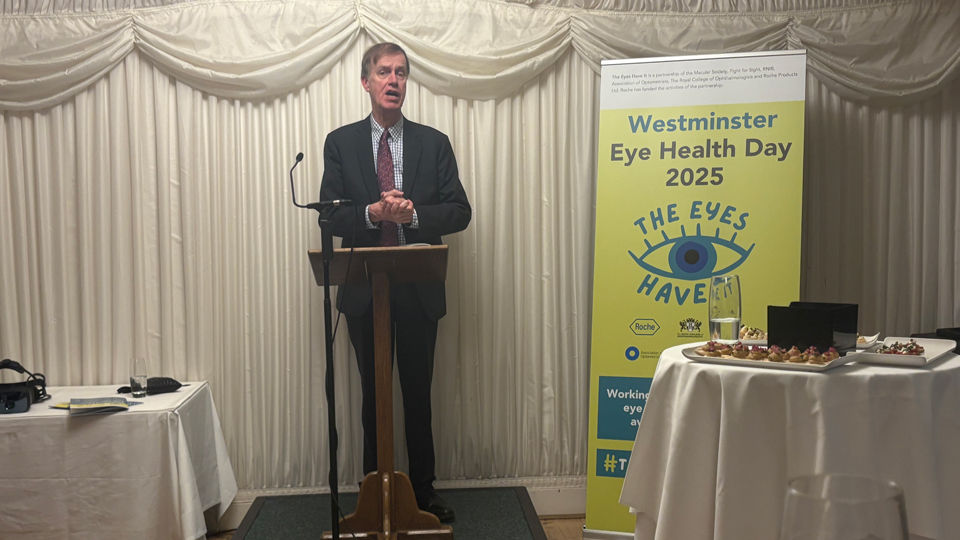
Westminster Eye Health Day took place two days before the International Day of Persons with Disabilities, which is marked annually on 3 December and provides “an opportunity for all of us to highlight the rights and wellbeing of disabled people in all parts of society,” Sir Stephen Timms, the social security and disabilities minister, said.
Reflecting on how eye health and eye care can be improved and working to make sure there is accessible support for people living with sight loss in the context of the 10-Year Health Plan is important, Timms told attendees.
Timms also emphasised that his department is focused on removing barriers in order to help people with disabilities lead fulfilling lives.
"We want all disabled people to have equitable, effective, responsive access to health care and the kind of services that everybody needs,” he said.
The Government has a person with a disabilities brief embedded in each department, he revealed.
A new plan for disabilities has been developed in order to “set out a vision for breaking down barriers to opportunity for disabled people,” Timms said.
The plan aims to support government departments to work together to boost opportunities for those with disabilities and to remove barriers for people with sight loss, visual impairments, and other disabilities, he explained.
Ideas highlighted in the plan will be shared in the new year, Timms told attendees.
He added: “I hope that [the report] will be an important step towards making sure that, whatever your background, disability is not a barrier to success.”
The collaboration of six organisations as part of The Eyes Have It is a “really effective partnership,” Timms emphasised.
He added: “I think there is a great deal we can do to champion the rights of all disabled people and make sure that people have the support they need. Let’s all work together to make that happen.”
Importance of collaboration emphasised by the AOP
The AOP’s clinical and policy director, Dr Peter Hampson, told OT at Westminster Eye Health Day that working with ophthalmology is vital if the value that optometry can bring is recognised in the long-term.
“This report makes some really good recommendations. It talks about getting rid of the postcode lottery, which is something that we’re really keen on. It talks about how we can do so much more,” Hampson said.
He added: “It also talks about some of the ongoing challenges more widely, for optometry and ophthalmology. The whole point of The Eyes Have It is collaboration: understanding the challenges that we have; understanding the challenges that ophthalmology has.
“That understanding between the two professions is going to be really important going forward. If we keep this artificial divide and don’t work together as well as we could, I don’t think we'll ever solve the challenges.
“I want people to embrace what it recommends in terms of making sure care is accessible, making sure good examples are brought forward at all points, and making certain that everybody is aware that only by working in conjunction and understanding the challenges that we both have will we ever solve the problem.”
Not all ophthalmologists are aware of the proven success of services such as the minor eye conditions services or the community urgent eye care service, Hampson believes.
Ophthalmologists need reassurance that the success of these services is evidence-based, he said.
The need for collaboration is the key learning that Hampson hopes optometrists will take away from the report.
Working together can foster better understanding amongst members of Parliament that there are opportunities for both optometry and ophthalmology to help with their plans, Hampson said.
He emphasised: “That’s what I’d really like people to understand: that we’re in this together. We can solve the challenges together.”
Speaking about Westminster Eye Health Day, Hampson told OT: “We’re here because it’s really important to have these conversations with people who are in a position to influence it: to talk to MPs, to talk to people who can influence decisions.”
He added: “We’re trying our best to make certain that optometrists get the opportunity to do the things that they really want to do, that can benefit their patients as well.”
The charity view

The Royal National Institute of Blind People’s head of policy, Mike Wordingham, and Fight for Sight’s director of impact and external affairs, Ellie Southwood MBE, are both member of The Eyes Have It partnership.
OT asked Wordingham and Southwood: what is the main takeaway that you would like people to retain after reading the Transforming eye care for tomorrow’s NHS: from vision to action report?
Wordingham emphasised the importance of improving connectivity between primary and secondary care and between all stakeholders within eye care.
This would allow professionals to work more closely together, to have clearer communication lines, to improve advice and guidance between primary and secondary care, and to reduce avoidable sight loss through getting waiting times down, he said.
Events like Westminster Eye Health Day are important in highlighting the “huge opportunity” that exists with the left shift and the 10-Year Health Plan, Wordingham believes.
“Eye care is a really important and useful case to show how hospital to community can work, how analogue digital can make a huge difference to us as blind and partially sighted people, and to the care people get and in preventing avoidable sight loss and in treatment and prevention,” Wordingham said.
“We are a test case, and events like this can get that message out to decision makers and everyone who needs to hear it.”
Southwood told OT: “Tonight is a fabulous opportunity to launch the report, and to demonstrate how the eye care and health sector is ready and has the ideas and the motivation to deliver on the Government’s 10-Year Health Plan.
“Lots of the themes in the 10-Year Health Plan are things that, within The Eyes Have It partnership, we have been talking about for some time, and that we have been really keen to gather evidence about in terms of how much more cost effective it is, for example, to have high quality community support in the High Street.”
One recommendation in the report is for systems to talk to each other, Southwood said, and this would mean “a much better and smoother experience for patients, which is the most important thing.”
The unfairness of the postcode lottery for eye care services is the one factor that Southwood hopes people will take away from the report, she told OT.
“We know this can work, because it does work in many places across the UK, and I think that can lead some of us to feel quite frustrated that it that isn’t replicated in all parts of the UK, because we know it can be – we know what the savings can be that are delivered, and we know that it massively improves the experience somebody has at quite a scary time,” she said.
“Plucking up the courage to go and have your eyes checked when you think there’s something wrong is hugely difficult for lots of people, and we need to really ensure that the system is ready to support people through that.”
The Eyes Have It partners are ready to put the recommendations of the report into action and start delivering on the Government's plans, Southwood added.


Comments (0)
You must be logged in to join the discussion. Log in