


20 November 2025
A pathway for children and young people with visual impairments was celebrated at an event at the Houses of Parliament on Thursday 13 November.
The parliamentary launch of the Eye Care Support Pathway for Children and Young People with a Vision Impairment in England was hosted by Guide Dogs and Shockat Adam MP.
Adam is an officer of the All-Party Parliamentary Group (APPG) on Eye Health and Visual Impairment. He worked as an optometrist before being elected as MP for Leicester South at the 2024 General Election.
Adam told OT that optometrists have a vital role to play in ensuring that young patients access the right services at the right time.
“Optometrists have to play a key role, almost like a sign-poster, but also to ensure they are always there to guide and offer support,” he said.
The unique location of community optometrists means they are well-placed to fully support young patients through their sight loss diagnosis, Adam believes.
“Usually, we’re on the High Street. We’re much more accessible to our patients than other specialties, so we must be equipped with all the knowledge to ensure that those with vision loss are directed in the right way, and given assurances when they are needed,” he told OT.
The Eye Care Support Pathway for Children and Young People with a Vision Impairment in England has been in operation since July 2025, and is designed to complement the adult Eye Care Support Pathway, published in late 2023 by the Royal National Institute of Blind People.
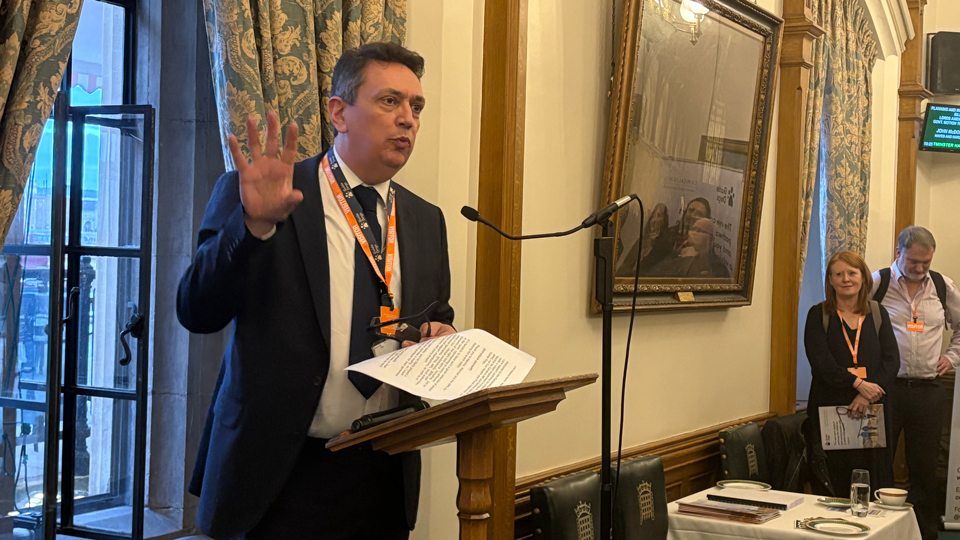
Chief executive of Guide Dogs, Andrew Lennox, told attendees that as of 2021, when development of the pathway began, there was no consistency in delivery of support for young people with visual impairments across the UK.
He noted that 25 organisations subsequently came together to create the pathway, which sets out the full journey and standards that children and young people and their families should expect, from initial diagnosis through to the transition to adult services.
Lennox called the pathway a “vital road map for the future” that will help children and young people with visual impairments to “achieve the greatness that we know is within them.”
The creation of the pathway means that a “comprehensive framework” of support now exists, Lennox said.
Lennox did emphasise, however, that guidance alone will not change lives.
The eye health sector must ensure that the pathway is implemented, and this relies on clinicians signposting their patients to it every day, he said.
“The key to success is how we work together,” Lennox told attendees.

The optometrist who became an MP
OT speaks with newly elected MP, Shockat Adam, about championing eye care within parliament and serving the people of Leicester South
Lack of support for diagnoses of visual impairment
Speaking to attendees, Adam noted that only one in 27 children with a visual impairment has an Education, Health and Care Plan, which would ensure that they receive the support needed from the local authority.
In some areas only 3% of children with visual impairments are receiving the required support, Adam said, emphasising that this is why the pathway was created.
“Like any other child, a child with a visual impairment is unique, and given the right support, will be able to achieve anything in life,” he said.
Adam added: “We must ensure that each child is given the opportunity, and that starts with adequate eye care. The approach that we must have is to support them to lead a fulfilling life, through the educational journey, and to be given every opportunity to excel.”
Rachel Bone, a mother of three who lives with ocular albinism, spoke to attendees about the challenges she faced in securing a diagnosis of the same condition for her two oldest children.
Receiving a formal diagnosis was extremely difficult and included a long wait for visual testing in both instances, Bone explained.
In attempting to secure a diagnosis for her son, Bone said that it felt as though she was “starting from scratch” – despite having previously received a diagnosis for her daughter.
Challenges included a breakdown in communication between different local authorities, Bone revealed.
Now, she explained, all appointments are aligned and her children are all under the care of the same hospital.
Guidance provided by the pathway means that Bone is confident that when her youngest child starts school there will be more understanding, she said.
How the Eye Care Support Pathway for Children and Young People with a Vision Impairment in England can help patients
Claire Bradnock, a qualified teacher of children and young people with vision impairment, also spoke during the event.
The pathway will help parents understand the journey that their children are going on and explains the processes involved at a level that means they can be understood by the general population, Bradnock said.
The pathway also “demonstrates the importance of professionals” in the journey of children and young people with visual impairments, she believes.
Marsha de Cordova, chair of the APPG on Eye Health and Visual Impairment, called the pathway “a vital tool that will improve lives.”
All those attending the parliamentary launch were doing so because they are invested in improving the lives of children with visual impairments, de Cordova said.
The pathway must also be included as part of vital Special Educational Needs and Disabilities (SEND) reforms that are expected in 2026, she added.
Adam emphasised the importance of the pathway to OT.
“We’ve all got a part to play to make sure that we join up the dots for a smooth journey,” he said.
“There are so many shortcomings that don’t need to be there. If we all work together, we can create a pathway for people with visual disabilities or visual impairments and sight loss all the way from the cradle to the grave – at school, into the workplace.”
Adam added: “Small adjustments will make huge changes. With the SEND paper coming out very soon, this pathway will be vital to contribute to legislative changes, which will make a life-changing difference for people with visual impairments.”
De Cordova added that she would like the pathway to be “in everyone’s hands.”
“We know that, working together, we can absolutely improve the lives of blind and partially sighted children,” de Cordova said.
She added: “We can certainly improve the outcomes to make sure that they have the best start in life, to make sure that we can continue to break down those barriers.”


Comments (0)
You must be logged in to join the discussion. Log in