


23 May 2025
Her Royal Highness The Duchess of Edinburgh attended the third annual Orbis Visionaries reception at Battersea Power Station this week (Tuesday 20 May).
The reception featured a panel discussion, where the importance of tackling avoidable vision loss and the need to expand access to eye health services worldwide were discussed.
Innovative approaches to providing eye care, access to eye care for women and children, and improving vision in order to support people into work, were also discussed during the event.
The charity used the evening as an opportunity to showcase its plans for the next five years, which were noted as ‘critical’ in achieving the United Nations Sustainable Development Goals.
Orbis’s Road to 2030 strategy includes expanding school screening programmes, delivering projects for low-income workers, and training a new generation of eye care professionals.
The aim is to see an end to poverty and inequality, with vision care playing a key role, the charity said.
The Duchess of Edinburgh is the global ambassador for the International Agency for the Prevention of Blindness, and has previously travelled to Ethiopia, Bangladesh and India to see Orbis’s work being carried out.
Other guests at the Battersea event included journalist and writer, Susannah Constantine, and eyewear designer, Tom Davies.
TV presenter and journalist, Helen Fospero, hosted the panel, which included Dr Alemayehu Sisay, country director for Orbis Ethiopia; Lucia Mvula, country director for Orbis Zambia, and Professor Nathan Condon, director and research and tech adviser at Orbis International.
The state of eye care globally
1.1 billion
The number of people who live with vision loss globally
90%
of these cases are avoidable
$411 billion
The estimated economic impact of untreated sight loss in terms of lost productivity
The event highlighted that 1.1 billion people live with vision loss globally, and that 90% of these cases are avoidable. Most of those impacted live in countries where eyecare can be difficult to access.
Condon noted that, of this 1.1 billion, around half are living with near vision impairment.
“These are people that just need a pair of reading glasses, something that we could go to Boots Opticians and get within 15 minutes, but which is unavailable for most of the world's population,” Condon said.
Mvula spoke about her work in Zambia, where Orbis teams have seen children from rural communities present in hospital with late-stage retinoblastoma.
Mvula said: “Without early intervention, by the time they get into the hospital, it’s probably too late. We want to bring services as close to these communities as possible.”
Sisay noted that over half of those at risk of trachoma live in Ethiopia, and that almost 200,000 people in the country are living with the disease.
“Ethiopia still carries the largest share of the global burden of trachoma,” Sisay said.
“Eliminating trachoma by 2030 is our top priority. It should not be a disease affecting mothers and children in the 21st century. That is our vision for Ethiopia.”
Orbis Visionaries
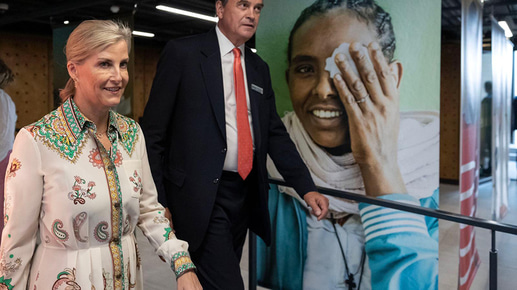

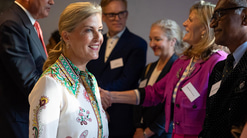
Her Royal Highness, The Duchess of Edinburgh, said: “I have been lucky enough to travel with Orbis through my work with the International Agency for the Prevention of Blindness as global ambassador, and I have seen for myself so many times the very effective operations that are carried out in varying situations.”
Eyecare provides a simple solution to some of these problems, she said.
She added: “We have the technology. We have the know-how. We just don’t have the spread of capability.
“I had a wonderful trip to Ethiopia, which is the country with the largest number of people with blinding trachoma in the world, and although they face a massive uphill struggle, we have already seen huge improvements in interventions.”
More News
-
 New eye clinic liaison officer suite opens at Sunderland Specialist Eye Hospital
 -
 Eye care leaders call on sector to unite behind global compact
 -
 Half of people experiencing homelessness have worsening eyesight or hearing, Specsavers says
 -
 Specsavers practice partners join Thames Path Ultra Challenge in memory of colleague
Comments (0)
You must be logged in to join the discussion. Log in