


11 December 2024
Key figures from the blind and partially sighted community joined the Royal National Institute of Blind People (RNIB) for an event celebrating 200 years of Braille at the British Library last month (26 November).
The evening saw guests including Lord David Blunkett, content creator Seren Jaye, and disability campaigner and influencer Lucy Edwards sharing their experiences.
Edwards told OT that the evening’s celebration of braille was “so important.”
“I read braille every single day of my life,” she said.
The event was organised by the RNIB to mark 200 years since the creation of braille. The charity hopes to raise awareness of how braille can assist blind users in their careers and personal lives.
The charity also used the event to highlight its key policy asks for the government, including that budgets for local authority vision impairment services are protected and increased, that the NHS and other organisations commit to making correspondence available in braille, and that the process of accessing alternative formats of medication packaging and patient information leaflets is made easier.
The RNIB is encouraging people to become “supportive allies” to braille users, for example by adding alt text to social media images, and by learning to either read or write their name or the alphabet in braille.
The RNIB has guidance on how to make social media accessible here.
The charity is also calling on UK organisations, businesses and services to review and improve their provision of braille to mark 200 years since its creation.
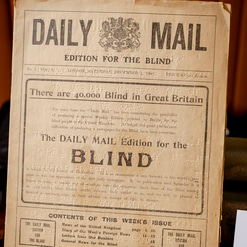
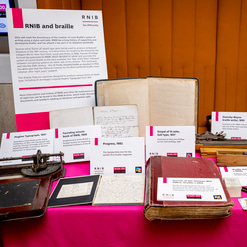
Historic items including a braille version of the Communist Manifesto from 1890, Secrets of the German War Office in braille from 1914, and a braille version of the Koran were on display during the evening.
Guests were also entertained by braille musicians.
Edwards told OT: “I’m so glad that I did braille lessons as a young girl, because I was like a sponge back then.
“When I lost my eyesight a bit more, braille was a thing to be celebrated in my mind. It opened up a world of journalism and the ability to read scripts back to myself.”
Seren Jaye, who started to lose her sight in 2021 and is currently studying journalism, said that the evening had allowed her to network with other braille users.
“The best thing is being able to talk to other people who know braille,” she said.

The importance of braille in everyday life
The Braille 200 event featured a panel discussion, which was introduced by Anna Tylor, the RNIB’s chair of trustees, and hosted by Dave Williams, the charity’s inclusive design ambassador and chair of The Braillists Foundation.
Williams used being able to read your own birthday cards as an example of why braille is still a vital tool for blind people.
“As wonderful as technology is, it does not replace hardcopy braille, especially when batteries and signal let us down,” he said.
Tylor noted that there is a 33% attainment gap for blind and partially sighted children at Key Stage One, and that this gap continues throughout their education.
Every visually impaired child has the ability to achieve their potential and braille helps them to realise this, Tylor said.
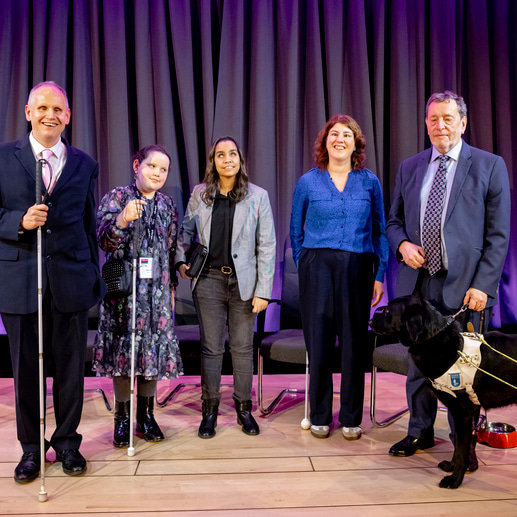
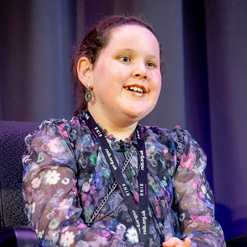
The panel featured former Home Secretary David Blunkett, who is also vice president of the RNIB; visually impaired musician Jane Constance; BBC journalist and host of the Access All podcast, Emma Tracey, and 11-year-old braille author Betsy Griffin.
Panellists at the Braille 200 event
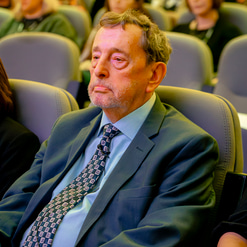
The panellists, who are all braille users, began by discussing the misconception that braille is no longer necessary as audio options are so ubiquitous.
“Innovation is happening all the time,” Tracey told the audience.
Blunkett shared his experiences of using braille to help with agendas and notes during his career as an MP.
People would often think he was ad-libbing, but instead he would often be reading braille via a hand in his left pocket, he shared.
Blunkett also noted that his late colleague, John Prescott, would often adlib, but that he felt unable to do so because if he stumbled on his words people would have blamed his visual impairment.
Musician Constance, who was born in Mauritius and is a UNESCO Artist for Peace, revealed that she practices braille by reading lyrics, and that she can also read braille in French.
She noted that, during her law degree and her Master’s in human resource management, none of the books that she was asked to read were accessible – but that she was able to find them independently via the RNIB Bookshare platform.
The role of technology was also discussed, with Blunkett emphasising that braille is just “part of the mix” for blind and partially sighted people.
There has been an uptake in the teaching of British Sign Language in schools, Blunkett said, and the same should be done with braille so that understanding of its uses is increased.
Griffin, who was diagnosed with optic nerve glioma at the age of two and is the author of Out of the Woods: A feel good collection of fables to teach and guide you through life, support your mental health, and inspire you, revealed that she has started a petition to encourage the use of braille on restaurant menus.
The increased use of QR codes has been a challenge for blind and partially sighted people, the panel noted, with Tracey revealing that “getting a cup of tea on the train is now impossible.”
The issue of pharmacies often adding the dosage label over the top of the braille on medicine bottles was also flagged as a recurring problem.
Griffin noted that lifts in hospitals often do not have Brialle displays, meaning blind users have no way to know which floor they are requesting.
“Surely the vision department of a hospital should have braille buttons?” she said.
Braille should be a requirement in all public buildings, Blunkett believes.
He added that, when braille is present, it is often in an odd position – as though the fact that users wouldn’t be able to see it had been forgotten.
This was the exact experience that he recently had on the Staten Island Ferry in New York, he said.
Griffin added that, if there was one message she wanted people to take away from the evening, it was: “don’t underestimate blind people.”
She added: “I wanted to be the first blind dancer on Strictly Come Dancing. But maybe now I’ll just be the first blind winner.”
More information about the bicentenary of braille can be found online.
More News
-
 New eye clinic liaison officer suite opens at Sunderland Specialist Eye Hospital
 -
 Eye care leaders call on sector to unite behind global compact
 -
 Half of people experiencing homelessness have worsening eyesight or hearing, Specsavers says
 -
 Specsavers practice partners join Thames Path Ultra Challenge in memory of colleague
Comments (0)
You must be logged in to join the discussion. Log in